Loxam Brand Guidelines
A 1967 Breton depot, red branding and a hire group in 28 countries.
Aa
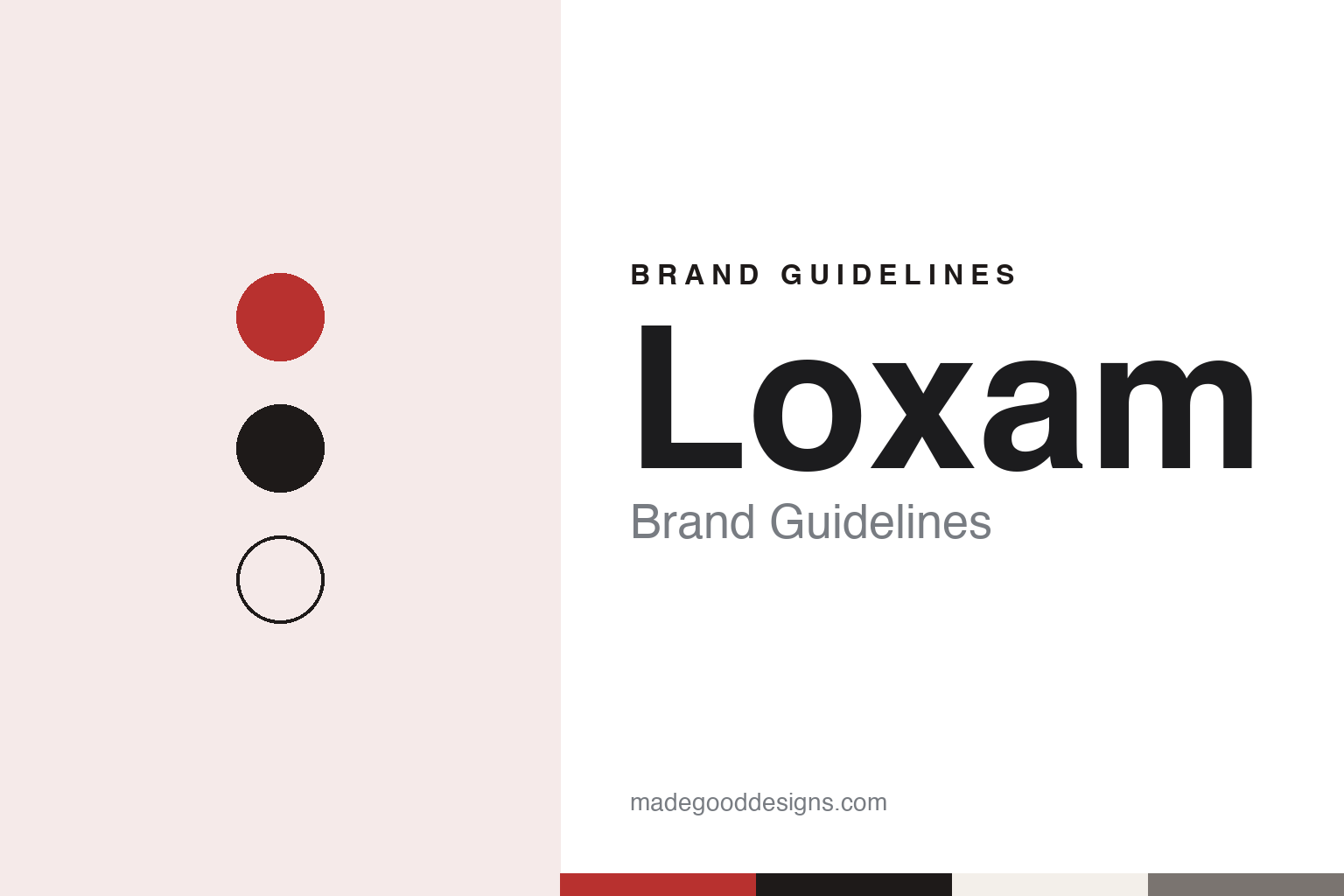
Two constants: a Loxam red, asphalt and concrete palette and a heavy grotesque sans register. Abstract homage — not a Loxam product or mark; no machine, logo or livery is reproduced.
SAM
Two Bretons, a few compressors and a depot near Lorient.
Loxam began in Brittany in 1967 as the Société Armoricaine de Matériel, known as SAM. A 2009 portrait in Bretagne Économique names its founders as two Bretons, Joseph Robin and François Le Du, and says Le Du opened the first hire depot at Hennebont, near Lorient, after buying a few compressors and vibrating rollers. French Wikipedia dates the company’s creation to July 1967. Loxam’s own history describes the 1967 launch as a new service for building and public-works firms: renting them machines rather than selling them, from a first depot, before the idea spread across the region.
SAM grew first across the west of France. The company says it had 26 depots in 16 départements by 1976. Ownership changed twice in the following decade. French Wikipedia says the water and services group Lyonnaise des Eaux bought the business in 1978 and that the cement group Origny-Desvroise took it over in 1987, when it became SAM Location; Bretagne Économique dates the sale from Lyonnaise des Eaux to Origny-Desvroise to 1986. Both sources agree on what happened next: Gérard Déprez, who had worked in the finance department of the Ciments d’Origny group, was made head of SAM, and Loxam’s governance page says he has been chairman since 1986.
The network then spread nationally. Loxam says its 100th depot opened in Marseille in 1991, and French Wikipedia counts 119 agencies after the Origny-Desvroise years. In 1994 SAM Location became Loxam. Bretagne Économique reported in 2009 that Déprez had been the main shareholder since that year, when he bought the business from Origny-Desvroise and gave it its new identity, and that he shared the capital with employees.
Colour
From Brittany to 28 countries.
Loxam’s growth since the 1990s has come mostly through purchases. French Wikipedia lists the French rental firm Serre & Ansot in 1998, Locma in Belgium and Comrent in Germany around 1999 and 2000, the network of Loueurs de France BTP in 2004, Spreeuwenberg in the Netherlands in 2006 and the Laho group in 2007. Loxam’s own timeline places its first moves abroad in Switzerland in 1996, then Belgium and Germany in 1999, Britain and Ireland in 2000, Spain in 2002, Luxembourg in 2005, the Netherlands in 2006 and Denmark in 2007. From 2010, the company says, it went beyond Europe, to Morocco and Brazil.
2017 was a year of large deals. French Wikipedia records the purchase of the British access-platform group Lavendon in February, the Spanish group Hune the same month, an 80 percent stake in the Italian firm Nacanco in September and the Irish company Swan at the end of the year. In 2019 Loxam bought Ramirent, the Finnish rental group then listed in Helsinki, which brought depots across the Nordic and Baltic countries and central Europe; Loxam says that purchase made it the fourth-largest company in the sector worldwide.
The group sorts its business into named networks. French Wikipedia describes Loxam Rental and Loxam City for general tool and machine hire, Loxam Access for aerial work platforms, Loxam Power for generators, heating and pumps, Loxam Module for modular buildings and Loxam TP for heavy earthmoving machines, with Loxam Laho Tec and Loxam Event for more specialised work. Abroad, local names sit alongside the Loxam word, such as Loxam Hune in Spain and Portugal, Loxam Ramirent in the Nordic countries and Nationwide Platforms in Britain. Loxam was also an official supplier to the Paris 2024 Games, its timeline says.
The head office moved in November 2008 from Châtenay-Malabry to the Porte Maillot area of Paris, French Wikipedia says. Bretagne Économique reported in 2009 that the registered office had stayed in Lorient since the start, which Déprez described as the company’s roots.
Typography
Design and documentation.
Equipment rental and hire companies sell access rather than ownership, so their public identity is spread across depots, machines, vans and screens. This guide looks at the places where those identities appear as the companies publish them: photographs of depots and fleets, livery colours on machines and vans, online hire catalogues and apps, and the corporate pages that describe branches, listings and owners. No product or mark of any company is reproduced.
Much of the business has moved online. Sunbelt Rentals launched a mobile app in March 2022 that lets customers find, reserve and manage equipment and view invoices, the company said at the time. United Rentals added Equipment Fit, an augmented-reality feature for placing 3D models of machines on a jobsite, in August 2025, and an AI-based Equipment Agent for choosing equipment in March 2026, according to its own announcements. Sunbelt Rentals’ own website lists more than 14,000 product types, sorted into groups such as aerial work platforms, compaction and concrete equipment.
Corporate pages tell a different story: depots, listings and owners. Branch counts are a common headline figure, and they change with each takeover, so this guide gives them only as dated sources state them. Ownership changes are frequent too. In February 2025, Transport Topics reported that Herc Rentals had outbid United Rentals for H&E Equipment Services, and in March 2026 Sunbelt Rentals moved its primary listing from London to the New York Stock Exchange, the company said.
Each guide that follows sets out who founded the company, who owns it now and how it presents itself, and marks clearly what rests only on the company’s own word. Rental prices, fleet values and revenue are left out throughout.
Aa
A heavy grotesque — our register for a depot-sign voice. (Specimen set in Archivo, a sans STAND-IN; NOT the Loxam logo.)
Loxam
A colour chosen with a model.
Loxam’s colour is part of its own origin story. Describing the years after 1986, Bretagne Économique wrote that an organisational model, a colour, red, and a spirit of service were put in place, and that these became the company’s reference. The same portrait says that in 1997 Loxam set down a standard model of processes that could be repeated each time it opened a new depot.
Ownership has stayed private. French Wikipedia says the investment funds 3i and Pragma Capital took a 15 percent stake in 2011 to help pay for growth, and that 3i sold its holding in 2017 through a share buyback. Loxam describes itself in 2026 as a privately held company. Gérard Déprez is chairman and chief executive, and Stéphane Hénon has been managing director since July 2012, the governance page says.
The latest chapter is in Brazil. On 25 May 2026 Loxam announced an agreement to buy a 50.3 percent controlling stake in Mills, the São Paulo-listed rental company founded in 1952, the trade publication JDL reported. Loxam’s results statement of August 2026 said the deal was still under review by CADE, the Brazilian competition authority: agreed in May 2026; not completed at the time of writing. In the same statement Loxam gave its 2025 network as about 11,600 people and some 1,130 branches in 28 countries.
For a design guide, Loxam shows how one colour and one repeatable depot model can carry a regional Breton business into dozens of countries, with acquired names kept beside its own. Compare Kiloutou, its French rival from the north, and Ramirent, the Finnish group it bought in 2019. For this guide we use a depot red, asphalt and concrete grey with a heavy grotesque sans, an unofficial interpretation; no product or logo is reproduced.
Explore & save
Keep Loxam’s identity on hand — save it to a board in the Made Good inspiration library.
Loxam identity set
Pin the Loxam red, asphalt and concrete palette and the heavy grotesque sans register to your own board.