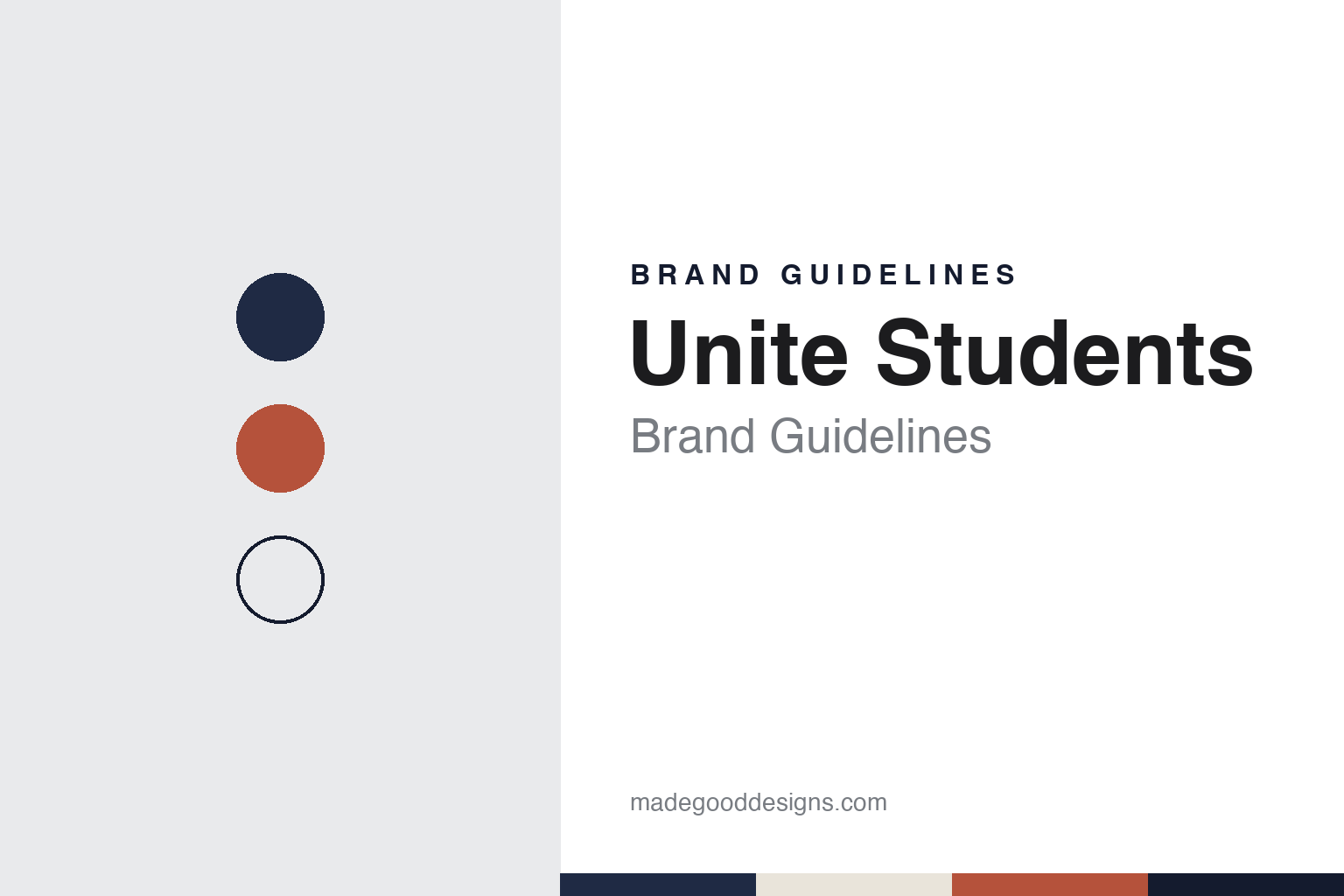
Unite Students Brand Guidelines
The Bristol student-housing company that renamed itself for its residents.
Aa
Two constants: an ink blue, brick and stone palette and a friendly sans register. Abstract homage — not a Unite Students asset or mark; no building, logo or photograph is reproduced.
Bristol, 1991
A 21-year-old, a university survey and a first building.
Unite Students is the trading name of The Unite Group plc, a developer, owner and operator of purpose-built student accommodation in the UK. English Wikipedia says the business was founded in Bristol in 1991 by Nicholas Porter, then 21, who saw a growing demand for student rooms after research with the University of the West of England. The company’s own timeline gives the same year and city, and says its first property opened in Bristol in 1992; it describes Unite as the UK’s first purpose-built student accommodation provider, a claim it makes itself.
The growth that followed can be traced through dates the company and English Wikipedia agree on. Unite opened its first London property in 1998, listed on the Alternative Investment Market in 1999 and moved to the Main Market of the London Stock Exchange in 2000, the year English Wikipedia says it also opened in Manchester, Liverpool and Portsmouth. In 2006 it formed the Unite UK Student Accommodation Fund (USAF), and in 2012 the London Student Accommodation Vehicle (LSAV), a 50-50 joint venture with GIC, the Singapore sovereign wealth fund. English Wikipedia says the business had grown to 40,000 beds by 2011.
The founder moved on. English Wikipedia says Porter announced in 2006 that he would step down as chief executive, and The Dot Group, the company he leads today, says he stepped down as chair of Unite in 2008–09 before setting up Urbanest and, later, Global Student Accommodation, the group behind Yugo. The two brands therefore share a founder, though not an owner.
Colour
From Unite to Unite Students.
The consumer name came later than the company. English Wikipedia says Unite renamed itself “Unite Students” in April 2014, launching at the same time a corporate philosophy called “Home for Success,” which it describes as its business purpose, with 16 “signature commitments” about the student experience. The listed parent kept the Unite Group name, and the split still shows online: unitegroup.com carries the investor, fund and university-partner pages, while unitestudents.com is the booking site, with a page for each city.
The booking site speaks directly to students, with emoji in its headings. It says Unite Students has provided student accommodation for over 30 years, helps 65,000 students find a place to stay each year, has buildings in 22 UK cities and works with more than 60 university partners. Room types are set out plainly — studios, en-suites, non en-suite rooms in shared flats and accessible rooms — and the company says bills, including Wi-Fi and contents insurance, are included in its rents. It also reports a Gold rating in the Global Student Living Index survey of residents for the third year running, as its own result.
An app sits alongside the website. The company says it lets residents choose an arrival time for check-in, meet future flatmates through a feature called Flat Chat, report maintenance issues and receive parcel and building alerts. In 2012 Unite also set up the Unite Foundation, a charitable trust that English Wikipedia says provides free accommodation and a living allowance to students from difficult circumstances; the company’s timeline describes it as offering scholarships for students lacking family support.
Since 2026 the group has run two consumer brands. Its corporate site says Unite Students is aimed mainly at first-year students, while Hello Student, which came with the Empiric purchase, is aimed at second- and third-year, postgraduate and international students, with studios, shared flats, townhouses and duplexes.
Typography
Rooms, cities and funds.
Student housing operators sell a room, a building and a city at once, and their websites are built around that order. Booking sites usually begin with a search by country, city, university or residence: Yugo’s menu runs city by city across 14 countries, and Unite Students keeps a page for each UK city it serves. Room types are named in plain terms, such as studio, en-suite or non en-suite, and the companies stress what is included in the rent rather than the architecture.
Photography does most of the selling. The operators publish their own pictures of bedrooms, shared kitchens, study rooms, gyms and lounges, and present communal space as part of the product. Apps extend the same promise after booking: Unite Students says its app handles check-in times, flatmate chat and maintenance requests, and Yugo runs programmes under its own name for residents.
Building names are a brand decision in their own right. Some operators put the brand in front of a place name, as with Yugo Adelaide City, or rename a building when it changes hands; C-VILLE Weekly reported in December 2025 that The Standard in Charlottesville would become Yugo Crestline. A large group can also run more than one consumer brand for different years of study, as Unite does with Unite Students, aimed mainly at first-years, and Hello Student, aimed at later-year, postgraduate and international students.
Behind the student-facing brands sits a second, corporate register. Listed companies, funds and joint ventures publish separate sites for investors and university partners, with timelines, portfolio maps and fund pages; Unite Group’s name GIC, Singapore’s sovereign wealth fund, as its London joint-venture partner, and The Dot Group’s name Morgan Stanley Real Estate Investing as a US partner of GSA. This guide treats both registers, the cheerful booking voice and the plainer corporate one, as part of each brand.
Aa
A friendly sans for a student-facing register. (Specimen set in Manrope, a sans STAND-IN; NOT the Unite Students logo.)
Unite Group
A REIT with a fund, a joint venture and two brands.
Unite Group converted to a real estate investment trust from 1 January 2017, according to English Wikipedia and the company’s timeline, and English Wikipedia lists it as a constituent of the FTSE 250 Index. Its structure mixes owned buildings with co-investment: the company says it holds a 28% stake in USAF, which it manages and calls the largest specialist student accommodation fund in the UK, and that the LSAV joint venture with GIC was extended in May 2021 to September 2032.
Two acquisitions shaped the present group. The first was Liberty Living: the Competition and Markets Authority opened a merger inquiry in September 2019 and cleared the purchase on 6 November 2019, publishing its full decision in December. English Wikipedia says the deal was completed in December 2019; Unite’s own timeline lists it under 2020. The second was Empiric Student Property, owner of the Hello Student brand, which the CMA cleared on 27 November 2025; Inside Housing Living reported in November 2026 that Unite had acquired the Empiric portfolio in January 2026, and Unite’s timeline lists the purchase under 2026.
The group is changing shape again. In November 2026 Inside Housing Living reported that Unite planned to become a “smaller, more focused business,” aligned more closely with the UK’s strongest universities, and described it as the UK’s largest owner, manager and developer of purpose-built student accommodation, with 207 properties in 29 towns and cities and partnerships with 60 universities. On campus, the company says it has entered joint ventures with Newcastle University, for 2,000 new beds, and with Manchester Metropolitan University, for the redevelopment of Cambridge Halls.
For a design guide, Unite Students shows how a listed property company can speak in two voices: a plain investor register for the parent and a chatty student register for the booking site and app. Compare Yugo, started by the same founder, and iQ Student Accommodation, another UK operator. For this guide we use an ink blue, a brick red and a warm stone with a sans, an unofficial interpretation; no product or logo is reproduced.
Explore & save
Keep Unite Students’s identity on hand — save it to a board in the Made Good inspiration library.
Unite Students identity set
Pin the Unite Students ink blue, brick and stone palette and the friendly sans register to your own board.