RAK Porcelain Brand Guidelines
Ras Al Khaimah tableware for hotels and chefs.
Aa
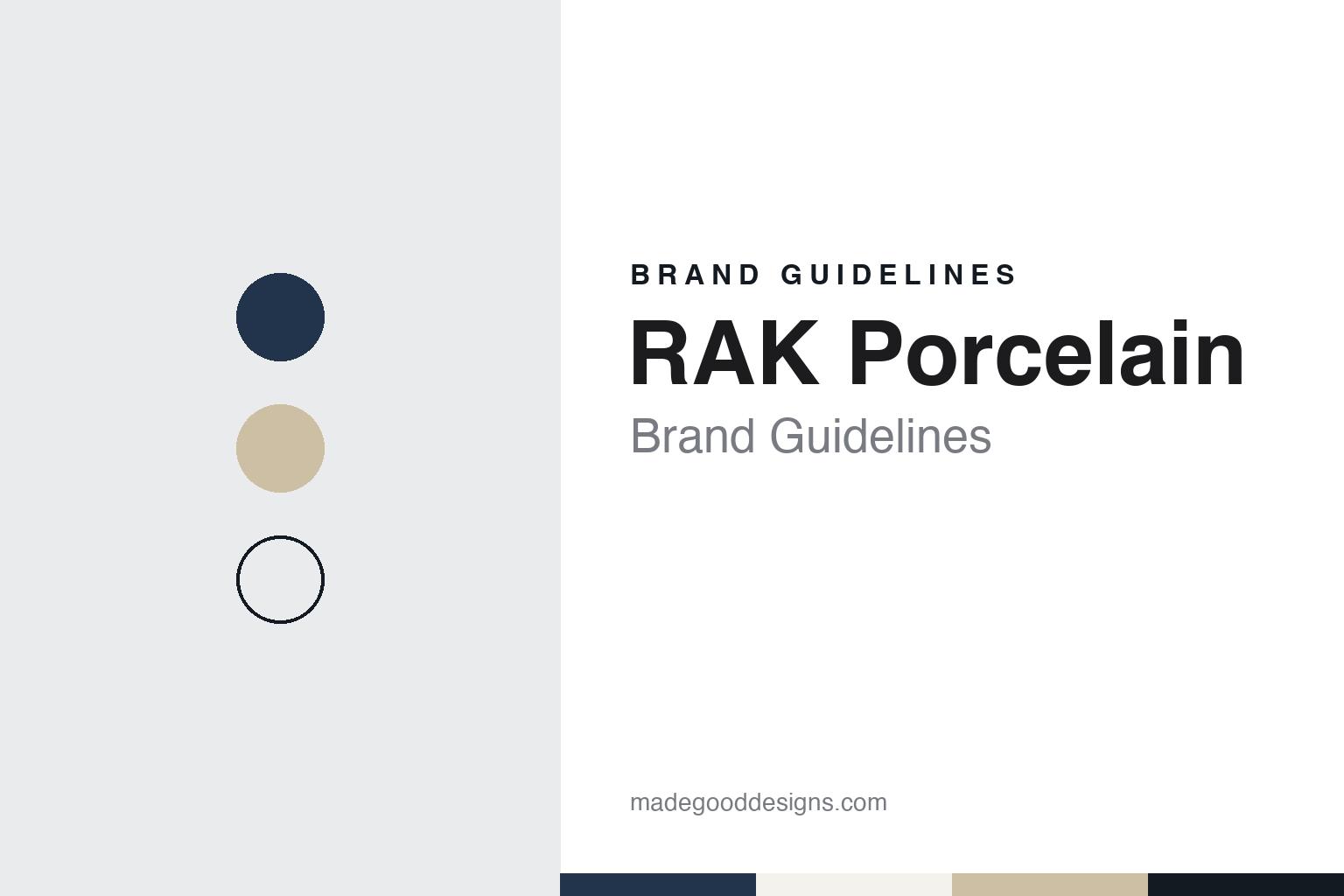
Two constants: a deep blue, white and sand palette and a clean sans register. Abstract homage — not a RAK Porcelain product or mark; no plate, logo or backstamp is reproduced.
A ceramics group adds the plate
From tiles and basins to the hotel table.
RAK Porcelain is the tableware company of RAK Ceramics, the tile and sanitaryware group of the emirate of Ras Al Khaimah in the United Arab Emirates. RAK Ceramics was established there in 1989 by Sheikh Saud bin Saqr Al Qasimi, the Ruler of Ras Al Khaimah, according to both the group’s milestones page and English Wikipedia. Its first tile plant began operating in 1991 and its first sanitaryware plant in 1993, and a tile plant in Bangladesh followed in 2000. English Wikipedia says the group is listed on the Abu Dhabi Securities Exchange and, in Bangladesh, on the Dhaka Stock Exchange.
The porcelain company came next. The milestones page lists 2004 as the year RAK Porcelain was established, while the group’s separate brand page dates the launch of RAK Porcelain LLC to 2005, so both years appear in RAK Ceramics’ own material. The brand page says the business was set up to serve the hotel, restaurant and catering trade, known as HORECA, from Ras Al Khaimah, and that the site was chosen for its closeness to the ports of Dubai and short shipping times. It gives a starting capacity of 15 million pieces a year in 2005 and 24 million by 2018, and says the factory floor is being enlarged to 100,000 square metres, with yearly capacity raised to 36 million pieces.
English Wikipedia calls RAK Porcelain a “sister company” of the listed group. In 2022, the year in which RAK Ceramics took full ownership of the German tap and shower maker KLUDI, the group’s milestones page also records a “RAK Porcelain minority buyout,” without giving further terms. RAK Ceramics now lists three brands on its corporate site: RAK Ceramics, RAK Porcelain and KLUDI.
The wider group has had outside investors. Its milestones page says the private equity firm Samena Capital took 31 percent of RAK Ceramics in 2013 and left in 2021, and English Wikipedia names Falcone Investments as the largest shareholder, with the Government of Ras Al Khaimah among the others. Wikipedia also counts 23 plants across the United Arab Emirates, India, Bangladesh and Europe.
Colour
Made in the emirate, set before chefs.
Production is in Ras Al Khaimah. A Luxembourg government press release of 12 October 2017 describes finished porcelain being shipped each year from the factory in Ras Al Khaimah to Luxembourg. In January 2026 the broadcaster RTL Lëtzebuerg, reporting on a visit by a Luxembourg delegation, placed RAK’s production in the emirate; one member of the group told RTL he had been struck by how much handwork goes into each plate.
The company’s website presents RAK Porcelain as “premium porcelain tableware” and organises its range by named collections; names on its pages include DIGI, Neofusion, Opulence and Marea. It describes DIGI as offering “infinite design possibilities,” with pieces meant to let chefs “express individuality and creativity.” English Wikipedia says the group’s porcelain goes to hotels, airlines, cruise lines, convention centres and stadiums.
Chefs are the brand’s main public audience. RTL Lëtzebuerg reported in January 2026 that RAK Porcelain is an official partner of EXPOGAST 2026, the culinary exhibition at Luxexpo in Luxembourg, under the name RAK Culinary World Cup, and that it worked with Vatel Luxembourg on the event. According to the report, the company picked three different series for three of the contests: a more colourful set for community catering, classic white for the national teams’ three-course menu, and bone china, brought to an EXPOGAST for the first time. Glass and cutlery are supplied alongside the porcelain, RTL said, and the competing teams were sent sample pieces in advance so they could train their menus on the same plates; the selection was agreed with the contest’s jury.
Typography
How tableware makers present themselves.
Tableware and glassware makers mostly present themselves through the table rather than the logo. Their catalogues and websites lean on collection photography: a single glass against a plain ground, a stack of plates, or a full place setting with cutlery, napkins and food. The setting does much of the work, signalling whether a range is meant for a family kitchen, a formal dinner or a busy restaurant, and the same pieces are often shown in more than one of those roles.
Names carry a large share of the identity. Ceramic makers mark the underside of a plate with a backstamp that gives the maker’s name, often with a pattern name and a place, and collectors and buyers use that mark to identify a piece. Patterns and shapes are usually given their own names, so that a single company may sell dozens of named ranges, each with its own photography and description, while the company name stays small.
Many makers also split their identity between home and trade. Arc, for example, keeps separate brand names for consumer tableware and for bars, hotels and restaurants, according to French Wikipedia. Hospitality catalogues tend to be practical documents, organised by shape, capacity and use, with product codes and packing details, while the consumer side is closer to a lifestyle magazine. Some makers add their own shops: Paşabahçe, the Turkish glassware brand, runs a chain of stores under its own name.
Behind the products sits a corporate layer. Company pages describe factories, founding dates and owners, and in this sector those stories often involve old works, family control, takeovers and court-supervised restructurings, as the profiles in this guide show. For a designer, the useful lesson is how these makers keep a recognisable voice across a long range of named collections, a trade catalogue and a corporate history at once.
Aa
A clean sans for a hotel-trade name. (Specimen set in Manrope, a sans STAND-IN; NOT the RAK Porcelain logo.)
RAK Porcelain
A European base in Luxembourg.
Europe is served from Luxembourg. The 2017 government release says RAK Porcelain Europe SA had been based at Windhof since 2006, running a logistics platform for customers across Europe, with the European head office and showroom on the same site. During an official Luxembourg visit to Ras Al Khaimah on 12 October 2017, the company announced a project for a new multi-purpose building, with a distribution centre, offices and the European showroom, in the Krakelshaff business zone at Bettembourg, because storage at Windhof had reached capacity. In the January 2026 RTL report, the company’s representative described its European seat as being in Bettembourg.
The company’s representative told RTL that this European seat was the reason for joining EXPOGAST, having taken part in other international contests before. The 2017 release quoted the country’s economy minister of the time describing the company’s European growth from Luxembourg as confirmation of the country’s role as a logistics platform at the centre of Europe.
On screen, the brand keeps its own identity apart from the group. RAK Ceramics says it launched a new global brand identity for the group in 2016, but RAK Porcelain runs a separate website, with versions for Europe, the United States and the rest of the world in English, French, German, Italian and Spanish.
For a design guide, RAK Porcelain shows how a tableware maker owned by a ceramics group builds its name around chefs, competitions and named collections for the professional table. Compare Steelite and Churchill China, two Stoke-on-Trent tableware makers covered in this series. For this guide we use a deep blue, a porcelain white and a sand tone with a clean sans, an unofficial interpretation; no product or logo is reproduced.
Explore & save
Keep RAK Porcelain’s identity on hand — save it to a board in the Made Good inspiration library.
RAK Porcelain identity set
Pin the RAK Porcelain deep blue, white and sand palette and the clean sans register to your own board.