Aalberts Brand Guidelines
From a Venlo workshop of 1975 to a group that says it is often unseen and always essential.
Aa
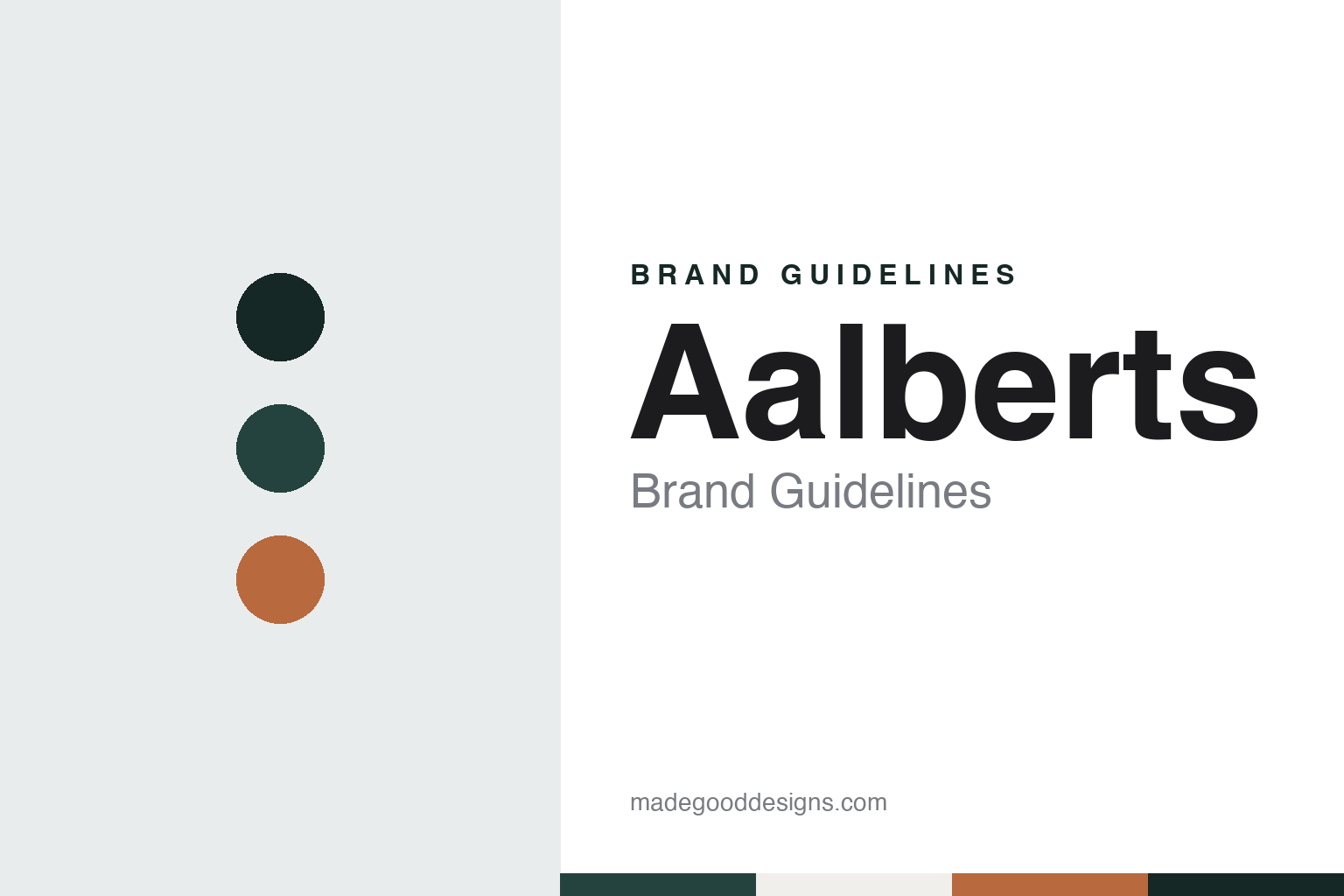
Two constants: a canal green, ink and copper palette and a geometric sans register. Abstract homage — not an Aalberts product or mark; no fitting, logo or nameplate is reproduced.
Mifa and the Aalberts way
One workshop in Limburg, then a long run of purchases.
Aalberts began in 1975, when Jan Aalberts set up a company called Mifa in Venlo, in the Dutch province of Limburg, Dutch Wikipedia says. Mifa became the base of Aalberts N.V., founded in 1981, and the company was listed on the Amsterdam stock exchange in March 1987. The group itself gives 1975 as its founding year and now marks “51 years of dedication to progress and entrepreneurship” on its website.
Growth came mostly by buying other firms. Dutch Wikipedia lists purchases including the German gas-fittings maker K M Schmöle in 1994 and the metal-hardening works Mamesta at Lomm in 1995; staff numbers rose from just over 500 in 1990 to about 1,500 in 1994. In 2003 the group bought Hage Fittings, a maker of stainless-steel press fittings. In 2006 it added Comap of France, Pemag of Spain and Holmgrens of Sweden, then a majority stake in the Polish plastic piping maker KAN that August. The French deep-drawing business of Thomson Genlis and the German anodising firm EWB joined on 1 January 2007, and the American maker Lasco Fittings followed in February 2007.
Some purchases were later sold again. Dutch Wikipedia says the group sold Adex in the Netherlands, Lasco in the United States and the Standard Hidráulica group in Spain in 2021. In 2012 Jan Aalberts handed day-to-day control to Wim Pelsma and stayed on as chairman of the supervisory board until 2014; the Aalberts family remained a large shareholder, according to the same article.
For years the company traded as Aalberts Industries; that is the name used in court papers from 2013, and the group now calls itself simply Aalberts, with Aalberts N.V. as its legal name.
Colour
Building, industry and semicon.
Aalberts describes itself today as a company that engineers and makes technologies for three segments: building, industry and semicon. It says it is headquartered in Utrecht, is listed on Euronext Amsterdam, employs around 13,000 people and is active in more than 50 countries. Dutch Wikipedia gives the split of sales in 2025 as about half from building, about a third from industry and the rest from semicon, with most of the total earned in Europe.
Building is the part closest to valves and pipes. Aalberts says it supplies piping systems, valves and products that control, treat and distribute water in heating, cooling and sanitary systems for homes, offices and industrial buildings. Its piping business, Aalberts integrated piping systems, describes four technologies on its own website: connection, valve, piping and fastening. It lists markets including commercial buildings, data centres, shipbuilding, tunnelling and mining, and offers a design service and prefabrication.
Industry is a different trade: heat treatment, surface treatment and specialised manufacturing processes that, the company says, make metal components last longer. This is where the old Mamesta hardening works and the anodising and coating firms bought in the early 2000s ended up.
Semicon is the newest emphasis. Aalberts says it designs and makes precision parts, frames, motion and vibration control systems and modules for machines used in semiconductor manufacturing and life sciences, and offers cleanroom assembly and testing. Dutch Wikipedia notes that the group does not make chips itself; it supplies the companies that build chip-making machines.
The company also had a long court case. In 2006 the European Commission fined Aalberts Industries over a cartel in copper fittings; the company denied taking part and appealed. The General Court annulled the decision as it applied to Aalberts and its subsidiaries Comap and Simplex in 2011, and on 4 July 2013 the Court of Justice of the European Union dismissed the Commission’s appeal, according to the published judgment.
Typography
Design and documentation.
Valve and flow-control makers sell to engineers, and their public material reads that way. Product pages are built around clear photographs of the hardware itself — a valve body, a fitting, an actuator housing — usually on a plain ground, so that shape, connection ends and materials can be read at a glance. Where a maker publishes cutaway drawings or sectioned views, they serve the same purpose: to show how a part is put together rather than to set a mood.
Colour on valves, fittings and pipes can be technical as well as decorative. Where a product range uses colour to mark a material, a medium or a pressure class, the maker’s own catalogue is the place to check what each colour stands for, since meanings can differ between companies, materials and markets. For a design guide, that is a reason to keep brand colour on paper and screens separate from the colours of the products themselves.
Much of the work happens in catalogues and tools. The tradition is old: Georg Fischer says its first fittings brochure, in 1865, listed 91 items for gas lighting. Today the same makers organise their websites by product family, industry and application, and offer downloads and online tools; Rotork, for example, publishes a sizing and selection toolkit for its actuators. Product range names, such as Rotork’s IQ, often do as much brand work as the company name.
The corporate pages tell a story of owners and divisions. Many of these companies have been reshaped by acquisitions, disposals and renamed divisions, and their sites set out which brands sit under which parent. This guide follows that record — when each company was founded, who owns it, and what it says about its own history — and marks clearly what rests on a company’s own word.
Aa
A geometric sans for a group of many trades. (Specimen set in Montserrat, a sans STAND-IN; NOT the Aalberts logo.)
Aalberts
Often unseen, always essential.
Aalberts presents itself with a short line on its about page: “Often unseen. Always essential.” Its segment pages repeat a matching phrase, “We are in the details,” and the about page sets the line over a video, followed by a plain account of the three segments.
The group’s language leans on a few repeated ideas. It calls its operating model “the Aalberts way” and says it is proven, repeatable and scalable; its values ask staff to be entrepreneurs, take ownership, share and learn, and act with integrity. Its current plan is called thrive 2030, which a May 2026 news item on the company website links to closer work with suppliers in the building segment. The executive team is led by Stéphane Simonetta, who joined as chief executive in 2023 after a career that included Grundfos, the company says.
Like many groups built by acquisition, Aalberts carries a family of older brand names beneath its own. Comap, bought in 2006, still appeared under its own name as a subsidiary in the 2013 court papers, and the piping businesses trade together as Aalberts integrated piping systems, while the corporate site speaks for the whole. Dutch Wikipedia says the shares were in the AEX index from March 2015 to March 2020, moved to the AMX in 2021 and returned to the AEX on 22 June 2026.
For a design guide, Aalberts shows how a holding company of many trades can present one calm voice, built on a short line and a few values rather than on any single product. Compare Danfoss, another European maker of heating valves and controls, and Georg Fischer, the Swiss group known for piping systems. For this guide we use canal green, deep ink and a copper tone with a sans, an unofficial interpretation; no product or logo is reproduced.
Explore & save
Keep Aalberts’s identity on hand — save it to a board in the Made Good inspiration library.
Aalberts identity set
Pin the Aalberts canal green, ink and copper palette and the geometric sans register to your own board.