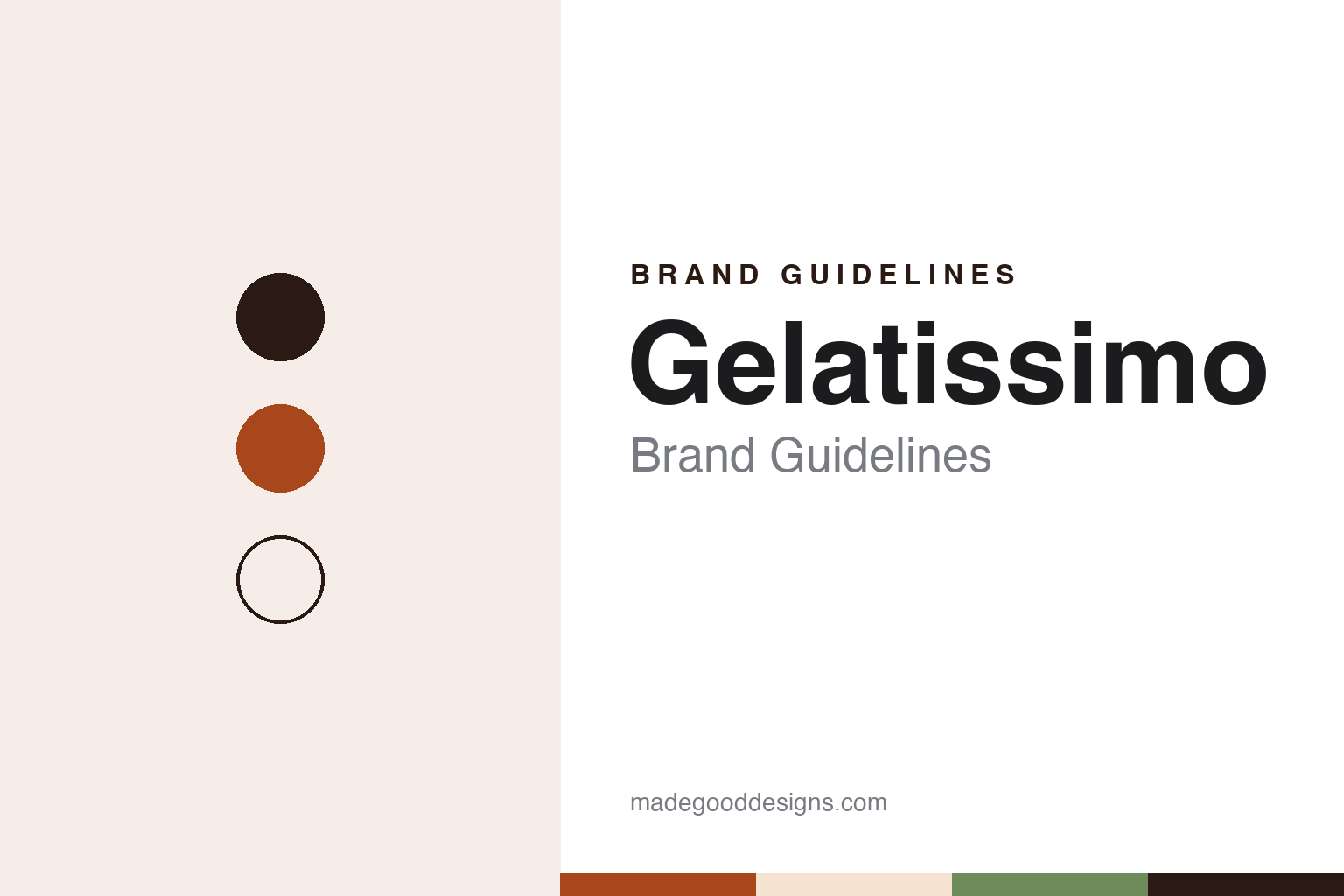
Gelatissimo Brand Guidelines
A 2002 King Street gelateria and a Flavour Obsessed franchise.
Aa
Two constants: a Gelatissimo apricot, cocoa and pistachio palette and a Warm serif register. Abstract homage — not a Gelatissimo product or mark; no cabinet, logo or pack is reproduced.
King Street
A family wholesale trade turned into a shopfront.
Gelatissimo is an Australian gelato chain that began with one shop in central Sydney. The company says its story “began in 2002” when its first store opened “in the heart of Sydney, right on King Street,” and that word of mouth soon brought queues out of the door. Inside Retail reported in November 2013 that the brothers Domenico and Marco Lopresti founded Gelatissimo in 2002 as a single gelateria in Sydney, with investment from John and Stanley Roth through Henroth Investments.
The business grew out of an older family trade. In an April 2012 profile, Dynamic Business reported that the brothers had worked in their father’s gelato bar in Crows Nest, on Sydney’s lower North Shore, in the early 1990s, and that the family had learned to make gelato from relatives in the south of Italy. When the bar was sold, its new owners kept ordering gelato from the family, and a wholesale business followed: Domenico Lopresti told the magazine he supplied restaurants around Norton Street in Leichhardt, the city’s Italian dining strip, and took gelato in display cabinets to street fairs, which he described as the beginning of the retail idea. Marco Lopresti joined full time in 2000.
The early menu needed adjusting. The brothers told Dynamic Business they had started with very Italian flavours, such as zuppa inglese, a trifle-style flavour that customers did not take to at first, and that tastes had since become more adventurous. They also said that making gelato fresh in each store let them adapt flavours quickly for each market.
Colour
Franchising at home and abroad.
Franchising came early. In 2012 Marco Lopresti told Dynamic Business it had been “almost eight years” since the company began to franchise, and the magazine counted 24 stores in Australia and more than 15 overseas, with gelato exported to Asia, to Italy and to Kuwait. By November 2013, Inside Retail reported 29 stores in Australia and 12 abroad, including sites in the Middle East and South East Asia.
That month the founders stepped back. Inside Retail reported that Filipe Barbosa, who had been with the company since its start, was appointed chief executive after the departure of the Lopresti brothers as joint chief executives, and it quoted Stanley Roth as the owner of Gelatissimo. Roth said Barbosa had been chosen because he understood the heritage of the business, where it had come from and what it stood for, and told franchisees and customers it would be business as usual; the departing brothers said they had joined the company when it was “just a newborn.” A decade later the chief executive was Braeden Lord: in February 2023 Franchise Executives reported that Gelatissimo had opened five stores in November and December 2022, bringing the network to 70 outlets. The new sites were at Rhodes in New South Wales, Highpoint in Victoria, Laguna in Phuket, the Royal Hawaiian Center at Waikiki and Jewel at Singapore’s Changi Airport.
The same report said the new stores used a contemporary store design combining gelato’s Italian heritage with the brand’s Australian roots, and that each market had local flavours, such as a mango sticky rice gelato in Phuket and a piña colada in Hawaii. It also noted that in October 2022 Gelatissimo had launched its first supermarket range, sold through Coles.
The franchise directory Franchise Business lists three formats, shopfront, kiosk and café, all trading seven days a week and making gelato on the premises each day. The company’s own franchising page describes stores in shopping centres, on high streets and in kiosks, and a fixed weekly royalty. It recruits franchisees for named shopping centres and regional towns across every mainland state and the Australian Capital Territory, and says it may offer finance to approved applicants buying a new store.
Typography
Design and documentation.
Ice cream, gelato and frozen-yogurt chains sell something that melts within minutes, so much of their identity sits in the shop itself. The counter, the cabinet of flavours, the cone and the cup are the brand’s most visible surfaces, and the companies’ own pages tend to describe their shops, their kitchens and their ingredients before anything else.
Serving style can become a signature. Amorino, the Paris gelato chain, shapes its gelato into a flower with a spatula, according to French Wikipedia, and in 2012 the business magazine Capital described its shops in tobacco tones rather than the bright white then common among its rivals. The guides in this series look at how each chain describes its own counters, cups and cones, in the words the companies publish.
Names carry a lot of the work. Gelato chains may keep Italian flavour names on their menus, as Capital reported of Amorino, and some chains tie their story to one place. Grom, the Turin gelateria, describes its history through a single founding square, Piazza Paleocapa, and a single central laboratory near the city, and says its shops churn the gelato each day.
Ownership is part of the story too. Some chains grow through franchising, some stay with their founders, and others pass into large groups: Unilever announced its purchase of Grom in 2015, and Grom says it has been part of The Magnum Ice Cream Company since 2025. Each guide in this series sets out who founded the brand, who owns it now and where its products are made, and marks clearly what rests on the company’s own word.
Aa
A warm serif — “For the Flavour Obsessed.” (Specimen set in Fraunces, a serif STAND-IN; NOT the Gelatissimo logo.)
Gelatissimo
“For the Flavour Obsessed.”
Today Gelatissimo presents itself under the line “For the Flavour Obsessed.” Its website says it makes “authentic gelato fresh in store every day” with more than 40 flavours, mixing “old school classics” with “quirky new flavours,” and that it uses traditional gelato-making techniques while “there’s nothing traditional about us.” It sells gelato cakes, milkshakes and take-home packs, hires out gelato carts, and runs a loyalty programme called Club Gelato through its own app.
The company counts more than 50 locations across Australia, and lists stores abroad in the Philippines, Singapore, Saudi Arabia and the United States. It also lists show medals: a gold for chocolate hazelnut at the Australian Dairy Industry Awards in 2023, a gold for espresso at the Royal Sydney Cheese and Dairy Show the same year, and golds for lemon and mango sorbets at the Sydney Royal Fine Foods Show in 2024, as the company gives them, along with a silver for mango sorbet at the Royal Queensland awards in 2022. Its news pages report its own franchise awards, such as a franchisee of the year named in October 2026.
For a design guide, Gelatissimo shows how a family wholesale trade became a branded franchise that keeps one promise, gelato made in the shop each day, while changing flavours from market to market. Compare Amorino, the Paris gelato chain, and Venchi, an Italian chocolate name that also sells gelato. For this guide we use an apricot clay, a cocoa brown and a pistachio green with a serif, an unofficial interpretation; no product or logo is reproduced.
Explore & save
Keep Gelatissimo’s identity on hand — save it to a board in the Made Good inspiration library.
Gelatissimo identity set
Pin the Gelatissimo apricot, cocoa and pistachio palette and the Warm serif register to your own board.