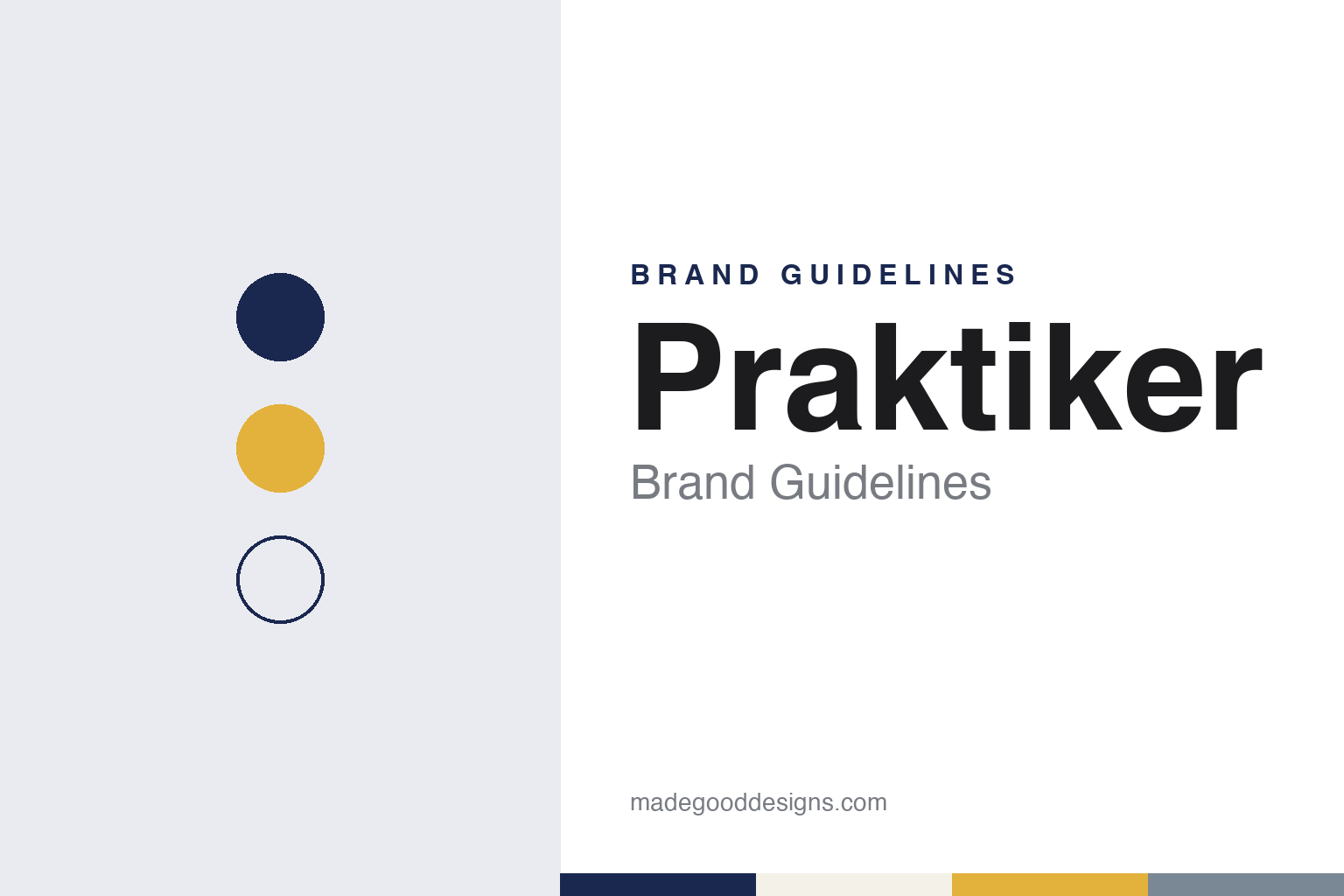
Praktiker Brand Guidelines
A German DIY chain that grew by buying others, and closed in 2013.
Aa
Two constants: a deep blue, sunflower and concrete grey palette and a discount grotesque register. Abstract homage — not a Praktiker product or mark; no logo, store sign or advert is reproduced.
bâtiself to Praktiker
A retailer’s DIY arm, from 1978.
Praktiker was a German chain of DIY and home-improvement stores, and it no longer trades in Germany. It began in 1978, when its first store opened in Luxembourg under the name bâtiself, according to both English and German Wikipedia. Its parent was the Saarbrücken retailer ASKO Deutsche Kaufhaus AG, German Wikipedia says.
The chain moved into Germany the following year. German Wikipedia says that in 1979 Praktiker took over nine DIY stores from the Bavarian group BayWa and opened four more of its own, and that from 1982 it moved step by step to a discount model. Unlike many German rivals, which mostly opened new stores, Praktiker grew largely by buying smaller chains and builders’ merchants, English and German Wikipedia both say. Among them, according to German Wikipedia, were the German stores trading as Wickes from 1985, the Real-kauf DIY stores in 1990, and, in the early 1990s, the DIY businesses of BLV, Massa, MHB, Huma and Extra; later purchases included Bauspar in 1996, Wirichs in 1997 and 27 Top-Bau stores in 2000.
Ownership changed with its parent. When ASKO merged with Metro Cash & Carry in 1995, Praktiker became part of the new Metro AG, English Wikipedia says. The chain also went abroad: German Wikipedia dates its first store in Greece to 1991, Poland to 1997, and Hungary and Turkey to 1998, with later stores in Bulgaria, Romania and Ukraine. The Luxembourg stores kept the bâtiself name, English Wikipedia says.
For most of its life, Praktiker’s head office was at Kirkel in Saarland, German Wikipedia says; Der Spiegel’s 2013 report on the group was datelined Hamburg and Kirkel.
Colour
A discount chain, a premium chain and a slogan.
Metro did not keep Praktiker for good. German Wikipedia says Metro took full control in 2002, then returned the company to the Frankfurt stock exchange on 22 November 2005, keeping a minority stake, and announced in April 2006 that it would sell the rest. English Wikipedia says the shares were in the MDAX index from 2006 to 2011 and in the SDAX from 2011 to 2013.
As an independent listed company, Praktiker bought a second chain. On 16 August 2006, n-tv reported that Praktiker had signed an agreement in Hamburg to take over the operating business of Max Bahr, a Hamburg DIY chain, subject to approval by the Federal Cartel Office; the store property went to a separate buyer. Praktiker planned to keep Max Bahr as its premium brand and to position Praktiker below it as a “price-aggressive” brand, the broadcaster reported. Der Spiegel later dated the purchase to 2007, and German Wikipedia to February 2007.
Praktiker’s public image rested on one line of advertising. n-tv reported in June 2007 that the chain advertised “20 per cent off everything, except pet food.” German Wikipedia dates the slogan to 2003.
The two-brand plan was later turned around. Der Spiegel reported in July 2013 that Praktiker had bought Max Bahr to benefit from its more positive image, and that in the final period the group had converted a growing number of former Praktiker stores to the Max Bahr name. German Wikipedia says the conversion programme began in 2012, after loss-making years, and aimed to move about half of the Praktiker stores to Max Bahr.
Typography
Design and documentation.
DIY chains, home-improvement retailers and builders’ merchants present themselves through the places where customers meet them. A home-improvement store is usually a large warehouse-style building with long aisles, high racking and a garden or timber area, and the chains describe those stores in their own words on their websites. A builders’ merchant is more often a yard and a branch, where tradespeople buy timber, bricks and fixings across a counter. For a design reader, the shed, the yard and the counter are where the colours, signs and lettering of these companies are seen at full size.
Many trade suppliers also sell from a catalogue and a website, with orders collected from a counter or delivered to site. Printed catalogues, product codes and click-and-collect services appear in the companies’ own descriptions, and in the trade press that covers them. Liveried vans and lorries carry the same names and colours from the branch to the building site, so a merchant’s identity often travels further on the road than it does on the high street.
Store and own-label naming is usually plain. Chains carry a founder’s surname, two merged surnames, or a literal compound of a product and a place, and many sell house ranges under their own names alongside the branded tools and materials they stock. Groups often run several trading names side by side, one for each trade or customer type, rather than folding them into one.
Corporate pages fill in the rest: founders, owners, listings, demergers and the investment groups that sit behind many chains. Ownership in this sector changes more often than the shop signs do, so the guides in this series date each change of owner to an independent source, describe each name and colour as documented, and treat the palettes shown here as unofficial interpretations.
Aa
A loud, compact grotesque for a discount DIY chain. (Specimen set in Archivo, a sans STAND-IN; NOT the Praktiker logo.)
Praktiker
Insolvency in 2013, and a name that lives on abroad.
The restructuring did not succeed. On 10 July 2013 Praktiker AG announced that it was insolvent, and filings followed at the Hamburg court for eight German subsidiaries and, on 12 July, at the Saarbrücken court for the parent company, according to English and German Wikipedia. On 25 July 2013 Der Spiegel reported that Max Bahr, until then seen as the stronger part of the group, was also filing for insolvency, after a trade-credit insurer withdrew its cover for suppliers. The foreign businesses were not part of the German insolvency.
No buyer was found for the German Praktiker chain. The trade paper Lebensmittel Zeitung reported on 13 September 2013 that a clearance sale was starting in 130 more Praktiker stores after the company had announced their closure, and German Wikipedia says the sale was completed on 30 November 2013, when the Praktiker and Extra stores closed for good. Some sites passed to other chains: Lebensmittel Zeitung reported on 4 December 2013 that, after a first property package went to Bauhaus, shareholders of the Hagebau group were taking over 16 more Praktiker and Max Bahr stores. The remaining Max Bahr stores closed on 25 February 2014, English Wikipedia says. In July 2014 the trade magazine DIY International recalled that two years earlier Praktiker had operated more than 430 stores in seven European countries.
The name did not disappear entirely. The foreign subsidiaries were sold to other companies between 2013 and 2015, and English Wikipedia says former subsidiaries still trade as Praktiker in Bulgaria, Greece, Hungary and Turkey, under separate owners. In Germany, the name rights were bought in 2016 and used for an online DIY shop at praktiker.de, which German Wikipedia says has nothing to do with the former company. Praktiker AG itself, the chain that began as bâtiself in 1978, closed with its German stores in 2013 and 2014.
For a design guide, Praktiker shows how a discount retailer can become known for a single advertising line, and how a brand can outlast the company that built it. Compare OBI and Hornbach, two German DIY chains of the same era. For this guide we use a deep blue, a sunflower yellow and a concrete grey with a sans, an unofficial interpretation; no product or logo is reproduced.
Explore & save
Keep Praktiker’s identity on hand — save it to a board in the Made Good inspiration library.
Praktiker identity set
Pin the Praktiker deep blue, sunflower and concrete grey palette and the discount grotesque register to your own board.