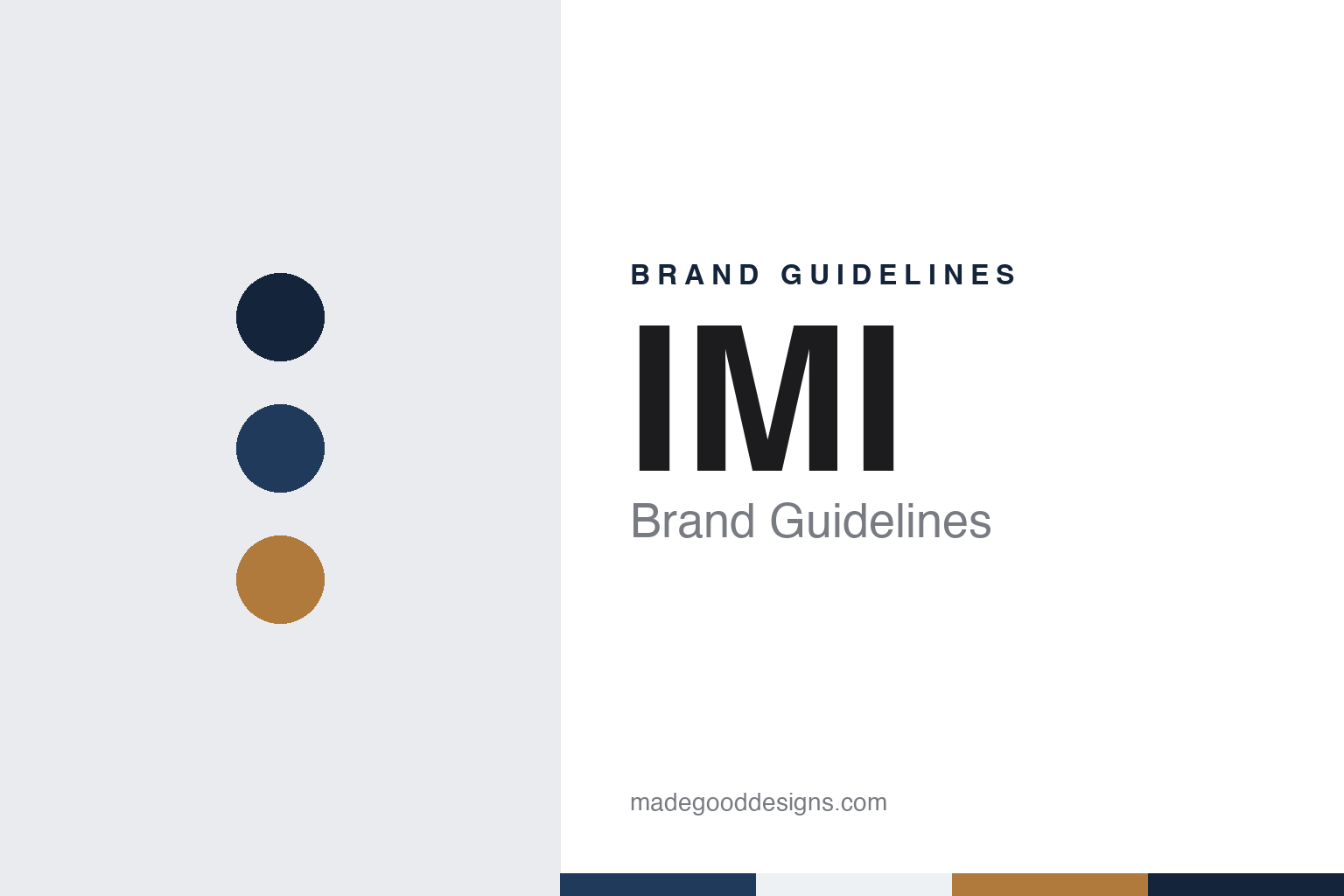
IMI Brand Guidelines
A Witton works of 1862, renamed for its centenary and rebuilt around flow control.
Aa
Two constants: a slate blue, ink and brass palette and an engineering sans register. Abstract homage — not an IMI product or mark; no valve, logo or nameplate is reproduced.
From Witton to IMI
A Birmingham works that changed owners, names and trades.
IMI traces its history to Witton, on the north side of Birmingham, in 1862. English Wikipedia says a works run by the firm of Pursall and Phillips moved to a site beside the railway at Witton that year, and that the Scottish businessman George Kynoch, who had joined the firm a few years earlier, took it over in 1863; the business then traded as G. Kynoch and Co. English Wikipedia treats 1862 as IMI’s founding year.
The business did not stay in one line of work. English Wikipedia says it spread into goods as varied as soap, bicycle components and non-ferrous metals, and that by the early twentieth century it had built up particular skill in metallurgy. It also ran its own printing shop: The Kynoch Press, founded in 1876 as a company press to print packaging, grew into a fine press that took on outside work and kept its name for decades.
After the First World War the firm became part of Nobel Industries, and when Imperial Chemical Industries was formed in 1926 the Witton works joined it. English Wikipedia says the site became the head office of ICI Metals, and in the 1950s the division’s researchers worked out a process for making titanium on a commercial scale. In 1958 ICI Metals bought half of Yorkshire Imperial Metals, and the other half four years later.
The modern name arrived on the firm’s centenary. In 1962 it became Imperial Metal Industries Limited, IMI for short, and in 1966 it was listed on the London Stock Exchange. ICI kept a majority holding at first, and IMI became fully independent in the late 1970s; English Wikipedia gives both 1977 and 1978. It says the company was called IMI Limited from 1978 to 1981, before taking its present form, IMI plc.
Colour
From smelting to valves, actuators and controls.
The IMI of today is a very different business from the metal works of the 1960s. English Wikipedia says the company sold its more basic businesses, such as metal smelting and founding, during the 1990s, and in 2003 moved its head office from Witton to a new building near Birmingham Airport. In October 2013 it announced that a programme of change lasting about a decade was complete, after selling the Cornelius beverage-dispensing business and a market intelligence business to Berkshire Hathaway; the aim was to concentrate on making control valves and related products.
Today IMI groups its work into five sectors, which English Wikipedia lists as Process Automation, Industrial Automation, Climate Control, Life Science and Fluid Control, and Transport. Each sector runs its own website under the IMI name.
Process Automation is where the heavy valves sit. Its website describes flow control technologies for severe service applications and lists product brands including IMI CCI, IMI Z&J, IMI Bopp & Reuther and IMI Orton. IMI CCI, it says, makes control valves for power generation, oil and gas and petrochemical plants, along with desuperheaters, steam conditioning valves and its DRAG pressure reduction technology.
Climate Control covers heating and cooling systems in buildings through three brands: IMI TA, for balancing, control and actuation; IMI Heimeier, for thermostatic controls; and IMI Pneumatex, for pressurisation, with products such as the TA-Modulator valve and the Compresso unit. That website says the line began when August Hilmer Andersson started making water and heating fittings at Ljung, in Sweden, in 1897, and that TA launched what it calls the first manual balancing valve in 1957.
Industrial Automation is led by IMI Norgren, whose website marks a hundred years of the brand and lists air preparation equipment, pneumatic and electric linear actuators, and fluid control valves for packaging, rail and beverage dispense. In November 2022 IMI bought Heatmiser, the Blackburn maker of smart thermostatic controls, English Wikipedia says.
Typography
Design and documentation.
Valve and flow-control makers sell to engineers, and their public material reads that way. Product pages are built around clear photographs of the hardware itself — a valve body, a fitting, an actuator housing — usually on a plain ground, so that shape, connection ends and materials can be read at a glance. Where a maker publishes cutaway drawings or sectioned views, they serve the same purpose: to show how a part is put together rather than to set a mood.
Colour on valves, fittings and pipes can be technical as well as decorative. Where a product range uses colour to mark a material, a medium or a pressure class, the maker’s own catalogue is the place to check what each colour stands for, since meanings can differ between companies, materials and markets. For a design guide, that is a reason to keep brand colour on paper and screens separate from the colours of the products themselves.
Much of the work happens in catalogues and tools. The tradition is old: Georg Fischer says its first fittings brochure, in 1865, listed 91 items for gas lighting. Today the same makers organise their websites by product family, industry and application, and offer downloads and online tools; Rotork, for example, publishes a sizing and selection toolkit for its actuators. Product range names, such as Rotork’s IQ, often do as much brand work as the company name.
The corporate pages tell a story of owners and divisions. Many of these companies have been reshaped by acquisitions, disposals and renamed divisions, and their sites set out which brands sit under which parent. This guide follows that record — when each company was founded, who owns it, and what it says about its own history — and marks clearly what rests on a company’s own word.
Aa
An engineering sans for a group that names every brand IMI first. (Specimen set in IBM Plex Sans, a sans STAND-IN; NOT the IMI logo.)
IMI
Three letters in front of every brand.
The clearest visual habit of the modern group is its naming. Across its sector websites, acquired names carry the three letters in front: IMI Norgren, IMI TA, IMI Heimeier, IMI CCI. Older brands such as Heimeier and Norgren keep their own names, but the group mark always leads. The sector websites share one structure, with the same menu of products, industries, services, resources and an about page, and they repeat one purpose line, “Breakthrough Engineering for a Better World,” which the Climate Control site says puts sustainability at the centre of the group’s strategy.
The initials themselves are a leftover of the 1962 name. Imperial Metal Industries was chosen for the centenary, at a time when the company was still part of ICI and still made metals; the long form has gone, but the letters stayed through the move from Witton, the sale of the metal trades and the shift to valves and controls. English Wikipedia says the company is headquartered in Birmingham, is listed on the London Stock Exchange and is a member of the FTSE 100 index.
The group is still buying. In October 2026 IMI signed an agreement to buy iSMA Controlli, an Italian building automation company with design and manufacturing at Sant’Olcese, near Genoa, and in Gdańsk, Poland, the Italian business news site BeBeez reported on 8 October 2026; the deal was agreed in October 2026 and was not completed at the time of writing. iSMA Controlli was formed in 2021 when the Genoa firm Controlli joined the Polish company Global Control 5, the same report says.
For a design guide, IMI shows how a group can keep a set of initials long after the words behind them stopped describing the business, and how one prefix can tie together brands bought over many years. Compare Spirax Sarco, another British steam and fluid engineer, and Rotork, the Bath maker of valve actuators. For this guide we use slate blue, deep ink and a brass tone with a sans, an unofficial interpretation; no product or logo is reproduced.
Explore & save
Keep IMI’s identity on hand — save it to a board in the Made Good inspiration library.
IMI identity set
Pin the IMI slate blue, ink and brass palette and the engineering sans register to your own board.