Elsewedy Electric Brand Guidelines
The 1938 Cairo trader that built Egypt’s cable group.
Aa
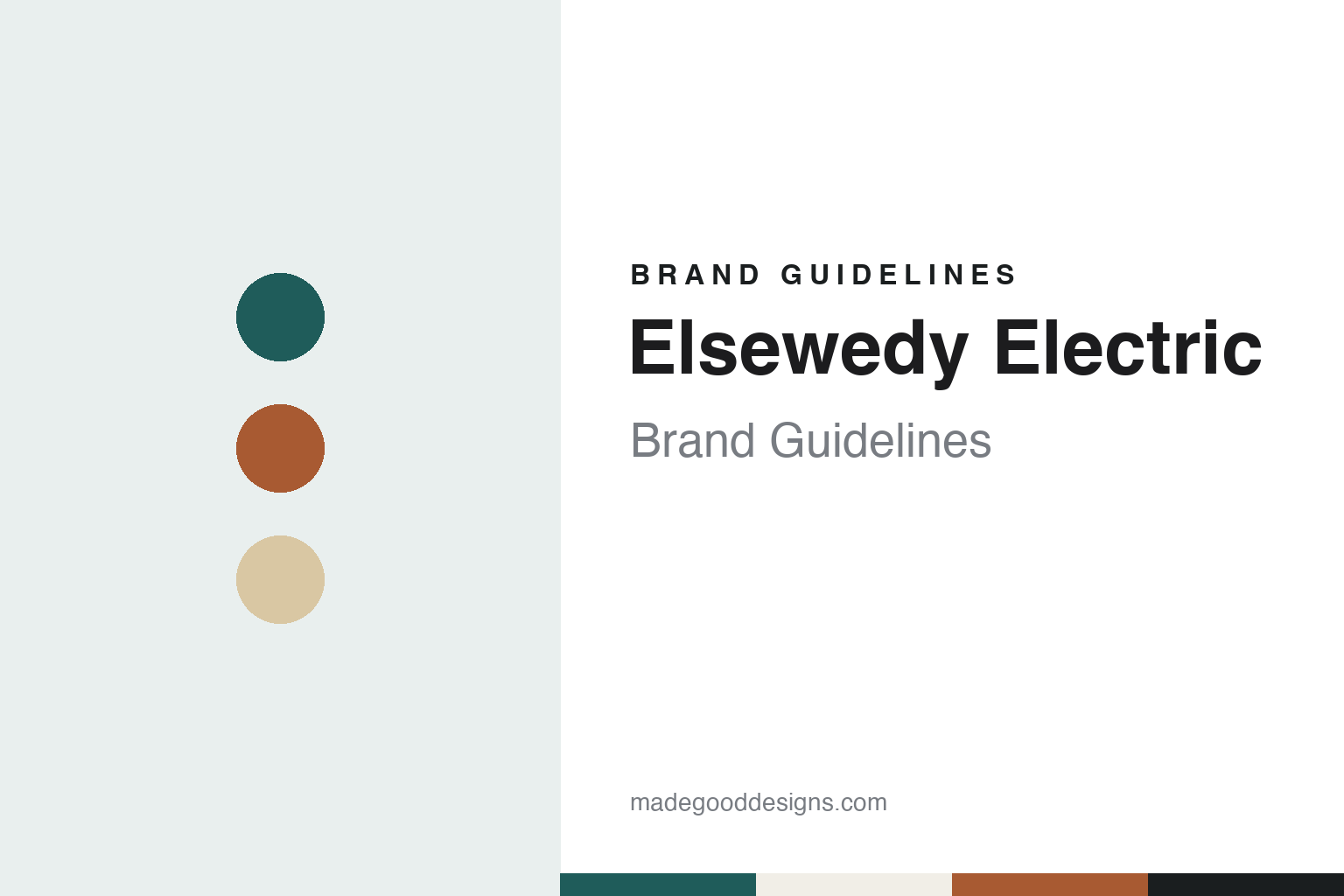
Two constants: a Nile teal, copper rod and desert sand palette and a geometric engineering sans register. Abstract homage — not an Elsewedy Electric product or mark; no cable, logo or wordmark is reproduced.
A Cairo trade
From selling electrical equipment to making cable.
Elsewedy Electric began as a shop, not a factory. The company says the Elsewedy family started a small business in Cairo in 1938, trading in electrical equipment, and English Wikipedia gives the same year and the same start as a trader. For its first two decades the business bought and sold rather than made.
Cable arrived as a distribution trade. The company says that in 1960 it began importing and distributing foreign-made cables in Egypt, and Wikipedia describes the period from 1960 to 1995 as one in which the family business acted as distributor for what was then the only cable manufacturer in Egypt, selling cable into the Egyptian market.
Manufacturing came in 1984. That year the family opened Arab Cables, which English Wikipedia describes as the first private-sector cable factory in Egypt, at a time when the country’s other cable makers were wholly owned by the state. Wikipedia places the plant in one of Egypt’s industrial zones, about 60 kilometres east of Cairo, with expressway links to the Mediterranean and Red Sea ports, and lists its products as low-, medium- and high-voltage power cables, control cables and overhead transmission lines.
A cluster of related companies followed in the 1990s. According to Wikipedia and the company’s timeline, Egytech opened in 1996 as a second plant making power cable for export; Sedplast began making PVC compounds and masterbatch the same year, so the group could control the plastics around its conductors; a 1997 facility added appliance cords, data cables, telephone cables and instrumentation cables; and a joint venture with Elastimold, then a unit of Thomas & Betts, made medium- and high-voltage joints and terminations. In 1998 the group added United Metals, a continuous cast and rolled copper rod plant that Wikipedia says was built in collaboration with the American wire maker Southwire, and Elsewedy SEDCO for cable joints and terminations.
Colour
Cables, then transformers, meters and wind.
In the 2000s the cable business became a wider electrical group. Wikipedia says the company began making transformers in 2003, formed a joint venture with the Italian firm Italsmea in 2004 for equipment used by oil and gas companies, and opened a cable facility for the Levant markets in 2005 and a further transformer factory in 2007. The company’s timeline adds a road lighting pole plant in Ghana in 2006.
From 2008 it spread across borders. Wikipedia lists cable facilities set up since then in Algeria, Saudi Arabia, Ethiopia, Yemen and Qatar, and transformer plants in Zambia and Egypt. The same year the group moved into energy metering by buying Iskraemeco, a Slovenian maker of meters operating since 1945, and into wind power through the Spanish turbine maker M. Torres Olvega Industrial and a joint venture with the German tower maker SIAG. The company’s own timeline places the Iskraemeco and M. Torres moves in 2008 and adds Doha Cables and a Nigerian business in 2010 and the Elsewedy Technical Academy in 2011.
The name changed to match. In 2010, according to both Wikipedia and the company, Elsewedy Cables became Elsewedy Electric, a rename Wikipedia says was meant to reflect the broader range of energy products and services. The shares had already been on the market for four years: the company’s investor site says it has been listed on the Egyptian Exchange since 2006.
Acquisitions kept widening the map. The company’s timeline lists the purchase of PT CG Power Systems in Indonesia and Validus Engineering in Pakistan in 2021, the opening of a cable factory in Tanzania the same year, a battery plant in Greece in 2024 and, in 2025, two factories in Saudi Arabia for copper and aluminium and another in Egypt for aluminium.
Typography
Design and documentation.
Cable makers sell products that most people never see once they are installed. Power lines run under streets and seabeds, data cable sits inside walls, and magnet wire is wound into motors. Their public image therefore leans on what can be photographed before installation: the cable itself, the plant that makes it and the ships that lay it.
The most common picture is the cut end. Company pages and catalogues show a cable in cross-section, with copper or aluminium conductor, insulation, screens and outer sheath set out in rings, often against a plain background. Wide shots of full reels and drums stacked in a yard do the same job at a larger scale, turning a long product into a single object that a camera can frame.
Submarine work has added another set of images. Press releases about offshore wind and grid links are often illustrated with cable-laying vessels, carousels of coiled cable and tall factory towers where high-voltage cable is made. These photographs carry the story of size and reach without needing a consumer product, and they are usually credited to the company that issued them.
Words matter as much as pictures. Makers organise their ranges into product families with short trade names, voltage classes and standard codes, and their corporate pages spend a lot of space on plants, subsidiaries and owners: where a factory stands, when it opened and which group holds the shares. For a designer, the category offers a practical vocabulary of rings, coils, ships and site maps, and a reminder that an industrial identity is often built from documentation rather than from packaging.
Aa
A geometric engineering sans for a cable and infrastructure group. (Specimen set in Sora, a sans STAND-IN; NOT the Elsewedy Electric logo.)
Elsewedy Electric
A cable maker that became an infrastructure group.
Today the company describes itself in six sectors: wires, cables and accessories; electrical products; engineering and construction; digital solutions; infrastructure investments; and building solutions. It says it has more than 21,000 employees, a presence in 60 countries and more than 34 production facilities across Africa and Asia, including plants in Egypt, Algeria, Saudi Arabia, Qatar, Indonesia, Pakistan and Tanzania, and that it exports to more than 100 countries. Its cable division covers power, special and telecom cables, winding wires, insulators and accessories, and the company says it has more than 40 years of cable-making behind it, counting from Arab Cables.
Press coverage tends to use shorter descriptions. In November 2026 the South African technology site TechCentral called Elsewedy Electric “an Egyptian cables, electrical equipment and energy infrastructure group,” reporting that Vodafone Egypt planned to co-invest through a joint venture with Elsewedy Electric and Cassava Technologies in what Vodafone describes as Egypt’s largest data centre; the plan was disclosed on 10 November 2026, with no amount, location or timeline given. English Wikipedia notes that Forbes placed the company fourth in its list of the top 50 listed companies in Egypt for 2023.
The identity leans on the family name and on its subsidiaries. The group name has carried the Elsewedy surname since the cable years, and its timeline is a long list of companies with their own short names, from Arab Cables, Egytech and Sedplast to United Metals and Iskraemeco, each tied to one product. The group’s corporate site sums up the arc in one line, describing a local maker of electrical products that has grown into an integrated infrastructure provider.
For a design guide, Elsewedy Electric shows how a family trading name can be stretched over a growing set of factories, each with its own brand, without losing the founding surname. Compare Southwire, its partner on the 1998 copper rod plant, and Prysmian, another cable maker that grew through acquisitions. For this guide we use a Nile teal, a copper rod brown and a desert sand with a sans, an unofficial interpretation; no product or logo is reproduced.
Explore & save
Keep Elsewedy Electric’s identity on hand — save it to a board in the Made Good inspiration library.
Elsewedy Electric identity set
Keep the Elsewedy Electric Nile teal, copper rod & desert sand palette and the geometric engineering sans register for reference.