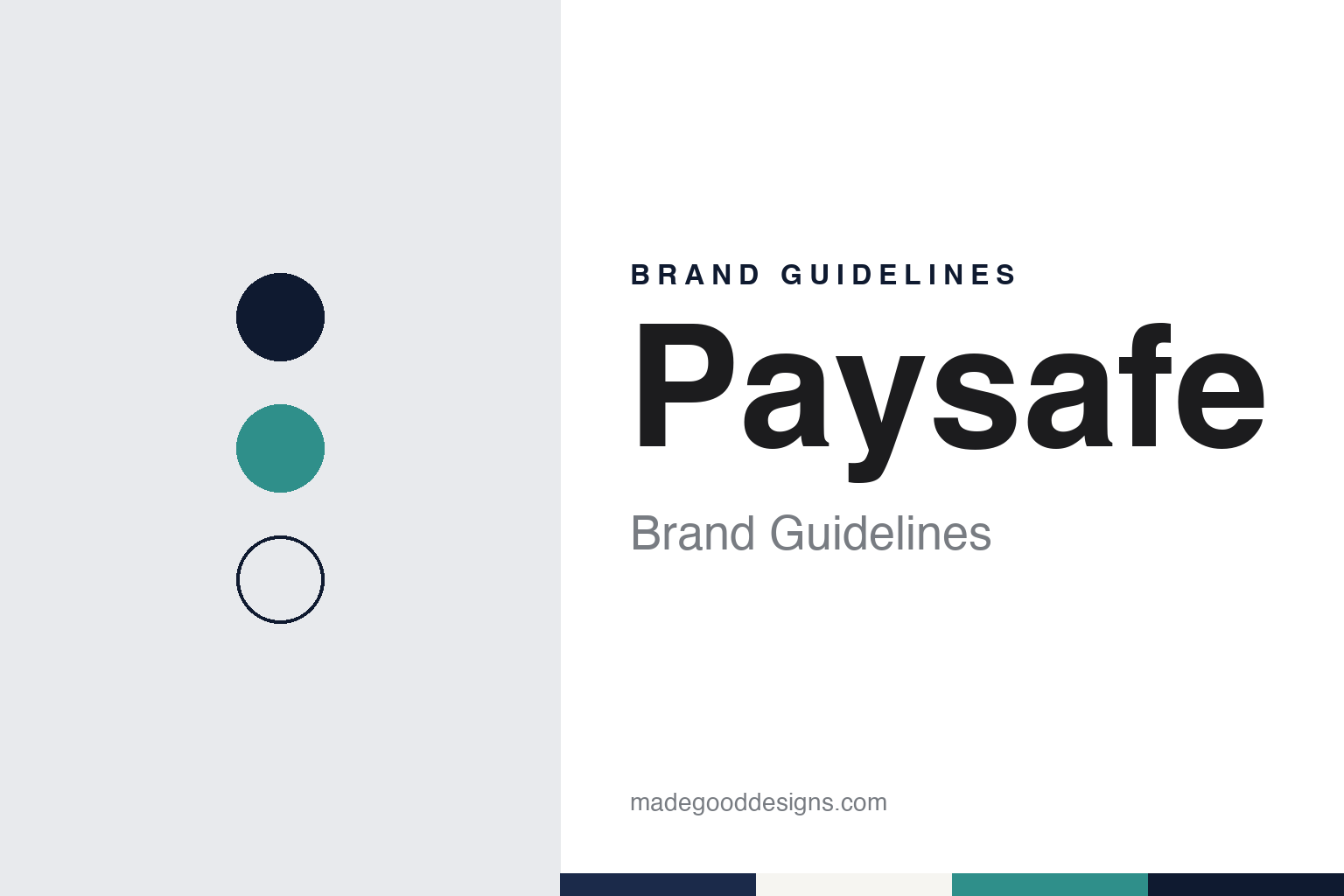
Paysafe Brand Guidelines
From a Calgary e-wallet to a New York-listed payments group.
Aa
Two constants: a Paysafe ink blue, teal and paper palette and a geometric sans register. Abstract homage — not a Paysafe product or mark; no card, app screen or logo is reproduced.
Neteller to Paysafe
A Calgary wallet, three names and a voucher.
Paysafe did not start under that name. German Wikipedia says its oldest line is Neteller, an online wallet set up in Calgary, Canada, in 1999. English Wikipedia lists two other strands that ended up in the same group: the payment platform Netbanx, founded in 1996, and Optimal Payments of Montreal, founded in 1997. Neteller moved to the Isle of Man and listed on London’s AIM market in April 2004, German Wikipedia says, and it bought Netbanx in late 2005.
The next decade was a run of renames. In November 2008 Neteller PLC became Neovia Financial, which German Wikipedia says was meant to separate the listed company from its product names: Neteller, Netbanx and the Net+ prepaid card. In 2011 Neovia bought Optimal Payments and took that name for the whole group. In 2015 Optimal Payments agreed to buy the Skrill Group, which brought with it the digital wallet Skrill and the Vienna prepaid voucher paysafecard; German Wikipedia dates completion to August 2015. In November 2015 the enlarged group renamed itself Paysafe Group. German Wikipedia describes paysafecard, founded in Vienna in March 2000, as the business that originally gave the group its name.
The listing history is just as varied. The renamed group moved from AIM to the main market of the London Stock Exchange in December 2015 and joined the FTSE 250 in 2016. In 2017 a consortium of Blackstone and CVC Capital Partners agreed to take it private. The European Commission cleared that acquisition under the EU Merger Regulation on 22 November 2017, finding that it raised no competition concerns, and English Wikipedia says the shares left the London market on 21 December 2017.
Colour
Wallets, vouchers and a merchant arm.
Paysafe sells to both sides of a payment. For businesses it offers card processing and a range of local payment methods; for consumers it runs digital wallets and what it calls eCash. On its investor site the company describes itself as “a global payments platform powering the experience economy,” with a focus on iGaming, video gaming, e-commerce, online trading, retail, travel and hospitality, and it says it has about 2,800 employees across 12 countries.
Much of the group’s public face is made of other brands. English Wikipedia lists Skrill and Neteller as its wallets and PaysafeCard and PaysafeCash as cash-based ways to pay online without a bank card, alongside regional payment methods in Latin America and an affiliate-marketing business. The voucher works offline: German Wikipedia says customers buy a 16-digit PaysafeCard code with prepaid credit at shops such as petrol stations, post offices and tobacconists, then type it into a merchant’s payment form to pay online. German Wikipedia notes that after the 2015 rebrand the subsidiary logos carried the line “A Paysafe Company,” while older platforms such as Netbanx were offered directly under the Paysafe name.
The newest consumer product carries the parent name itself. In a release of 22 April 2026 Paysafe introduced PaysafeWallet, which it describes as the evolution of PaysafeCard’s account and debit card into a full digital wallet with its own IBAN, run inside the PaysafeCard app and live in 18 European markets. A product chief quoted in that release called it “a brand that carries the Paysafe name.” In its release of 28 October 2026 the company said PaysafeWallet was now available across all euro-area markets and in Poland, and listed what it offers: an IBAN account, a Mastercard debit card, cash top-ups through PaysafeCard and peer-to-peer payments.
Regulation shapes the structure too. English Wikipedia says that after Brexit the group moved its European Economic Area business to companies incorporated in Ireland, each authorised as an electronic money institution by the Central Bank of Ireland, and that the parent is legally domiciled in Bermuda, with its corporate headquarters in the United Kingdom.
Typography
Design and documentation.
Payment processors and wallets present themselves in more than one place at once. A merchant meets them at the counter and in the checkout, a developer meets them in documentation, and an investor meets them on corporate pages about owners and listings. Each of those surfaces carries the brand in a different register.
At the counter, the brand is often a device. Global Payments, for example, described a modular countertop terminal for its Genius platform in November 2025, with a 15.6-inch merchant display, hidden cable management and stand, kiosk and wall-mount configurations, according to its release. Online, the brand shows up as a list of methods: PayU’s European corporate site sorts its offer into cards and digital wallets, online bank transfers, deferred payments and local schemes such as BLIK.
For developers, processors publish their own entry points. PayU’s Indian site links documentation and an API Playground, and its European site links a Developer Portal and a public status page. The Indian site also lists a mobile app SDK, a software kit for adding payments to apps, among its payment products.
Corporate pages tell the ownership story. PayU’s Indian site describes the business as part of Prosus, listed in Amsterdam and Johannesburg and majority owned by Naspers, while Global Payments’ investor site gives its New York Stock Exchange ticker, GPN, and its releases record deals such as the Worldpay purchase completed in January 2026. This guide sets out what can be checked about each company: who founded it, who owns it, and what its own pages say about its products and markets.
Aa
A clean geometric sans for a group name. (Specimen set in Manrope, a sans STAND-IN; NOT the Paysafe logo.)
Paysafe Limited
Back on a stock market, this time in New York.
Private ownership lasted a little over three years. In December 2020 Paysafe agreed to merge with Foley Trasimene Acquisition Corp. II, a special-purpose acquisition company. The company’s own release of 30 March 2021 says the merger closed that day, that the combined business would operate as Paysafe Limited, and that its shares would start trading on the New York Stock Exchange under the ticker PSFE on 31 March 2021. Blackstone and CVC stayed on as investors, the release says, and the new chairman pointed to iGaming “beginning to open up across the United States.”
That was a return to a market the group had once left. German Wikipedia says Neteller left the United States market in 2007, at a time when most of its business came from payments to online-gaming operators, and that its fee income fell steeply in the years that followed. The renames of 2008 and 2011 came after that exit.
Sport has been one way the group puts its names in front of customers. English Wikipedia says Optimal Payments sponsored Crystal Palace for the 2014/15 and 2015/16 seasons, with the Neteller logo on the front of the team’s shirts.
For a design guide, Paysafe shows a group whose own name came from one of its products, and whose consumer brands still sit under that umbrella with a shared sign-off. Compare the Skrill brand guidelines for the wallet it bought in 2015 and the Worldpay brand guidelines for another merchant processor. For this guide we use ink blue, a cool teal and warm paper with a sans, an unofficial interpretation; no product or logo is reproduced.
Explore & save
Keep Paysafe’s identity on hand — save it to a board in the Made Good inspiration library.
Paysafe identity set
Pin the Paysafe ink blue, teal and paper palette and the geometric sans register to your own board.