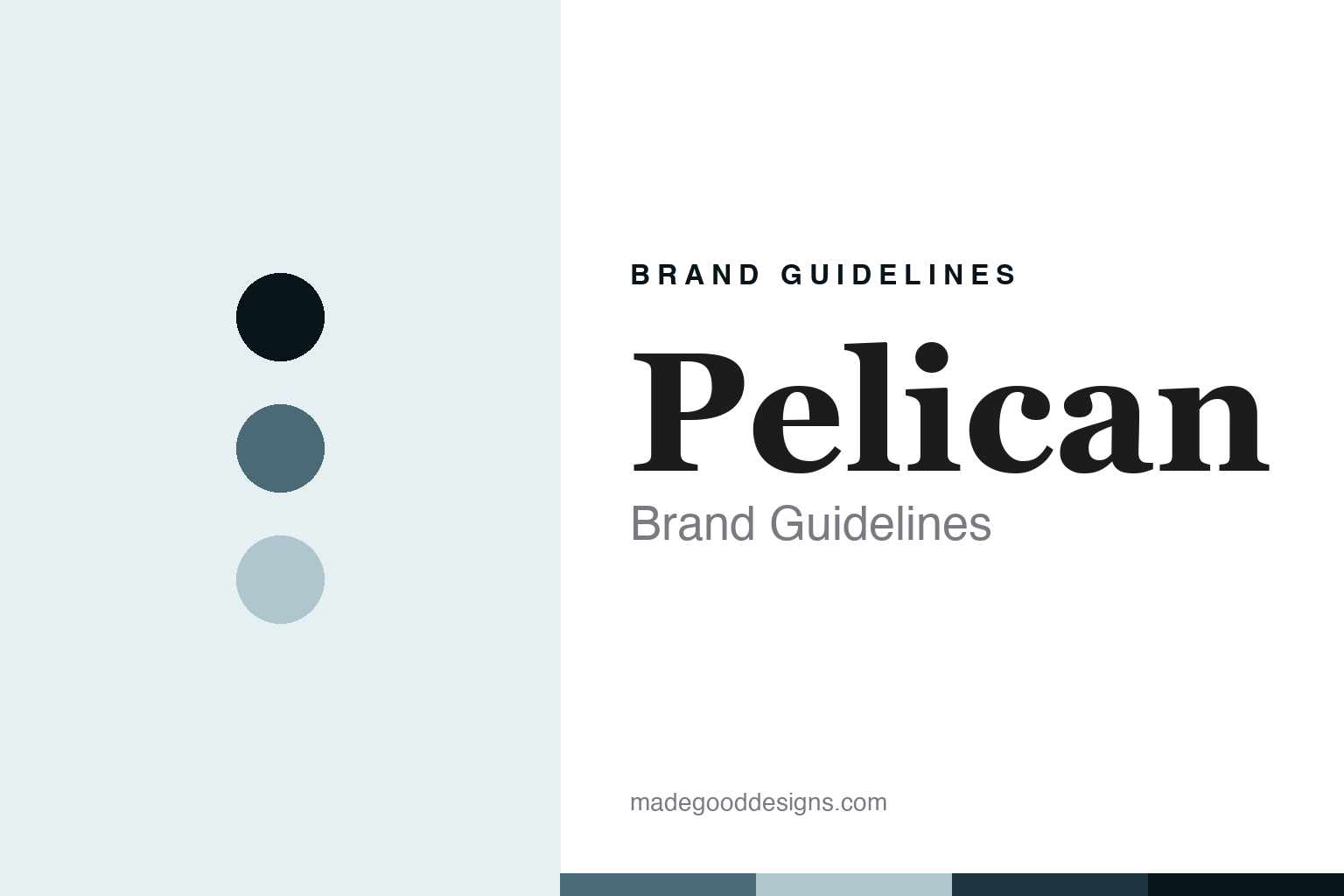
Pelican Brand Guidelines
The watertight-case house, PE-owned.
Aa
Two constants: a pro-slate palette and a pro-case-serif register. Abstract homage — not a Pelican product or mark; no cooler or case silhouette, gasket, latch or logo is reproduced.
The watertight-case house, PE-owned
Pelican is Pelican Products, the 1976 California watertight-case house whose Elite coolers sit under private equity.
Pelican brings the round its case house — Pelican Products, the California company, founded in 1976, famous for gasketed watertight moulded cases, whose consumer division makes the Pelican Elite rotomoulded hard coolers alongside wheeled and soft coolers, and which today sits under a private-equity owner. Pelican makes protective cases first and coolers among them, and its answer to a round about the cooler format is engineering — a rotomoulded cooler from a maker whose whole reputation is a watertight seal. A brand, sealed.
Its identity is the watertight-case house, PE-owned. The case engineering, the Elite coolers and the private-equity owner are the story here — and a name that must not be confused. A brand, sealed. The watertight-case house, PE-owned.
(Honest notes, so the story stays precise, and the two Pelicans stay separate. This Pelican is Pelican Products, at pelican.com, of Torrance, California, founded in 1976 by David and Arline Parker, known for gasketed watertight cases, whose consumer division makes the Pelican Elite hard coolers, and we report its performance language as the brand’s own marketing. It is a separate, unrelated company from Pelican International, the Canadian kayak and budget-cooler maker of Laval, Québec — the “pelican” of an earlier paddlesports round — and we do not conflate them. On where it is made, the star theme of this round, the origin of the Elite cooler models specifically we could not verify; Pelican runs a Torrance plant and has marketed rotomoulded coolers as US-made, but we could not confirm the Elite models today, so we do not assert a blanket American claim. On who owns it, a theme of this round, it was acquired by the private-equity firm Platinum Equity in 2021. Its designs — the gasket, the press-and-pull latch and the case form — are IP we describe but do not reproduce; there is no official brand hex; these tones are an unofficial interpretation.)
Colour
Pelican lives in a pro slate. Click a swatch to copy the hex.
Pelican’s identity is sealed, pro and owned — a pro slate, an ink, a pale steel, a deep petrol, and a paper. The palette leans pro slate and pale steel: a technical, professional register that nods to a watertight case and a rugged cooler rather than a loud logo colour. It signals a case house. The honest caveat: with no published brand hex, these values are an original, unofficial interpretation, not first-party colours.
The lesson is a pro slate signals a sealed, pro identity. Pelican’s world is a moulded, engineered object. For designers, it is a reminder that a pro slate and a soft pale steel can carry a cooler brand — the tone of professional gear. Because these tones can fail as small text, keep type dark and let the colour live in the accents, palette and band. The takeaways: seal the case; keep the two Pelicans separate; name the private-equity owner; and treat any single hex as unofficial.
Typography
The register is a pro-case serif — sealed, editorial, engineered.
Pelican’s identity carries a sealed, editorial, engineered spirit — a case house, not a graphics label. A pro-case serif captures the mood: refined, precise and confident, the register of professional gear. Set in a pro-slate palette, the pro-case serif feels sealed and engineered — exactly the personality Pelican carries. It is a moulded object rather than a logo, mirroring a gasket and rotomoulded polyethylene. (Pelican’s real cases and coolers are things we describe but do not reproduce — not the gasket, not the latch — and the exact typeface is not ours to use.) Because it is not ours to use, the honest description is “a pro-case-serif house,” shown here in a stand-in. The type behaves like the brand: sealed, editorial and engineered.
Aa
A pro-case-serif house — sealed and engineered. (Specimen set in Cormorant Garamond, a pro-case-serif STAND-IN; NOT the Pelican logo, gasket, latch or any cooler.)
The cooler
Pelican stands for the watertight-case house, PE-owned.
Pelican brings the round its case house. A pro-slate palette, a pro-case serif and a 1976 founding make one thing — the watertight-case house, PE-owned — the whole identity: sealed, pro and owned. The case engineering is the pitch, and the private-equity owner is the story. The point is a rotomoulded cooler from a maker whose whole reputation is a watertight seal, under a private-equity owner, and under a name that must not be confused with another.
Put to work, the identity is engineering told straight, as ownership — with the two Pelicans kept separate and the owner named. A maker in this spirit would seal the case, keep the two Pelicans separate, and name the private-equity owner. A reader in this spirit would keep the facts right: this Pelican is Pelican Products, of Torrance, California, founded in 1976 by David and Arline Parker, famous for gasketed watertight cases, whose consumer division makes the Pelican Elite hard coolers; it is a separate, unrelated company from Pelican International, the Canadian kayak and budget-cooler maker of an earlier paddlesports round; the origin of the Elite cooler models specifically is unverified, so no blanket US claim is made; and it was acquired by Platinum Equity, a private-equity firm, in 2021. Pelican brings the round its private-equity ownership case and its disambiguation story, and sits on the do-not-assert side of the where-made thread. The honest editorial moves are to date it to 1976, to credit the Parkers, to separate the two Pelicans plainly, to decline a where-made claim for the Elite models, and to name the Platinum Equity ownership.
For designers and brand-builders, Pelican continues the cooler format: seal the case — and keep the two Pelicans separate. The lessons: let case engineering carry a cooler; separate two same-named, unrelated companies plainly so a reader is never misled; decline a where-made claim you cannot verify even when a domestic plant exists; name a private-equity owner; and never reproduce a case, a gasket, a latch or a cooler. It is also a reminder to stay precise: Pelican is Pelican Products, the 1976 California watertight-case house whose Elite coolers sit under private equity — with the palette here an unofficial interpretation. Read that way, Pelican is less a cooler than a seal: engineered, Californian, private-equity-owned. The lesson for a brand is that engineering and honest disambiguation reinforce each other, and keeping the two Pelicans apart keeps the story earned. Pelican made the-watertight-case-house the identity — proof that a case house can carry a cooler, and the round’s clearest disambiguation.
Explore & save
Keep Pelican’s identity on hand — save it to a board in the Made Good inspiration library.
Pelican identity set
Pin the pro-slate palette and the pro-case-serif register to your own board.