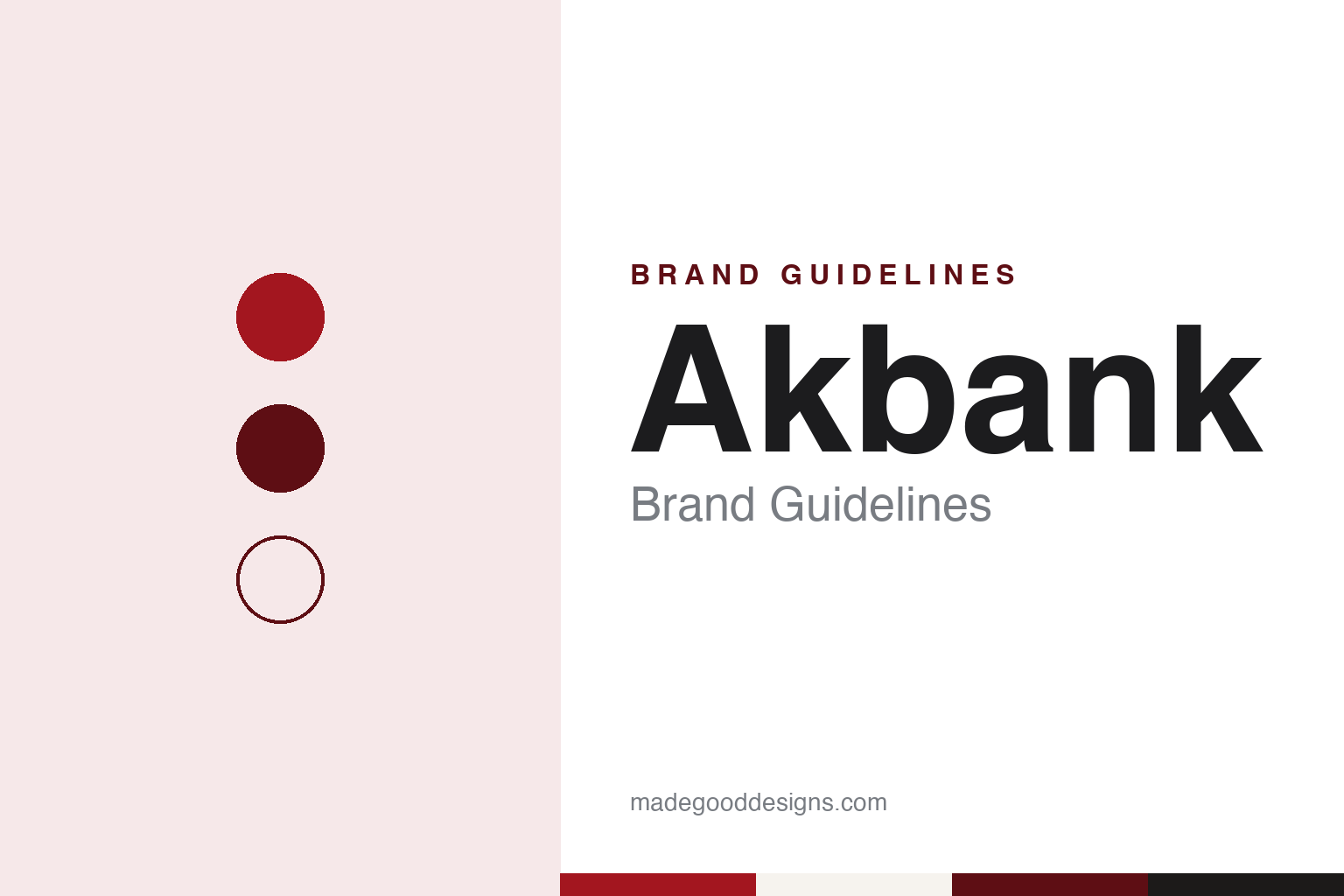
Akbank Brand Guidelines
The Adana cotton bank that took its name from two cities.
Aa
Two constants: a red, claret and cotton-white palette and a bold sans register. Abstract homage — not an Akbank product or mark; no logo, card or app screen is reproduced.
Adana-Kayseri Bankası
A cotton bank named after two cities.
Akbank began in Adana, the cotton city of southern Turkey. The bank dates its founding to 30 January 1948 and describes itself as a privately owned commercial bank from the start; Turkish Wikipedia gives an earlier date, 12 April 1947, for the bank’s start under its first name. Both English and Turkish Wikipedia say it was set up to finance the cotton producers of the Çukurova plain.
The name came from geography. Most of the founders were businessmen from Kayseri living in Adana, so the bank was called Adana-Kayseri Bankası, soon shortened to its initials, AK, and then to Akbank, English Wikipedia says. Turkish Wikipedia adds that the name was also chosen because it evoked the region’s cotton; ak is the Turkish word for white.
The founding group, as listed by both Wikipedias, was Hacı Ömer Sabancı, the industrialist brothers Ahmet and Bekir Sapmaz, and the four owners of the Adana textile company Milli Mensucat: Nuh Naci Yazgan, Nuri Has, Mustafa Özgür and Seyit Tekin. English Wikipedia says this group held 80 percent, with the remaining fifth offered to investors in Adana and Istanbul.
The bank started with a single branch. It opened its first Istanbul branch in Sirkeci on 14 July 1950 and moved its head office to Istanbul in 1954, according to the bank and to English Wikipedia. The founders ran it until 1962, when the Sabancı family took control; English Wikipedia says Akbank automated all of its banking operations in 1963, and Turkish Wikipedia says its first office abroad was a representative office in Frankfurt. In 1983, the same source says, it opened Ak International Ltd., later renamed Sabancı Bank, which Turkish Wikipedia describes as the first Turkish private-sector bank set up abroad.
Colour
A gallery, a jazz festival and a children’s theatre.
For many people in Istanbul the Akbank name is attached as much to culture as to banking. Akbank Sanat, the bank’s arts centre in Beyoğlu, was founded in 1993 and turned towards contemporary art from 2003, Turkish Wikipedia says, with exhibitions, talks, film screenings and concerts, and a lithography and screen-printing workshop for artists.
The Akbank Jazz Festival is the most visible of these projects. Its 36th edition ran across Istanbul from 26 September to 11 October 2026, with 36 concerts and about 200 artists from more than 15 countries, organised by Akbank Sanat with the producer BKM, Euronews reported in its Turkish edition on 2 September 2026. Turkish Wikipedia also lists the Akbank Children’s Theatre, the Akbank Short Film Festival, held since 2004, and the bank’s support for the Istanbul Film Festival since the same year.
The banking side is broad. The bank says it covers corporate and investment banking, commercial and small-business banking, retail and private banking, payment systems and treasury, and acts as an insurance agent for Aksigorta and AgeSA. Its group includes AKLease, AKYatırım, Ak Portföy and AKÖde, plus Akbank AG in Germany and Akbank Ventures. Turkish Wikipedia says AKÖde has offered financial services under the Tosla brand since 2019.
Digital work is a large part of how the bank presents itself. It says it set up Akbank LAB in 2016 to bring new technology and business models into the bank. In April 2025 it redesigned the “Senin İçin” (“For You”) menu of Akbank Mobil, grouping services under headings for spending, car, home and travel, according to a bank statement carried by Anadolu Ajansı on 22 April 2025. On brand value, English Wikipedia says Brand Finance’s Banking 500 report of 2018 named Akbank the most valuable banking brand in Turkey for the seventh year in a row.
Typography
Design and documentation.
Turkish banks tend to present themselves through bold, simple wordmarks and one dominant colour. Across the country’s large lenders the palettes run through greens, reds, blues and purples, and the names keep their Turkish letters — the dotted capital İ, the ş, the ı and the ğ — on logos, apps and branch signs, so a typeface that handles those diacritics cleanly belongs in any design brief for the sector.
Advertising is a large part of how these brands are known at home. Mascots, recurring characters and campaigns led by well-known actors and athletes appear across the sector, alongside photography of branches, city streets and Istanbul itself. On their websites the banks arrange themselves around everyday tasks: accounts, loans, credit cards and loyalty programmes, and mobile apps that sit at the front of most pages.
Sponsorship and culture extend the identity. Turkish banks sponsor football, concerts and festivals, and some run publishers, galleries, museums or art collections under their own names; İşbank’s publishing house and painting collection, and the SALT institution that grew out of Garanti BBVA’s Ottoman Bank archive, are two documented examples covered in this series.
The banks also publish a great deal of formal material. Listed lenders produce annual and integrated reports, sustainability reports and investor presentations in Turkish and English. This series sets out what can be checked about each bank — when and where it was founded, who owns it and how its name has changed — and marks clearly what rests only on a bank’s own word.
Aa
A bold sans for a short, two-letter name. (Specimen set in Rubik, a sans STAND-IN; NOT the Akbank logo.)
Akbank
A family-led bank listed in Istanbul.
Akbank is listed on Borsa İstanbul, and English Wikipedia says its largest shareholders are members of the Sabancı family. The bank says public offerings in 1990 and 1998 also brought its shares to international markets as American Depositary Receipts.
For eight years it had a large American partner. English Wikipedia says Citigroup completed the purchase of a 20 percent stake in Akbank on 9 January 2007. In May 2012 Citigroup sold about 10.1 percent of Akbank’s shares to the market, leaving it with about 9.9 percent as it prepared for the Basel III capital rules, Bloomberg HT reported on 25 May 2012; English Wikipedia says Citi announced in March 2015 that it was selling the rest.
The bank says it works through its head office in Istanbul, at the Sabancı Center, and 19 regional directorates, with 679 branches at home and abroad and close to 13,000 employees, and it presents itself around digital banking, sustainable finance and culture. It says it is a member of the Net Zero Banking Alliance, with a goal of becoming a net-zero bank by 2050. In 2023 it marked its 75th anniversary with a gala in Istanbul, according to a bank statement reported on 21 September 2023.
For a design guide, Akbank shows how a short name built from two place names can carry a bank through decades of change. Compare Yapı Kredi, another Istanbul bank tied to a family business group, and Garanti BBVA. For this guide we use a deep red, a claret and a cotton white with a sans, an unofficial interpretation; no product or logo is reproduced.
Explore & save
Keep Akbank’s identity on hand — save it to a board in the Made Good inspiration library.
Akbank identity set
Pin the Akbank red, claret and cotton-white palette and the bold sans register to your own board.