MCB Bank Brand Guidelines
A 1947 bank that shortened its name and moved its head office to Lahore.
Aa
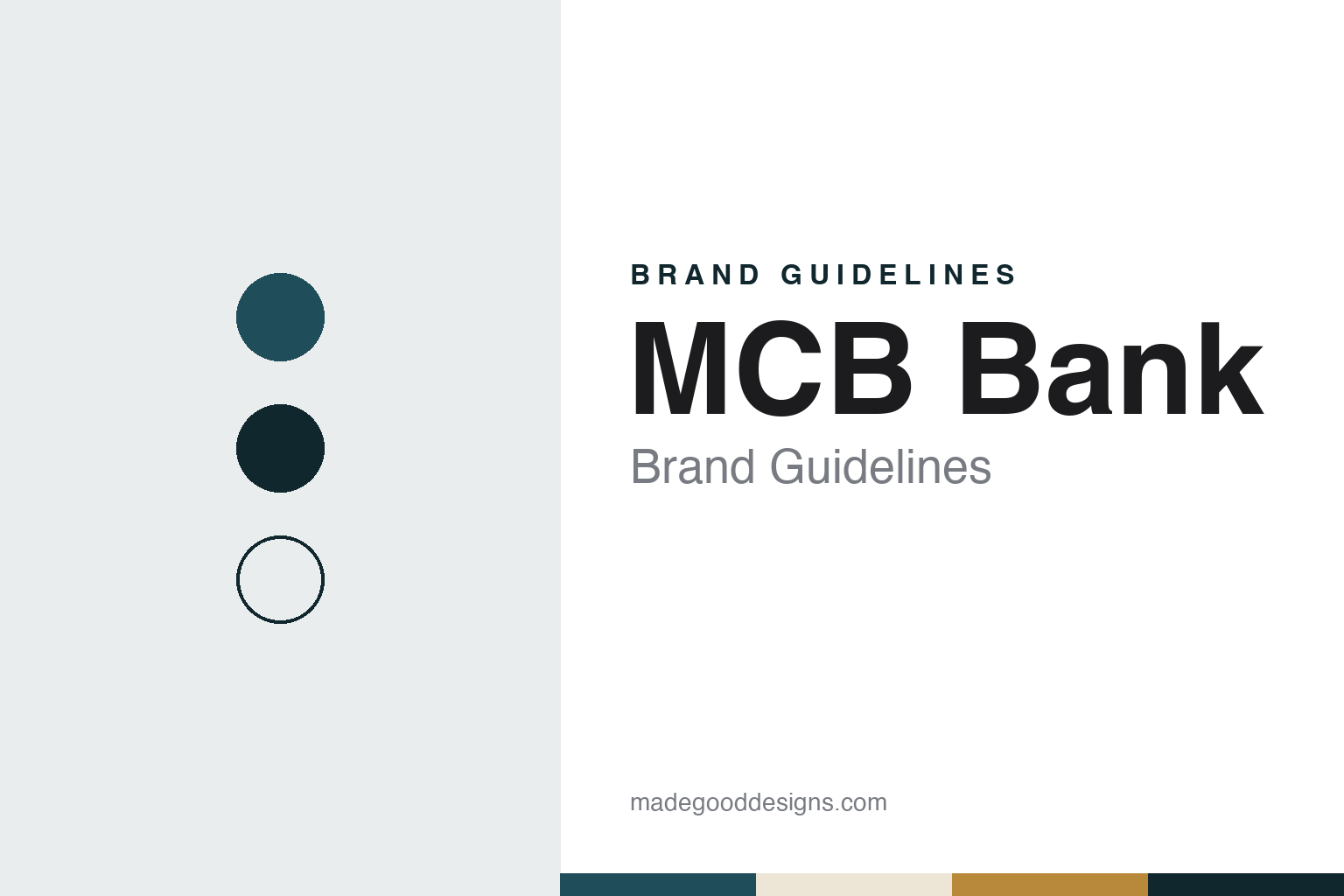
Two constants: a teal, cream and gold palette and a bookish serif register. Abstract homage — not an MCB Bank asset; no logo, card or branch sign is reproduced.
Muslim Commercial Bank
Incorporated in July 1947.
MCB Bank began as Muslim Commercial Bank. English Wikipedia says it was incorporated in July 1947, shortly before partition, and names its founders as Adamjee Haji Dawood and M. A. Ispahani. They were joined on the board by directors from several commercial and industrial families, among them the Ispahani, Adamjee, Dada, Arag and Amin Jute families. English Wikipedia’s article on Adamjee Haji Dawood describes him as an industrialist with match and jute businesses in Rangoon and Calcutta, and says he set up the bank together with Mirza Ahmad Ispahani, whose own article places him in his family’s business in Calcutta.
The bank’s early decades were shaped by those families. In 1964, English Wikipedia says, MCB became part of the Adamjee Group. Ten years later, in 1974, the government of Pakistan nationalised it, and its shares were delisted from the Karachi Stock Exchange after the state took ownership. For the next seventeen years it operated as a state-owned bank.
MCB’s headquarters for much of that time was MCB Tower in Karachi, a building of 29 floors and three basements, according to English Wikipedia. In 2008 the head office moved to Lahore, to a newly built building on Jail Road. Pakistan Stock Exchange records today list the registered office in Lahore and describe the company as a banking company incorporated in Pakistan and engaged in commercial banking and related services.
Colour
From 1991 to the MCB Bank name.
Privatisation began in 1991. On 6 April 1991, English Wikipedia says, the government sold 26 per cent of its shares to the National Group under an “as is where is” arrangement. A public offering of a further 25 per cent followed on 19 February 1992, after which the bank was no longer governed by the 1974 nationalisation law, and on 31 December 1992 the National Group raised its holding to 50 per cent. English Wikipedia now describes the bank as majority owned by a group of companies affiliated with the Nishat Group and by the Malaysian bank Maybank, which agreed in 2008 to buy a stake of about 20 per cent from the Nishat Group.
The name changed in 2005, when the bank shortened Muslim Commercial Bank Limited to MCB Bank Limited. English Wikipedia links the change to the bank’s plans for international markets.
Islamic banking became a second line of business. English Wikipedia says MCB set up an Islamic Banking Business Group in 2000 and opened its first Islamic branch in 2003; by 2014 it had 34 Islamic branches alongside a much larger conventional network. In 2015 it created a separate, wholly owned subsidiary, MCB Islamic Bank. The subsidiary says that, under an order of the Lahore High Court dated 20 April 2018, it took over 90 branches from MCB and converted them into Islamic banking branches over a weekend in June 2018. MCB Islamic Bank now markets its own range under separate names, including a mobile app called SUBUK, a car-finance product called MICAR and a housing-finance product called Rihayesh Finance.
English Wikipedia lists further subsidiaries, including MCB Investment Management, MCB Exchange Company and a non-bank credit organisation, and records that MNET Services, a payments company, was amalgamated into the bank on 30 April 2019.
Typography
How the category presents itself.
Banks in Pakistan, Bangladesh and Sri Lanka present themselves to customers who may read in more than one script. A bank’s name can appear in English on one line and in Urdu, Bengali or Sinhala on another, on branch signs, cards, forms and apps. Short initials such as HBL or MCB travel well across those scripts, and several of the banks in this group have turned long founding names into letters that work on a cash machine, a cricket broadcast or a phone screen.
Colour does a lot of the work. Green, red and blue wordmarks are common across the region’s banking signage, and each colour has to hold up in strong sunlight on a shopfront, at small sizes in a mobile app and in print on a passbook or statement. The palettes in these guides are our own interpretations, chosen to show how a dark accent and a pale ground can carry a name in all of those places.
The product range shapes the website as much as the logo does. Islamic-banking and conventional ranges often sit side by side: MCB Bank, for example, runs its Islamic business through a separate subsidiary, MCB Islamic Bank, with its own product names and its own app. Pages on savings accounts, remittances from workers abroad, mobile wallets and lending to small and medium-sized businesses appear next to branch-locator maps and photographs of branch interiors and staff.
Formal documents complete the picture. Listed banks publish annual reports, and some also issue sustainability reports, with the same typefaces, colours and photography carried into long financial tables. For a designer, the useful lesson from this category is consistency across scripts, channels and formats, from a stadium board to a page of notes to the accounts.
Aa
A bookish serif for an old commercial name. (Specimen set in Lora, a serif STAND-IN; NOT the MCB Bank logo.)
MCB Bank
Seventy-two years in one campaign.
MCB’s advertising leans on longevity. Branding in Asia reported in April 2019 on a corporate campaign created by the agency Orientm McCann, which ran from 21 to 31 March 2019 on television, in print, outdoors, on radio and online, with support inside branches. The agency’s creative chief described the work as celebrating how the bank had grown over 72 years with the people of Pakistan, and the bank’s head of advertising told the magazine that corporate image building, showing strength and stability, was the approach he had found most effective over eight years in the role. The campaign spoke to both corporate and consumer customers rather than selling a single product. He also named television as the most effective medium for creating a personality for the bank in customers’ minds, while the agency’s account team said it would judge the work less by media numbers than by how well it kept existing customers and won new ones through referrals.
The group now presents two banks under the same letters: MCB Bank, with its conventional range, and MCB Islamic Bank, which describes its products as Shariah-compliant and sells them under their own names through its own branches and app. MCB Islamic Bank’s website dates its copyright from 2015, the year the subsidiary was set up.
For a design guide, MCB Bank shows how a bank can turn an old descriptive name into initials, keep the initials as its legal name, and use the same letters to tie a conventional bank to an Islamic subsidiary. Compare HBL, another Pakistani bank nationalised in 1974 and later privatised, and Allied Bank, also based in Lahore. For this guide we use a petrol teal, a ledger cream and an old gold with a serif, an unofficial interpretation; no product or logo is reproduced.
Explore & save
Keep MCB Bank’s identity on hand — save it to a board in the Made Good inspiration library.
MCB Bank identity set
Pin the MCB Bank teal, cream and gold palette and the bookish serif register to your own board.