Meezan Bank Brand Guidelines
A 1997 investment bank turned Pakistan’s Islamic lender.
Aa
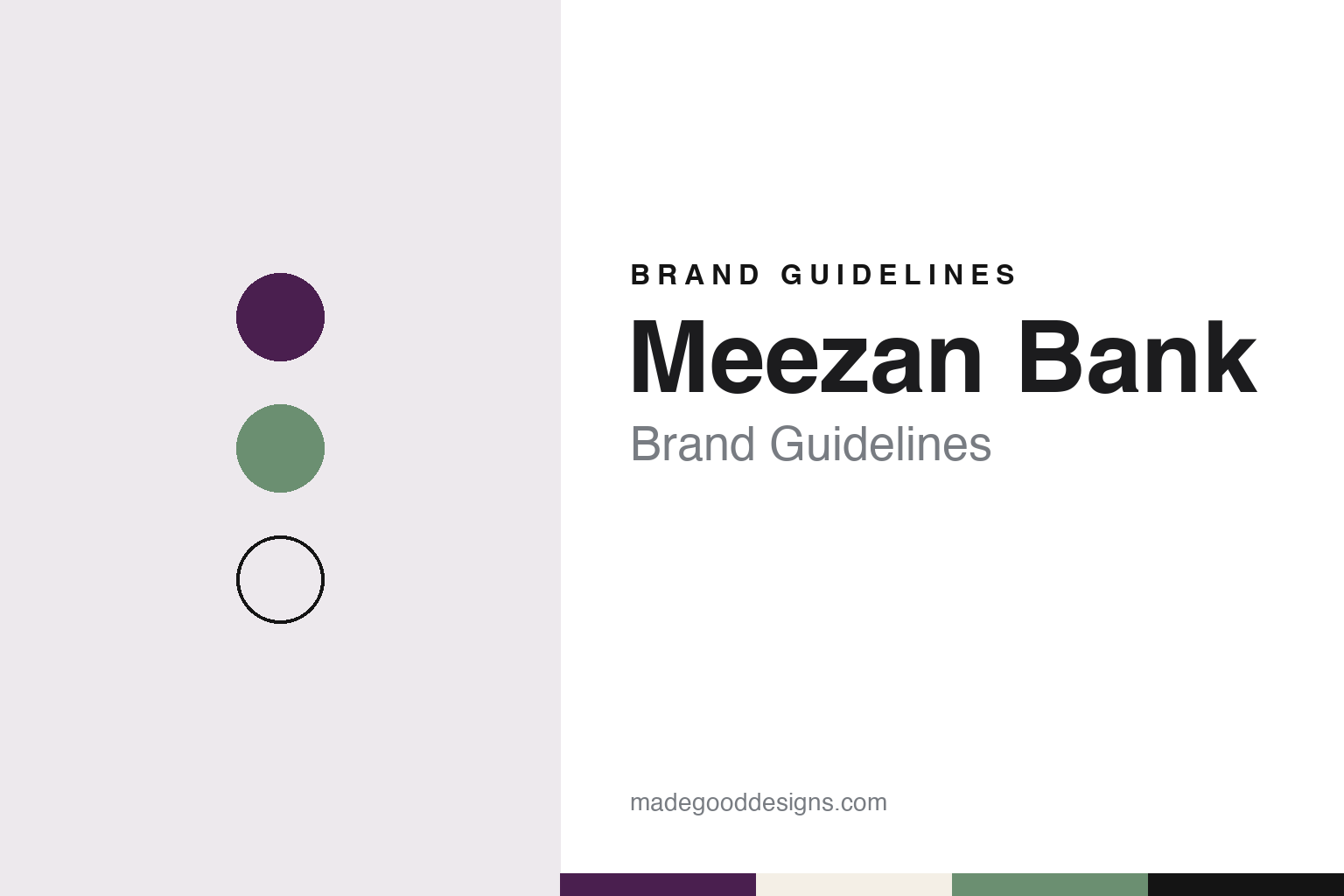
Two constants: a deep plum, ivory and sage palette and a calm serif register. Abstract homage — not a Meezan Bank product or mark; no logo, card or signage is reproduced.
Al-Meezan
An investment bank with an Islamic mandate.
Meezan Bank began in Karachi in 1997 as Al-Meezan Investment Bank. English Wikipedia names its founding shareholders as Noor Financial, the Pak Kuwait Investment Company and the Islamic Development Bank, and the bank’s own timeline says it was set up “with a mandate to pursue Islamic Banking,” launching riba-free certificates of investment, a savings instrument that pays no interest. Its shares were listed on the Karachi Stock Exchange in 2000, according to Wikipedia.
The turn came in 2002. That year the bank bought the Pakistan operations of the French bank Société Générale and converted itself into a full Islamic commercial bank. The company says it was issued the first Islamic commercial banking licence by the State Bank of Pakistan, the country’s central bank, and took the name Meezan Bank at the same time.
Its early years were not easy. Wikipedia says the bank at first struggled to win acceptance, because Islamic banking was unfamiliar in Pakistan and because it scrutinised loans more strictly than its rivals. It drew deposits from religious savers and turned to lending to small and medium-sized businesses, including firms that had kept away from banks for religious reasons.
The ownership has stayed recognisable. As of 30 June 2026, Wikipedia gives Noor Financial Investment Company about 35 percent, the Pak Kuwait Investment Company about 30 percent and the Islamic Development Bank about 9 percent, with the rest held by other shareholders. Wikipedia also records that a 2013 attempt by Noor Financial to sell its whole stake to a buyer based in the British Virgin Islands was blocked by the State Bank of Pakistan, and that it later sold shares in tranches in 2018 and 2019.
Colour
Car Ijarah, Easy Home and a Shariah board.
Meezan built its range by giving Islamic-finance structures plain retail names. The bank’s timeline lists Car Ijarah, a lease-based car finance scheme launched in 2002 that it calls Pakistan’s first riba-free car financing; Easy Home, a Shariah-compliant housing finance scheme from 2003; and Meezan Islamic Fund, launched the same year by its asset-management arm, Al Meezan Investment Management, which the company describes as the country’s first open-end Islamic mutual fund. Later came Meezan Labbaik, a product for Hajj and Umrah travel, in 2009, and Meezan Business Plus, a mudaraba-based account for businesses, in 2010.
Product decisions sit with a Shariah board. The bank’s website names its chairman as Justice (Retd.) Muhammad Taqi Usmani, a scholar who also holds advisory roles at other Islamic financial institutions, and describes the board’s members as internationally known scholars. In 2005, the company says, it signed a memorandum of understanding with Pak-Kuwait Takaful Company, which it presents as the start of takaful, the Islamic form of insurance, in Pakistan.
The network grew in steps the bank records year by year: 100 branches in 31 cities in 2007, 275 in 83 cities in 2011, and more than 600 in 159 cities by 2017. Its corporate profile now gives more than 1,000 branches in over 300 cities. Two acquisitions added to that base. In May 2014 Meezan agreed to buy the Pakistan operations of HSBC Bank Middle East, including ten branches and access to corporate clients, and a year later it took over the single Pakistan branch of HSBC Oman, according to Wikipedia.
Typography
Banks of Pakistan, Bangladesh and Sri Lanka.
Banks in Pakistan, Bangladesh and Sri Lanka present themselves to customers who may read in more than one script. A bank’s name can appear in English on one line and in Urdu, Bengali or Sinhala on another, on branch signs, cards, forms and apps. Short initials such as HBL or MCB travel well across those scripts, and several of the banks in this group have turned long founding names into letters that work on a cash machine, a cricket broadcast or a phone screen.
Colour does a lot of the work. Green, red and blue wordmarks are common across the region’s banking signage, and each colour has to hold up in strong sunlight on a shopfront, at small sizes in a mobile app and in print on a passbook or statement. The palettes in these guides are our own interpretations, chosen to show how a dark accent and a pale ground can carry a name in all of those places.
The product range shapes the website as much as the logo does. Islamic-banking and conventional ranges often sit side by side: MCB Bank, for example, runs its Islamic business through a separate subsidiary, MCB Islamic Bank, with its own product names and its own app. Pages on savings accounts, remittances from workers abroad, mobile wallets and lending to small and medium-sized businesses appear next to branch-locator maps and photographs of branch interiors and staff.
Formal documents complete the picture. Listed banks publish annual reports, and some also issue sustainability reports, with the same typefaces, colours and photography carried into long financial tables. For a designer, the useful lesson from this category is consistency across scripts, channels and formats, from a stadium board to a page of notes to the accounts.
Aa
A calm serif for a bank that explains its products in plain words. (Specimen set in Lora, a serif STAND-IN; NOT the Meezan Bank logo.)
Meezan Bank
Islamic banking, measured by deposit share.
Meezan’s standing is usually measured in deposits. English Wikipedia calls it Pakistan’s largest Islamic bank. In September 2026 the business magazine Profit, published by Pakistan Today, reported that Meezan held about 29.6 percent of all Islamic banking deposits in the country at the end of June 2026, more than twice the share of its next rival, down from 32.9 percent in 2023 after three years of small losses. The magazine named UBL’s Islamic arm, UBL Ameen, as the fastest-growing competitor, and noted that Faysal Bank had converted its whole business to Islamic banking.
The company presents itself in confident terms: its website describes Meezan as the first and largest Islamic bank in Pakistan and states a vision of making Islamic banking “banking of first choice.” Those are the company’s own claims. Its credit ratings were upgraded to AAA by VIS Credit Rating Company in 2021, the bank says. Behind the counter it runs the Temenos T24 core banking system, which Wikipedia says it upgraded in 2017, and its timeline records internet banking from 2006 and a mobile banking app from 2014.
The bank also works with the state on Islamic debt. In 2004, its timeline says, Meezan acted as Shariah structuring adviser for the Government of Pakistan’s debut international sukuk, a bond built to comply with Islamic rules, and in 2017 it served as joint financial adviser to the Ministry of Finance on a government ijarah sukuk. In 2012, the bank says, it marked ten years of riba-free banking and began opening premium banking centres.
For a design guide, Meezan Bank shows how an Islamic bank can present religious-finance terms such as ijarah, mudaraba and takaful as everyday retail products with short English names. Compare UBL, a conventional bank that runs its own Islamic arm, and HSBC, whose Pakistan branches Meezan took over in 2014. For this guide we use a deep plum, warm ivory and a muted sage with a serif, an unofficial interpretation; no product or logo is reproduced.
Explore & save
Keep Meezan Bank’s identity on hand — save it to a board in the Made Good inspiration library.
Meezan Bank identity set
Pin the deep plum, ivory and sage palette and the calm serif register to your own board.