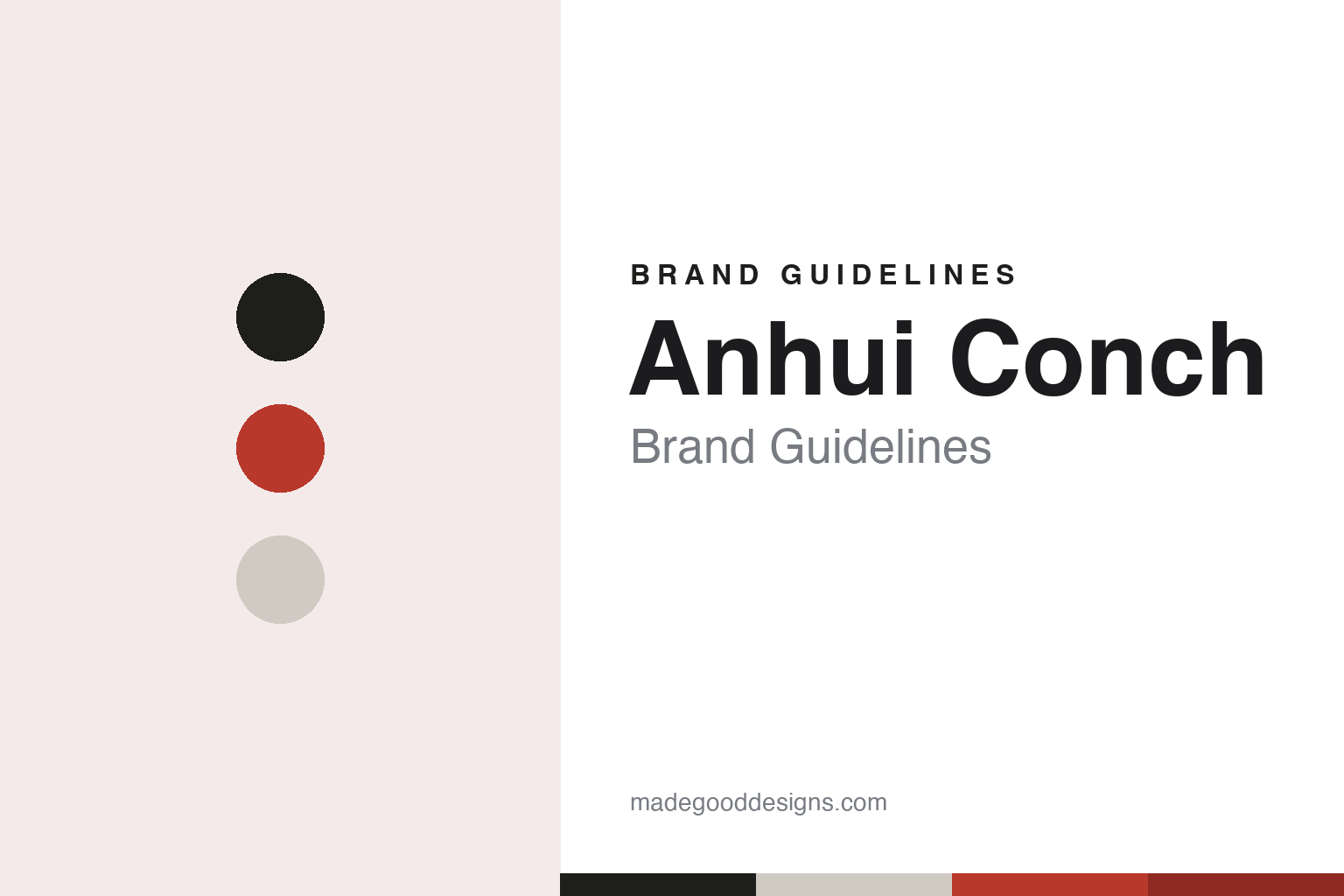
Anhui Conch Brand Guidelines
The Wuhu cement maker whose bold black wordmark is split by a red bar.
Aa
Two constants: a wordmark black, kiln red and clinker grey palette and a Bold sans register. Abstract homage — not an Anhui Conch product or mark; no bag, logo or wordmark is reproduced.
Wuhu, 1997
A provincial cement maker that listed in Hong Kong first.
Anhui Conch Cement — in Chinese Hailuo, “conch” — is based in Wuhu, in Anhui province. The company says it was founded on 1 September 1997. Its H shares were listed on the Hong Kong Stock Exchange on 21 October 1997, and the company describes itself as the first company in China’s cement industry to list overseas. Its A shares followed on the Shanghai Stock Exchange on 7 February 2002, English Wikipedia records; Chinese Wikipedia gives its stock codes as 914 in Hong Kong and 600585 in Shanghai.
English Wikipedia’s article on Wuhu places the company’s headquarters in the Wuhu Economic and Technological Development Area, a state-level zone launched in 1993 in the north of the city, alongside the carmaker Chery. Cement is listed there among the city’s major industrial products, with cars, plate glass, steel and copper.
The company is state-linked. English Wikipedia names Anhui Conch Holdings as its largest shareholder, owned by the Anhui Provincial People’s Government through Anhui Provincial Investment Group Holdings, and says a second shareholder, Conch Venture Investment, is owned by trade unions and other private shareholders. Chinese Wikipedia says China Conch Venture Holdings, listed separately in Hong Kong, holds about 18 percent of the cement company and 15.7 percent of the A-share-listed Wuhu Conch Profiles. English Wikipedia describes Anhui Conch as the largest cement maker and seller in mainland China.
Colour
Clinker, cement and a long list of projects.
By its own account, the company has grown into a group of more than 470 subsidiaries, including its new-energy business and Conch Environment, spread across 25 Chinese provinces, municipalities and autonomous regions and five other countries: Indonesia, Myanmar, Laos, Cambodia and Uzbekistan. It gives its workforce as 48,100 people, and lists businesses from cement and plastic products to equipment, logistics, construction installation, international trade, refractories, green energy and environmental services.
Its core products, the company says, are Conch-brand high-grade cement and commercial clinker, made on new dry-process kiln lines with limestone from its own quarries in East and South China, and managed under the ISO 9001 quality system. It says the CONCH trademark has been recognised by China’s national trademark office as a well-known mark. It also names special cements in its range: sulphate-resisting cement, moderate- and low-heat cement and road cement.
The company lists the projects that have used its cement: the Beijing–Shanghai high-speed railway, the Hangzhou Bay Bridge, Shanghai’s Oriental Pearl Tower, the track beams of the Shanghai maglev line and Pudong International Airport. It says its products are exported to more than 20 countries and regions across the Americas, Europe, Africa and Asia. These are the company’s own claims.
One overseas plant appears in the local press. On 30 October 2026, KlikPapua reported that officials of the Manokwari regency and a deputy of Indonesia’s national defence council visited the PT Conch West Papua Cement plant at Manokwari, in West Papua, to review its operations. At home it has also bought and sold plants: in October 2015 it bought the cement assets of Anhui Chaodong Cement, and in November 2015 it sold four cement companies in Shaanxi to West China Cement, Chinese Wikipedia says.
Typography
Design and documentation.
Cement is sold in bags by the million, so the makers in this guide mostly present themselves through plain, solid wordmarks that have to read on a sack, a lorry, a silo and a dealer’s signboard. Their palettes tend towards greys, reds and greens, often with one strong colour that can be spotted across a building site. Imagery leans on the industry itself: quarries, kilns, grinding units, bulk terminals and finished buildings, more than people or lifestyle scenes.
Their websites are usually split by audience. Pages for individual home builders sit beside pages for engineers, contractors and infrastructure buyers, and products are often listed by cement type — ordinary Portland, Portland pozzolana, slag and composite cements — and by strength class or intended use, alongside ready-mix concrete and building products such as plasters, waterproofing and tile adhesives. Several makers add home-building guides, how-to videos, store locators and calculators for estimating materials.
Sustainability has become a standard section. Many cement groups publish sustainability reports and pages on lower-carbon or blended cements, alternative fuels, waste-heat recovery and water use; this guide reports such material only as the companies or dated sources state it, and makes no claims of its own about emissions or performance. Investor pages, annual reports and capacity figures in million tonnes a year sit close by, because many of these makers are listed companies that grew through acquisitions.
Community and safety programmes complete the picture, from local schools and water projects near plants to training for masons and contractors. For a design reader, the interest lies in how heavy, commodity products are given a recognisable face: a name on a bag, a colour on a truck, and a tone of voice that speaks both to a family building one house and to a highway contractor.
Aa
A bold sans — heavy black capitals. (Specimen set in IBM Plex Sans, a sans STAND-IN; NOT the Anhui Conch logo.)
CONCH
Black letters and a red parallelogram.
Anhui Conch explains its own logo. On its corporate-culture page, the company describes the Conch Group mark as derived from the English word CONCH, set in thick black heiti letters — the Chinese term for a bold sans — meant to express strength, rigour and steadiness. At its centre is a red parallelogram, which the company says stands for the group’s eager pursuit of the future and its internal vitality; the parallelogram projects above and below the frame of the letters, which it reads as seeking breakthroughs and opening new space.
Its words are as formal as its mark. The company gives its mission as “to create a better living space for humanity,” its vision as becoming “a world-class materials group,” and its business motto as “highest quality, sincerest service.” Its English website opens with the line “The World Looks to China, China Looks to Conch,” an English version of a saying the company quotes in Chinese. Among its recent news items, it reported support for the Pinglu Canal project in September 2026.
Its naming needs care. The company’s information page gives its legal English name as Anhui Conch Cement Company Limited, its registered and office address as Wuhu and its English abbreviation as ACC — the same three letters as ACC, the unrelated Indian cement maker in the Adani Group. Its Chinese short name, Hailuo Shuini, simply means Conch Cement. Its website, at conch.cn, sorts its corporate culture into four pages — corporate image, values, “Impressions of Conch” and “Voice of Conch” — and its footer points readers to the company’s official WeChat account and video channel.
The palette here — black, two reds and a clinker grey — is our own interpretation, chosen to echo the company’s description of black letters and a red bar, not copied from any file.
For a design guide, Anhui Conch shows how a single geometric accent can carry a heavy industrial wordmark. Compare SCG, another large Asian cement group, and Heidelberg Materials, another large cement group. For this guide we use black, a kiln red and a clinker grey with a sans, an unofficial interpretation; no product or logo is reproduced.
Explore & save
Keep Anhui Conch’s identity on hand — save it to a board in the Made Good inspiration library.
Anhui Conch identity set
Pin the Anhui Conch wordmark black, kiln red and clinker grey palette and the Bold sans register to your own board.


