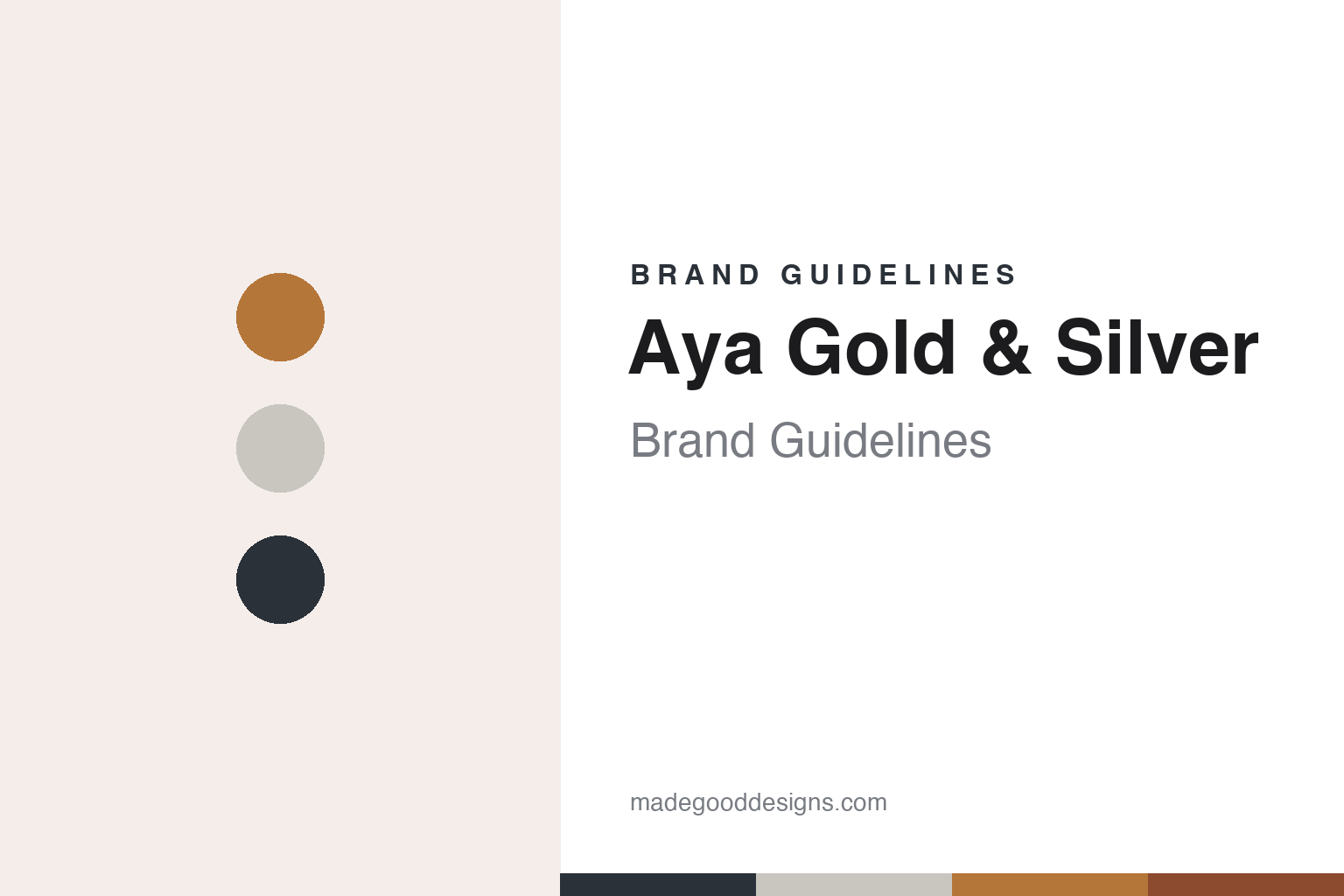
Aya Gold & Silver Brand Guidelines
A Quebec explorer that found its silver in the Anti-Atlas.
Aa
Two constants: an ochre, silver and slate palette and a geometric sans register. Abstract homage — not an Aya Gold & Silver product or mark; no logo, bar or mine image is reproduced.
Maya Gold and Silver
A Quebec explorer that turned to Morocco.
Aya Gold & Silver began as Maya Gold & Silver, a Quebec-based explorer. The Northern Miner reported in October 2011 that Maya had listed on the TSX Venture Exchange in mid-2008 as a gold explorer focused on Mexico, and that the Quebec geologist Rejean Gosselin, then its chairman, had been the main principal behind its founding. The company’s own timeline also dates its TSX Venture listing to 2008. In 2011 its president and chief executive was Guy Goulet, based in the Montreal area, and its move into Morocco was led by its chief operating officer, Noureddine Mokaddem, who had earlier worked in Moroccan mining, the same report said.
Morocco soon replaced Mexico. Maya optioned its first Moroccan property, the Amizmiz gold project, in early 2009, and by 2011 it had been pursuing several gold, silver and polymetallic projects in the country, The Northern Miner reported. The most important was Zgounder, a past-producing silver mine in the central Anti-Atlas mountains. Through an international tender submitted in March 2011, Maya agreed to buy an 85% interest from the state-owned Office National des Hydrocarbures et des Mines (ONHYM). Maya said the mine had produced silver from 1982 to 1990 and came with a processing plant kept on care and maintenance. Around the same time it picked up the past-producing Azegour mine, south of Amizmiz, and a claim just south of the Imiter silver mine.
Maya filed for a Zgounder mining permit in 2012 and bought 85% of the Boumadine polymetallic project in 2013, its timeline says. Processing began at Zgounder in July 2014 and the first silver pour followed in August 2014, NS Energy reported in 2022. In 2020, the company says, a new management team was appointed and the name changed to Aya Gold & Silver. Its website names Benoit La Salle as president and chief executive and gives its corporate office as Mont-Royal, Quebec.
Colour
A silver-only mine in the Anti-Atlas.
Zgounder lies in the province of Taroudant, about 260 km east of Agadir, according to NS Energy, which described it in 2022 as the second most important silver mine in Morocco after Imiter. The deposit has been explored since ancient times, the same report said, and the site is reached by road from Agadir through Taliouine to the village of Askaoun, a short gravel track from the mine. A flotation plant went into commercial production in January 2019. At that point the mine was still held through a joint venture, 85% through Aya’s subsidiary Zgounder Millennium Silver Mining and 15% by ONHYM. In September 2022, NS Energy reported, Aya agreed to buy ONHYM’s 15% stake together with five neighbouring permits; the company now lists Zgounder as 100% owned.
A feasibility study for an expansion to 2,700 tonnes a day was completed in February 2022, according to the same report. Aya says the expanded plant was declared in commercial production on 29 December 2024, and that 2025 was the mine’s first full year of commercial production, at 4.8 million ounces of silver. The company calls Zgounder “a rare silver-only mine”: it is worked by open pit and underground methods, and the silver is recovered by cyanide leaching and poured into doré bars that are refined abroad. Aya gives proven and probable reserves of 73 million ounces of silver and a mine plan running to 2036.
Two further Moroccan assets sit behind Zgounder. Boumadine, held 85% by Aya and 15% by ONHYM, is a gold, silver, zinc and lead project with open-pit and underground potential, on which the company says feasibility work is under way, following a preliminary economic assessment in 2025, with completion targeted for the end of 2027. Imiter Bis, a wholly owned exploration property about five kilometres south of the Imiter mine and 150 km from Ouarzazate, had more than 8,800 metres of drilling in 2021 and 2022 along a polymetallic vein system about 4 km long, the company says. On 5 November 2026 Aya announced an agreement to sell Azegour to Sama Resources; the sale had not completed at the time of writing.
Typography
Design and documentation.
Silver miners speak mainly to investors, governments and the communities around their mines, and their visual identities tend to follow from that audience. Palettes lean on metallic greys and silvers, often paired with a deep blue or slate, sometimes warmed by an earth tone drawn from rock or desert. Typography is usually a plain sans or a sober serif, set for long reports rather than for packaging, because there is no consumer product on a shelf to sell.
Photography carries much of the identity. Company websites and annual reports tend to show mills, headframes, haul roads and open pits set against mountain or desert landscapes, alongside portraits of workers in protective gear and views of nearby towns. Maps matter too: a miner’s portfolio is a set of places, and operation pages are commonly organised mine by mine and country by country, each with its location, ownership share, processing facilities and expected mine life.
Numbers form a second visual language. Mineral reserves and resources statements, quarterly production reports and guidance tables are published on fixed calendars, and their charts, tonnages and grades are repeated across press releases and investor presentations. Because these figures are regulated disclosures, they tend to look alike from company to company, and the brand shows mostly in the colour of a chart or the cover of a report.
The third strand is sustainability. Most listed miners keep pages on water, tailings management, energy use, community relations and human rights, often with downloadable reports and lists of the standards they say they follow. For a designer, the category is a study in restraint: a consistent palette, a clear type hierarchy and careful photography do most of the work, and the identity must hold together across a website, a technical report and a slide shown to analysts.
Aa
A geometric sans for a miner anchored in Morocco. (Specimen set in Manrope, a sans STAND-IN; NOT the Aya Gold & Silver logo.)
Aya Gold & Silver
Silver, Morocco and one fault line.
Aya presents itself as “a Canadian precious metals mining company anchored in Morocco.” Its website leads with the line “Unlocking Silver Value Through Exploration in Morocco” and organises its pages around the portfolio, sustainability, investors and news. A section headed “Why Morocco?” cites the Fraser Institute’s 2024 ranking of the country as Africa’s most attractive mining destination, and the company lists its values as passion, perseverance, ethics and respect.
The company describes its exploration as systematic, technology-led and data-driven, concentrated along the Anti-Atlas Fault, and its quarterly releases report output in silver-equivalent ounces. Its website shows its shares trading on the Toronto Stock Exchange and on Nasdaq under the symbol AYA, and its pages are set in Roboto.
For a design guide, Aya Gold & Silver shows how a miner can build its identity around a single producing silver mine and one country. Compare Endeavour Mining, another miner centred on Africa, and Silvercorp, another Canadian-listed silver producer whose mines lie abroad. For this guide we use desert ochre, doré silver and a deep slate with a sans, an unofficial interpretation; no product or logo is reproduced.
Explore & save
Keep Aya Gold & Silver’s identity on hand — save it to a board in the Made Good inspiration library.
Aya Gold & Silver identity set
Pin the Aya Gold & Silver ochre, silver and slate palette and the geometric sans register to your own board.


