BBVA Brand Guidelines
The Bilbao bank of 1857 that became one initialism across countries.
Aa
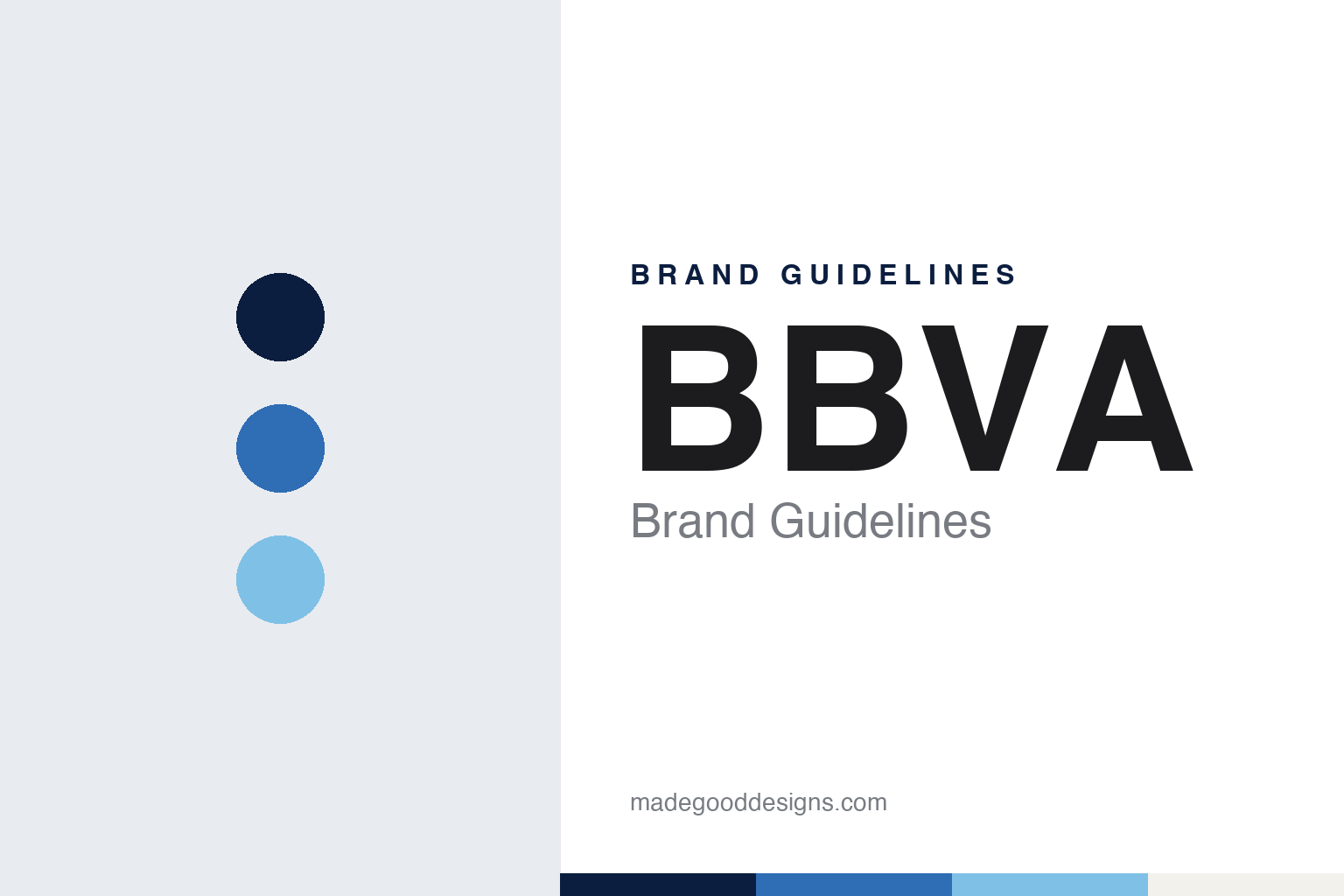
Two constants: a BBVA navy and blue palette and a geometric sans register. Abstract homage — not a BBVA product or mark; no logo, card or branch sign is reproduced.
Banco de Bilbao
A Bilbao bank of issue, founded in 1857.
BBVA traces its start to 28 May 1857, when Banco de Bilbao was founded in the Basque city of Bilbao. Spanish Wikipedia says the city’s Board of Trade promoted it as a bank of issue and discount, and that until the last decade of the nineteenth century it worked almost alone in the local market, financing infrastructure and the steel industry of the region. In 1878 it lost the right to issue its own banknotes and reorganised as a lending and discount bank.
A second Bilbao bank, Banco de Vizcaya, was founded in 1901 and spread across Spain step by step. Spanish Wikipedia says that, besides commercial and deposit banking, it took part in creating much of Spanish industry, including the electricity companies Hidroeléctrica Ibérica and Hidroeléctrica Española. Banco de Bilbao looked outward early: English Wikipedia says it opened a branch in Paris in 1902 and another in London in 1918, and calls it the first Spanish bank with a presence abroad. In 1932 the bank set up an economic research department, the root of what became BBVA Research in 2010.
Both banks grew through takeovers in the 1960s and 1980s; the Vizcaya’s most important purchase, Spanish Wikipedia says, was Banca Catalana in 1984. The two Bilbao banks signed a merger agreement in 1988, and the BBV brand was adopted in 1989.
Colour
From BBV and Argentaria to a group across two continents.
The last part of the name came from the state sector. Argentaria was created in 1991 to group Spain’s public banks and was privatised between 1993 and 1998, according to Wikipedia. BBV and Argentaria announced their merger on 19 October 1999; Spanish Wikipedia says the single BBVA brand was adopted in January 2000 and that integration was completed in February 2001. The full legal name, Banco Bilbao Vizcaya Argentaria, keeps all three ancestors.
Through the 1990s the group bought banks across Latin America, among them Banco Continental in Peru and Probursa in Mexico in 1995 and Banco Ganadero in Colombia and Banco Francés in Argentina in 1996, English Wikipedia says; in Mexico, Probursa was merged with Bancomer in 2000. Later moves took it into the southern United States, where its banks traded as BBVA Compass until that business was sold to PNC Financial Services in 2020, and into Turkey, through a stake in Garanti first bought in 2010.
At home, BBVA grew in Catalonia during the restructuring of Spain’s banks by taking over Unnim Banc and Catalunya Banc, two nationalised groups formed from six Catalan savings banks. Spanish Wikipedia says the Unnim name came down from the branches in May 2013 and that the Catalunya Banc merger deed was signed on 1 September 2016. More recent ventures are digital: a branchless bank in Italy from 2021 and another in Germany from June 2025, according to Wikipedia.
BBVA also tried twice to combine with Banco Sabadell. Merger talks were confirmed in November 2020 and ended the same month. On 1 May 2024 BBVA launched a takeover offer, which Sabadell’s board rejected; BBVA then took the offer directly to shareholders, and it passed competition and government review in 2025 with conditions, Spanish Wikipedia says. The acceptance period closed in October 2025. The result published by Spain’s market regulator, the CNMV, on 16 October 2025 showed acceptances for 25.33% of the shares, below the thresholds the offer needed, and the bid failed, RTVE reported that day.
Typography
How Spanish and Portuguese banks present themselves.
Spanish and Portuguese banks tend to present themselves through a strong wordmark and a small set of colours, most often a blue, a red or a green. Many of today’s names are recent: BBVA settled on a single initialism for every market in 2019, and CaixaBank took its name in 2011, yet both carry much older histories, in the case of BBVA back to Banco de Bilbao in 1857.
Savings-bank and regional heritage runs deep in the sector. Several of the banks in this guide grew out of the cajas and caixas, the savings banks that served a city or a region, and mergers have often kept old local names on the branches of their home territory. Foundations formed from those savings banks remain shareholders in some of the banks and fund cultural, scientific and social work, such as the la Caixa Foundation and its CaixaForum centres.
On their own websites the banks give most space to everyday banking: current accounts, cards, mortgages, savings and the mobile apps that now carry much of the business, often with digital-only brands beside the main one. Branch fronts and head-office buildings in the banks’ home cities appear often in their photography, and sponsorship of football, basketball and other sports keeps their names in public view.
For the design-minded, the useful material sits in the banks’ corporate sections: brand pages, press releases about new logos, and the annual reports that every listed bank publishes. This guide reads those alongside independent dated sources; the palettes are our own unofficial interpretations, and no logo or mark is reproduced.
Aa
A geometric sans for a four-letter initialism. (Specimen set in Work Sans, a sans STAND-IN; NOT the BBVA logo.)
One BBVA
A single name and a new logo in 2019.
For two decades BBVA ran a family of local names. That ended on 24 April 2019, when the bank told its staff that it would use BBVA as its brand in every market where it operates and introduce a new logo. Its announcement said the local names Francés in Argentina, Compass in the United States, Bancomer in Mexico and Continental in Peru would be dropped in the following months, and that the Turkish bank Garanti would become Garanti BBVA. The bank tied the change to a single digital offer, with products and its mobile app developed once for every country, and said the new identity would be rolled out progressively to its corporate buildings, its branch network and its other materials.
The name itself is an initialism of the bank’s ancestors, Banco Bilbao Vizcaya Argentaria, and since 2019 it has been the one name on the group’s banks from Spain to Mexico and South America. Sponsorship has carried it widely. BBVA sponsored Spain’s top football division as the Liga BBVA for eight seasons, from 2008–09 to 2015–16, was the official bank of the NBA from 2010 to 2017, and has backed Mexico’s first division, the Liga BBVA MX, since 2013, Spanish Wikipedia says. Its BBVA Foundation, created in 1988, supports scientific research and cultural work and has given the Frontiers of Knowledge Awards since 2009, according to Wikipedia.
The bank keeps its registered head office in Bilbao, with operational offices in the Ciudad BBVA complex in Madrid, and its shares are listed in Madrid, New York and Mexico. One court matter remains open: in July 2026 a judge at Spain’s Audiencia Nacional sent to trial a case over alleged commissioned espionage in which the bank is accused as a legal entity, Infobae reported on 9 July 2026. No verdict had been given at the time of writing.
For a design guide, BBVA shows how a bank assembled from mergers can settle on one initialism and carry it across countries and sponsorships. Compare Santander, which Wikipedia ranks as Spain’s largest bank, ahead of BBVA, and Banco Sabadell, the target of its 2024–25 offer. For this guide we use a deep navy, a clear mid blue and a light sky blue with a geometric sans, an unofficial interpretation; no product or logo is reproduced.
Explore & save
Keep BBVA’s identity on hand — save it to a board in the Made Good inspiration library.
BBVA identity set
Pin the BBVA navy and blue palette and the geometric sans register to your own board.