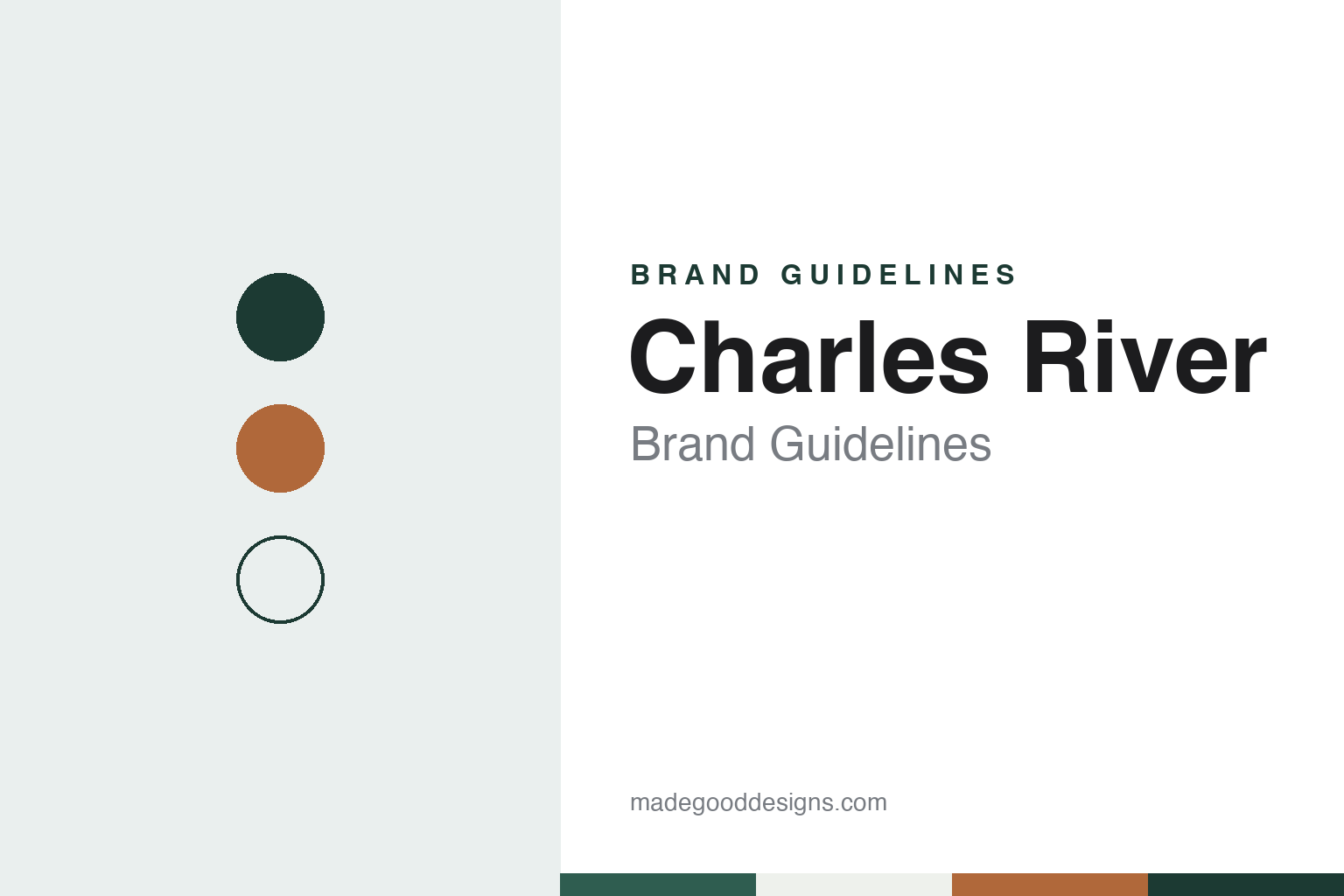
Charles River Brand Guidelines
A one-man animal breeder on the river that became a preclinical research group.
Aa
Two constants: a green and copper palette and a bookish serif register. Abstract homage — not a Charles River asset; no logo, product or facility is reproduced.
The Loft
A veterinarian, a rat farm and a view of the river.
Charles River began in 1947 with one person. The International Directory of Company Histories, in its entry on the company, says its founder, the veterinarian Henry L. Foster, graduated from Middlesex Veterinary College in 1946 and then bought the cages and animals of a small rat farm in Clinton, Maryland, which he moved to a second-floor loft in Boston’s West End. English Wikipedia adds that the laboratory overlooked the Charles River, which gave the business its name: Charles River Breeding Laboratories.
The idea was to supply researchers with laboratory animals. For the first years Foster was the only employee, the Directory says, caring for the animals, calling on customers and doing the paperwork himself. In 1952 he moved the operation out of the city to Wilmington, about 20 miles north of Boston, where the company is still headquartered.
Wilmington is also where Charles River made its technical name. Researchers at the time could not be sure whether a test animal’s reaction came from the substance being studied or from an infection picked up at the breeder. The Directory says Foster took a technique then confined to university laboratories, raising animals free of known germs in sealed barrier rooms, and turned it into a commercial operation, with staff who showered and wore sterile coveralls, gloves and masks before entering. Over time the company also built a fleet of climate-controlled trucks and opened sites within reach of the big drug makers.
Demand grew with regulation. The Directory links a rise in animal testing to the 1960 Federal Hazardous Substances Act and later laws. Charles River Breeding Laboratories first sold shares to the public in 1968, and Wikipedia says the company became international in 1966, when it opened an animal production facility in France.
Colour
An optical group owner, a buyout and a second listing.
In 1984 Charles River gained a corporate parent. The Directory says Bausch & Lomb, then turning itself from an optical company into a broader health-care group, bought the business in an exchange of stock, and that little changed in day-to-day running: Henry Foster carried on as before, and the company began to diversify into cell-culture products and testing services. In 1992 his son, James C. Foster, who had joined the company in 1976 as its lawyer, took over as chief executive.
Wikipedia dates two technical steps to these years: the first commercial genetic-monitoring programme for research animals in 1981, and the creation of transgenic mice and rats from 1988. In the 1990s the company added endotoxin testing, a laboratory check for bacterial contamination in drugs and devices.
The Bausch & Lomb years ended in 1999, when the eye-care group decided to focus on its core business. The Directory says a management-led buyout, arranged with the Global Health Care Partners unit of the investment bank Donaldson, Lufkin & Jenrette, took an 87.5 per cent stake. Late that year the holding company was renamed Charles River Laboratories International, and in June 2000 it went public on the New York Stock Exchange, where it trades under the ticker CRL.
From there the company bought its way into drug-development services. Wikipedia lists a merger with Inveresk, an Edinburgh research company, in 2003; the purchases of Argenta and BioFocus in 2014, which it says made Charles River a full-service early-stage research organisation; MPI Research, completed in April 2018; and the French group Citoxlab, completed in April 2019. Not every deal went through: a planned purchase of the Chinese research company WuXi PharmaTech was withdrawn in 2010 after opposition from several large Charles River shareholders, Wikipedia says.
Typography
How research organisations present themselves.
Contract research organisations sell a service rather than a product. Drug, biotechnology and medical-device companies hire them to plan and run clinical trials, to test compounds before they reach people, to manage laboratories and to collect and analyse the data that regulators review. Because what they sell is largely invisible, their public image is built from people, places and numbers.
The pictures tend to repeat. Corporate sites and annual reports in the category often show clinicians and patients of different ages and backgrounds talking in calm, well-lit consulting rooms; scientists in lab coats working with pipettes and sample plates; and world maps dotted with the countries and sites where studies run. Data dashboards, charts and screens are common too, reflecting how much of the work is now about managing information as well as patients.
Colour follows the same caution. Blues and greens, from deep navy to soft teal, are frequent choices in health care and research branding, usually set against plenty of white, with a clean sans for names and headings. The aim is to look steady and trustworthy rather than playful, and names are often short, sometimes initials or a single coined word, partly because many of these companies are the product of mergers.
The industry also meets in person. Large gatherings such as the DIA Global Annual Meeting and the SCOPE Summit for clinical-operations staff bring sponsors, research organisations and technology suppliers together, and exhibition stands, panels and presentation slides there are another place where these identities are on show. This guide sets out what can be checked about each company’s history and ownership, and treats every colour and typeface here as our own interpretation.
Aa
A bookish serif — a place name carried as a company name. (Specimen set in Source Serif 4, a serif STAND-IN; NOT the Charles River logo.)
Charles River
Research models, safety testing and a primate inquiry.
Today Charles River Laboratories International is headquartered in Wilmington, Massachusetts, and Wikipedia describes it as a contract research organisation working in at least 20 countries, with more than 20,000 employees as of 2024. Its work falls into three broad areas: research models, the bred animals and related services it started with; drug discovery and safety assessment, the preclinical studies that drug makers submit to regulators; and manufacturing and testing, including microbial testing.
The use of research animals has brought the company public scrutiny, Wikipedia notes. In February 2023 Charles River said it had received a subpoena from the U.S. Department of Justice on 17 February relating to a federal investigation of the Cambodian supply chain of non-human primates, Boston.com reported on 23 February 2023. The company said it would cooperate fully and that it had voluntarily suspended planned future shipments from Cambodia until new procedures could be agreed with federal wildlife officials. In its second-quarter results of 6 August 2025, filed with the U.S. Securities and Exchange Commission, the company said the U.S. Fish and Wildlife Service had cleared the shipments from late 2022 and early 2023 for legal entry, and that the Justice Department had closed its grand jury investigation and a parallel civil investigation.
The company has also narrowed its scope. In May 2026 the investment firm GI Partners completed its purchase of Charles River’s contract manufacturing and cell solutions businesses, which now operate as an independent company, Rose BioSolutions, from sites in Maryland, Tennessee, California and the United Kingdom, Pulse 2.0 reported on 8 May 2026.
For a design guide, Charles River shows how a name taken from a view out of a Boston window can outlast the loft and the founder’s first business, and stay on a company that now spans several continents. Compare Labcorp, another laboratory group that grew into drug-development services, and PPD, a clinical-research name now inside a larger group. For this guide we use river green, deep pine, copper and a pale sage with a serif, an unofficial interpretation; no product or logo is reproduced.
Explore & save
Keep Charles River’s identity on hand — save it to a board in the Made Good inspiration library.
Charles River identity set
Pin the Charles River green and copper palette and the bookish serif register to your own board.