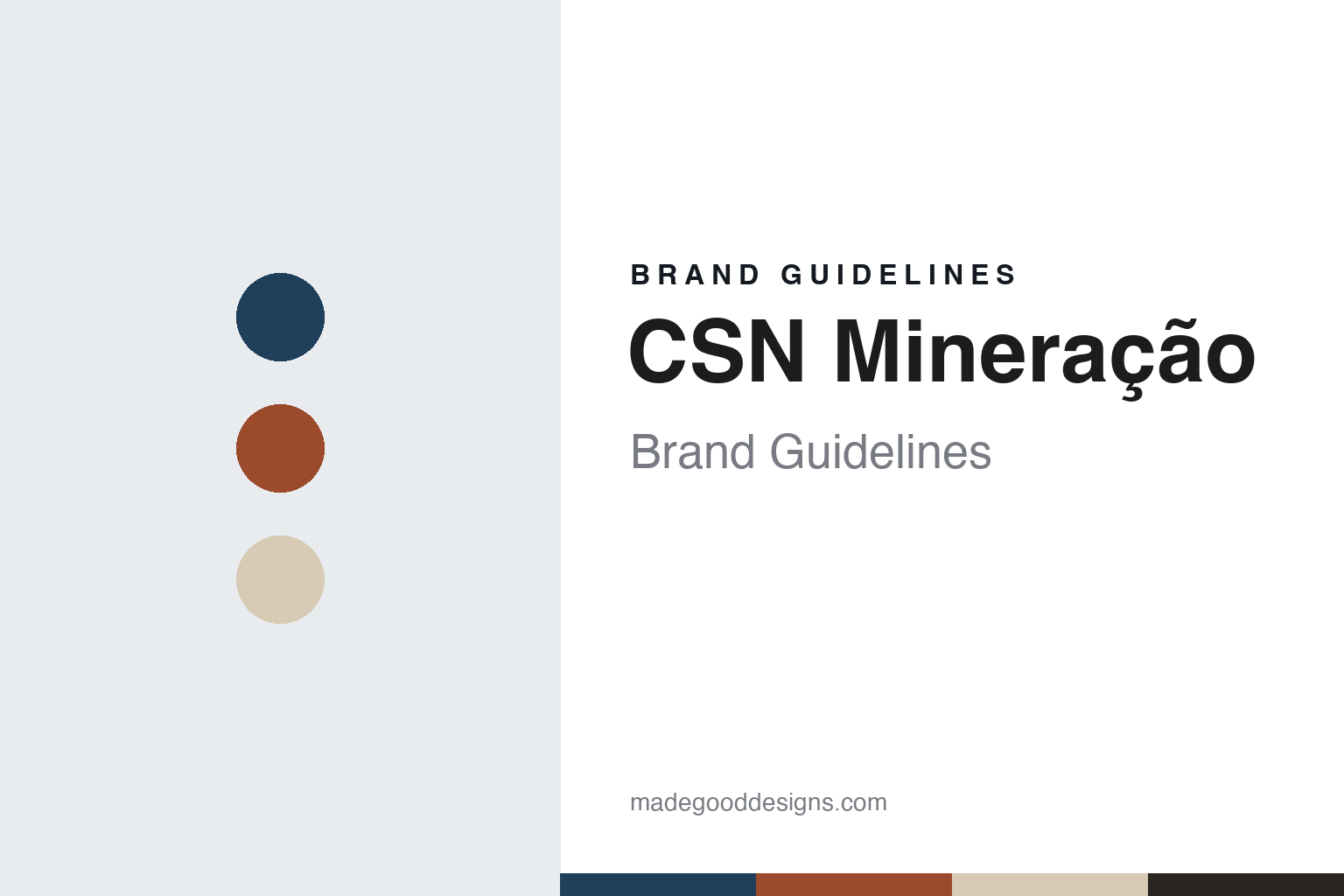
CSN Mineração Brand Guidelines
A century-old Minas Gerais ore mine with its own rail link and port terminal.
Aa
Two constants: a steel blue, iron red and ore-dust sand palette and a narrow grotesque register. Abstract homage — not a CSN Mineração product or mark; no logo, photograph or document is reproduced.
From Casa de Pedra to CSN
A Congonhas ore body, a wartime steel company and a 1946 takeover.
CSN Mineração is a company formed in the 2010s around a mine that is more than a century old. Its core asset is Casa de Pedra, at Congonhas in Minas Gerais, in the iron-rich region of Brazil known as the Quadrilátero Ferrífero. The company’s own history says a Danish businessman bought the Casa de Pedra land in 1910 to look for iron ore, and that extraction began there in 1913; Portuguese Wikipedia gives the same 1913 date. The company calls Casa de Pedra the oldest iron mine still operating in Brazil.
The mine’s later history is tied to Companhia Siderúrgica Nacional, or CSN, Brazil’s national steel company. English Wikipedia says CSN was created as a state-owned company on 9 April 1941, by decree of President Getúlio Vargas during the Estado Novo period, after an agreement between the Brazilian and American governments. Portuguese Wikipedia says that agreement, part of the Washington Accords, provided for a steelworks that could supply steel to the Allies during the Second World War and help Brazil’s development in peacetime. The Presidente Vargas Steelworks at Volta Redonda, in Rio de Janeiro state, began production in 1946.
That same year, the company says, Casa de Pedra was nationalised and incorporated into CSN, which wanted to be self-sufficient in iron ore. For almost half a century the mine fed the state steelmaker. English Wikipedia says CSN was privatised through auctions held in 1993 and early 1994, in which the government sold its stake; Portuguese Wikipedia says the buyers included the Vicunha group and the banks Bamerindus and Bradesco.
Colour
Namisa, an Asian consortium and a 2014–2015 combination.
The separate mining company grew out of an export venture. According to the company, CSN founded Nacional Minérios S.A., or Namisa, in 2006 to sell iron ore abroad, and in 2007 Namisa bought a neighbouring miner, Companhia de Fomento Mineral. In 2008 a 40 per cent stake in Namisa was sold to an Asian consortium of steelmakers and trading houses; Portuguese Wikipedia dates the sale to November 2008 and the company to December 2008. Portuguese Wikipedia names the consortium’s members as the Japanese trading house Itochu, the Japanese steelmakers Nippon Steel, JFE Steel, Sumitomo Metal Industries, Kobe Steel and Nisshin Steel, and South Korea’s Posco.
In 2014, the company says, CSN’s board approved a strategic alliance with that consortium, which it describes as made up of Japanese, Korean and Taiwanese companies. Portuguese Wikipedia says that at the end of 2014 Namisa was merged with the Casa de Pedra mine to form Congonhas Minérios, the company later renamed CSN Mineração; the company’s own timeline dates the formation of CSN Mineração to 2015. It lists the assets brought together as the Casa de Pedra and Engenho mines, the Pires processing complex, the right to operate the TECAR port terminal and a stake of 18.63 per cent in the railway operator MRS Logística.
The next step was a stock-market listing. On 6 November 2020 the Estadão business column Coluna do Broadcast reported that CSN was pressing ahead with plans to take its mining unit public, and that fund managers and analysts had been taken to see the operations at Congonhas. The paper said CSN had told the market it expected iron ore output to rise from 33 million tonnes a year to 108 million tonnes in 2033. The company says its share offering took place on 17 February 2021, and Portuguese Wikipedia records the 2021 listing on B3, the São Paulo exchange.
CSN kept control. The company’s shareholder page, updated to 30 September 2026, shows CSN with about 70 per cent of the shares, Itochu with about 11 per cent, a Japanese investment vehicle named Japão Brasil Minério de Ferro Participações with about 9 per cent, and smaller holdings for POSCO Holdings and China Steel.
Typography
Iron ore and how it is shown.
Iron ore miners sell a raw material that few people ever see, so their public image is built from the places where it comes out of the ground. The standard picture is aerial: a red-earth open pit cut into benches, haul roads spiralling down its walls, trucks reduced to specks. Underground miners show the opposite view — tunnels, drill rigs and lit caverns far below the surface — but the aim is the same, to make scale legible.
The second set of images is about movement. Iron ore is heavy and cheap to dig but costly to carry, so miners photograph the chain that gets it to customers: ore trains kilometres long crossing dry country or snow, pellet plants and stockpiles, and export jetties where bulk carriers load at the end of a long line. Rail and port pages often get as much space as the mines themselves.
Much of what these companies publish is explanation. Websites and reports carry geology and grade explainers, describe ore types such as lump, fines and pellets, and set out reserves and production as the companies report them. Alongside sit pages on rehabilitation of mined land, water use and tailings, and on newer projects to cut emissions in steelmaking.
The last layer is accountability. Miners publish community and Indigenous-partnership reports, accounts of resettlement where mines reach towns, sustainability reports and, for listed or state-owned groups, detailed annual reports. For a designer, the identity of an iron ore company lives as much in these documents, maps and diagrams as in any logo.
Aa
A narrow grotesque for ore trains and terminal signage. (Specimen set in Archivo Narrow, a sans STAND-IN; NOT the CSN Mineração logo.)
CSN Mineração
Mine, railway and port as one chain.
CSN Mineração presents itself as an integrated chain rather than a single pit. The company says Casa de Pedra holds four ore bodies, has a capacity of about 30 million tonnes a year, and produces lump ore, sinter feed and pellet feed; the neighbouring Engenho mine and the Pires complex, with crushing, screening and concentration plants, add further lump, sinter feed and concentrate. Ore leaves by rail from terminals at Casa de Pedra and Pires.
The railway is MRS Logística, which runs freight lines across Minas Gerais, Rio de Janeiro and São Paulo states and carries the ore down to the coast. There it reaches TECAR, the bulk terminal at the Port of Itaguaí in Rio de Janeiro state, which the company operates and says can export more than 42 million tonnes of ore a year from one berth. The company dates CSN’s lease of the terminal, then known as Sepetiba, to 1997, for 25 years with an option to renew, and says an expansion completed in 2013 raised its export capacity.
The company describes itself as the second-largest exporter of iron ore in Brazil, a ranking Portuguese Wikipedia also gives. It reported total production of 45.6 million tonnes in 2025, which it called the highest in its history, and sales of 45.8 million tonnes. On tailings, the company says that in 2020 all of its processing became independent of the use of a tailings dam, and that the same year it completed the decommissioning of its first tailings dam, known as B5.
The parent group is wider than mining. Portuguese Wikipedia lists CSN’s other businesses as steel, logistics, cement and energy, with the Volta Redonda works still at the centre of its steelmaking; for CSN Mineração, the steelworks is both its founding customer and its controlling shareholder.
For a design guide, CSN Mineração shows how an ore miner can present its mine, railway and port as a single line on the map. Compare Vale, the Brazilian miner that began as Companhia Vale do Rio Doce, and Samarco, another Minas Gerais miner. For this guide we use a steel blue, an iron red and an ore-dust sand with a narrow sans, an unofficial interpretation; no product or logo is reproduced.
Explore & save
Keep CSN Mineração’s identity on hand — save it to a board in the Made Good inspiration library.
CSN Mineração identity set
Pin the CSN Mineração steel blue, iron red and sand palette and the narrow grotesque register to your own board.


