First Quantum Brand Guidelines
From Zambian tailings to mines on five continents.
Aa
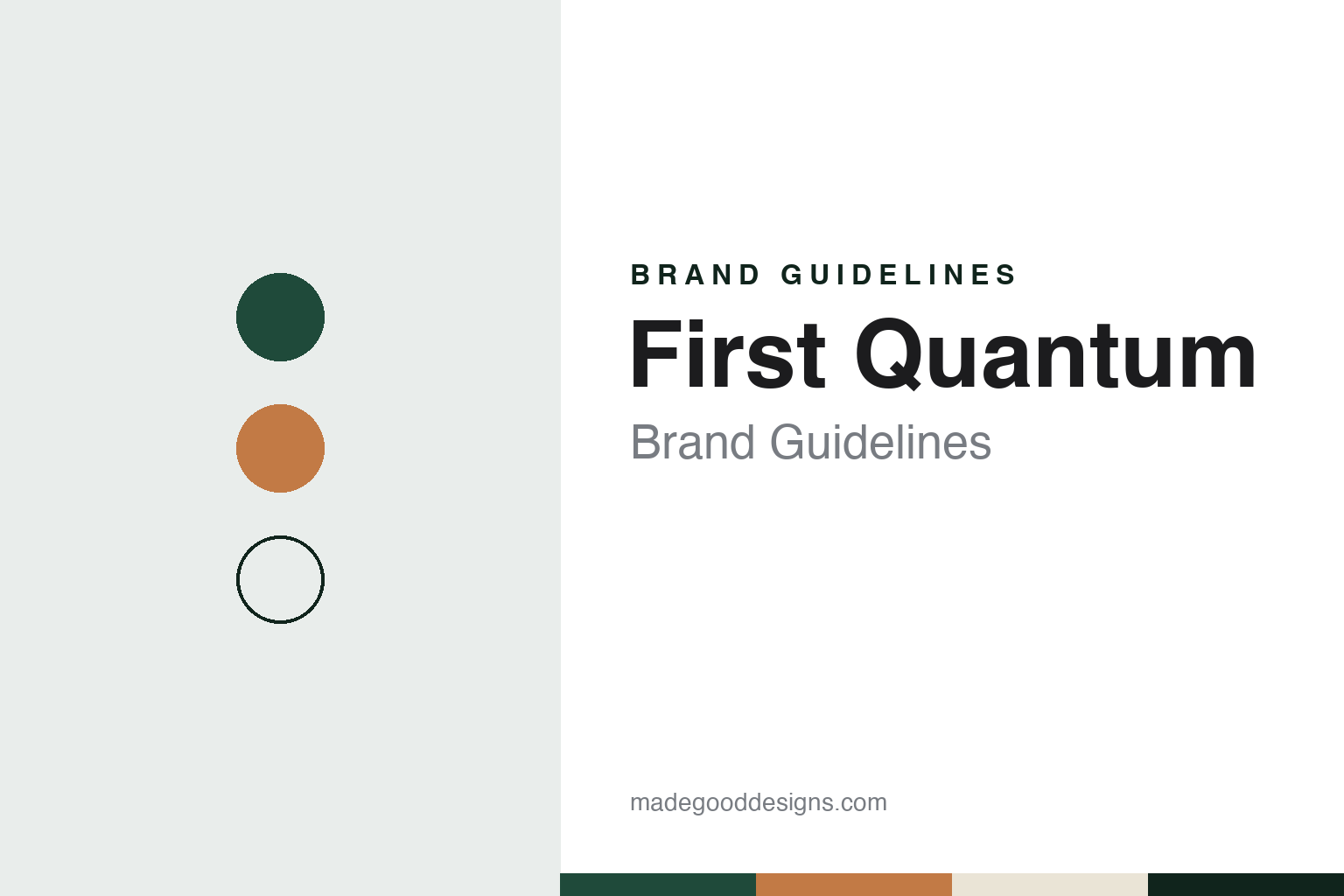
Two constants: a green, copper and limestone palette and a builder’s serif register. Abstract homage — not a First Quantum product or mark; no logo or nameplate is reproduced.
Xenium to First Quantum
Four names and a tailings plant in Zambia.
First Quantum Minerals was founded in 1983 under the name Xenium Resources, English Wikipedia says. It became Zeal Capital in 1989, First Quantum Ventures in 1993 and First Quantum Minerals in 1996. The company dates its own story from that last year: its timeline is headed “Forging our own path since 1996.”
The start was in Zambia. In 1996 the company acquired the Bwana Mkubwa project at Ndola, which it describes as the first new mining project in Zambia for 35 years and the first licence issued under the country’s 1995 Mining and Minerals Act. Its first plant there recovered copper from old tailings using solvent extraction and electrowinning, with a sulphuric acid plant, and was completed in 1998, the company says. In 2001 it bought Phelps Dodge’s 80 per cent interest in the Kansanshi copper-gold project in Zambia; commercial production followed in April 2005, and a smelter at Kansanshi reached commercial production in July 2015, according to the company. English Wikipedia adds the Lonshi mine in the Democratic Republic of the Congo, opened in 2001, and the Guelb Moghrein copper-gold mine in Mauritania, acquired in 2004.
Growth continued by acquisition. In 2009 First Quantum bought the Ravensthorpe nickel mine in Western Australia from BHP Billiton, and in 2010 it bought Kiwara, gaining the Trident licence in Zambia that holds the Sentinel copper mine and the Enterprise nickel deposit, English Wikipedia and the company say. Sentinel reached commercial production on 1 November 2016 and Enterprise on 1 June 2024, the company says, describing Enterprise as the largest nickel mine in Africa. The same timeline records that the government of the Democratic Republic of the Congo terminated the company’s Kolwezi tailings permit in September 2009.
Colour
Inmet, Panama and a Supreme Court ruling.
The largest step came in April 2013, when First Quantum completed a hostile takeover of the Canadian miner Inmet Mining, English Wikipedia says. The deal brought the Cobre Panamá project, along with mines in Spain, Turkey and Finland. Cobre Panamá, in Colón Province about 120 kilometres west of Panama City, comprises one open pit, a processing plant, a 300-megawatt power station and an international port, the company says. It processed its first ore in February 2019, fifty years after the deposit was discovered, and produced a record 350,000 tonnes of copper in 2022, according to the company.
Its legal footing became the central question. A previous contract had been ruled illegal in 2017, though operations continued while a new deal was negotiated, Mining Technology reported in November 2023. Negotiations began in January 2022; in February 2023 ore processing was suspended after concentrate loading at the Punta Rincón port was halted by the Panama Maritime Authority, and it resumed on 8 March 2023, English Wikipedia says. In October 2023 Panama’s National Assembly approved a revised contract, signed as Law 406. Large protests followed; on 3 November 2023 a moratorium on new metal mining was signed into law, and a blockade of the port by small boats forced the mine to stop production on 23 November 2023.
On 28 November 2023 Panama’s Supreme Court unanimously declared Law 406 unconstitutional, Mining Technology reported; the company had already sent notice of its intent to start arbitration. The mine was placed in a phase of preservation and safe management, a plan that English Wikipedia says the government formally approved in May 2025. On 30 September 2026 First Quantum noted that a ministerial commission had delivered a report to Panama’s president with seventeen recommendations, the first being to authorise negotiations on the feasibility of a new agreement that would end the pending international arbitrations and allow an orderly closure. In its third-quarter results of 28 October 2026, the company said the president was reviewing the report.
Typography
How copper miners present themselves.
Copper miners sell a raw material, not a consumer product, so their identities are built for investors, governments, employees and the communities near their mines. The pictures tend to repeat across the sector: terraced open-pit benches lit by low desert sun, haul trucks whose wheels stand taller than the workers beside them, the long sheds of a concentrator, and stacks of copper cathode sheets ready for shipment. Copper itself often supplies the colour, in warm orange and brown tones that run through reports and presentations.
Much of the communication is formal. Annual reports, sustainability reports and technical reports on reserves are published on fixed calendars, and quarterly results are written for analysts. Alongside the numbers sit recurring themes: safety, presented as a daily routine rather than a slogan; community programmes in schools, clinics, water and local suppliers; and, increasingly, the place of copper in electricity grids, electric vehicles and renewable energy, framed as the metal of the energy transition.
The sector also has its own meeting places. The PDAC convention in Toronto and the Mining Indaba in Cape Town gather miners, explorers, investors and ministers each year, and company stands, logos and presentation decks are designed for those rooms as much as for the web. Trade titles such as The Northern Miner and Mining Technology report on projects, permits and disputes, which are part of the public record of every large miner.
The companies in this guide differ widely in origin: some began as subsidiaries of older American smelting groups, some as small exploration companies, some as state enterprises. This guide sets out what can be checked about each one — who founded it, who owns it, where it mines and what has been reported about its disputes — and marks clearly what rests only on the company’s own word.
Aa
A sturdy serif for a company that calls itself a builder. (Specimen set in Fraunces, a serif STAND-IN; NOT the First Quantum logo.)
First Quantum
“We build the mines we operate.”
First Quantum’s press releases carry a Toronto dateline, and its shares trade on the Toronto Stock Exchange under the symbol FM; it kept a secondary London listing until 2016, English Wikipedia says. In September 2026 the company described itself as having operating mines in Zambia and Mauritania, with Ravensthorpe in care and maintenance since May 2024, the Taca Taca copper-gold-molybdenum project in Argentina, and the La Granja and Haquira copper deposits in Peru under exploration. It acquired a 55 per cent interest in La Granja from Rio Tinto in August 2023 and acts as operator in partnership with Rio Tinto, the company says. At Kansanshi, an expansion known as S3 was officially inaugurated in August 2025, according to the company.
The company’s own language is about construction. “We build the mines we operate,” it says, presenting its engineering and construction teams as its distinction, and it calls itself a “global copper company” with mines on five continents and about 14,500 employees. It reports 396,000 tonnes of copper produced in 2025 and describes itself as one of the world’s top 10 copper producers; those are its own figures.
For a design guide, First Quantum shows a company whose public record is told through its projects — a tailings plant, a smelter, a port and a power station — and through one long legal dispute. Compare Teck, another Canadian miner, and Rio Tinto, its partner at La Granja. For this guide we use a canopy green, cathode copper and limestone with a serif, an unofficial interpretation; no product or logo is reproduced.
Explore & save
Keep First Quantum’s identity on hand — save it to a board in the Made Good inspiration library.
First Quantum identity set
Pin the First Quantum green, copper and limestone palette and the builder’s serif register to your own board.