Iluka Brand Guidelines
Mineral sands, a monazite stockpile and a refinery at Eneabba.
Aa
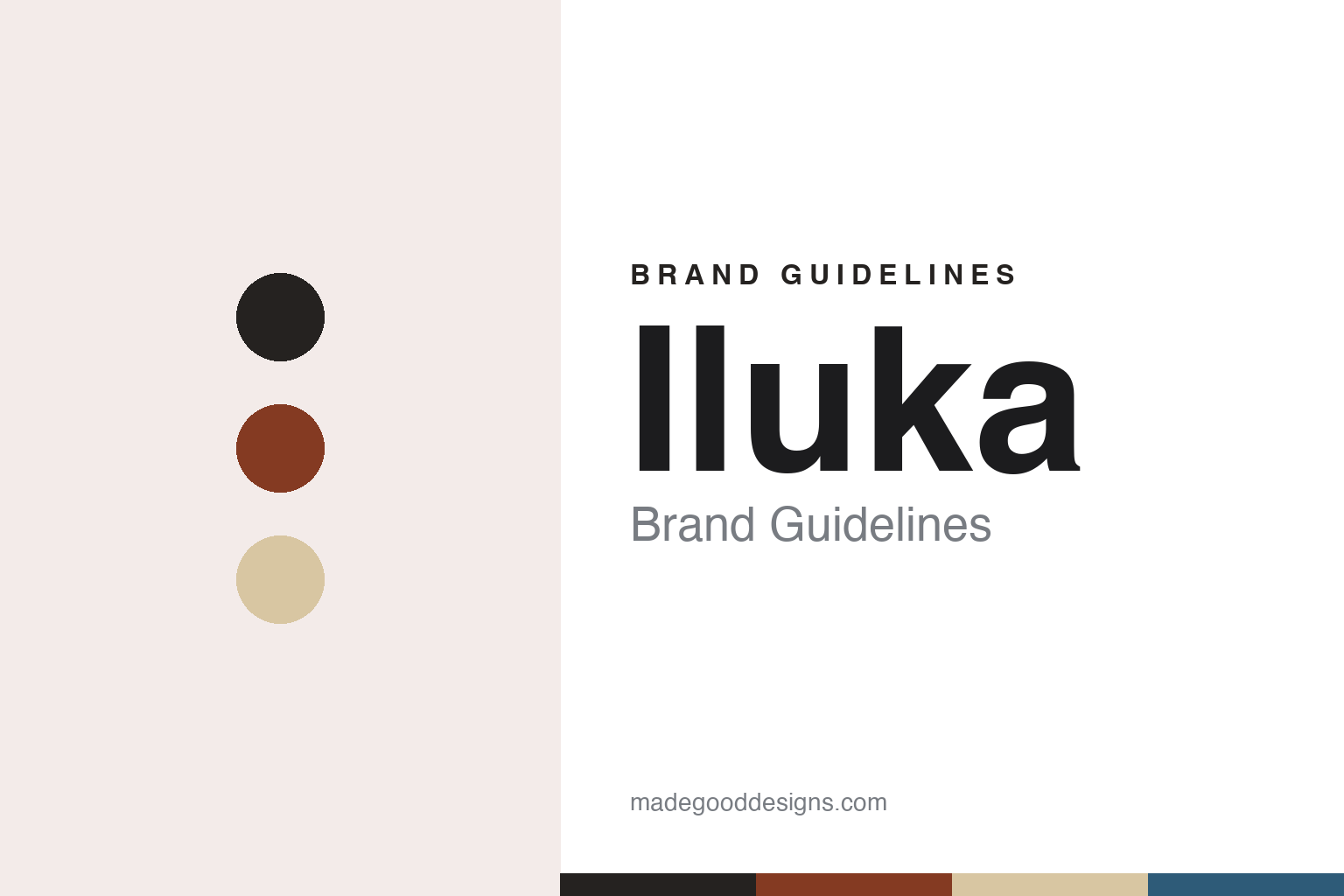
Two constants: a sand, red-brown and black palette and a plain serif register. Abstract homage — not an Iluka product or mark; no mineral sample, logo or nameplate is reproduced.
Westralian Sands and RGC
A mineral-sands merger in Western Australia.
Iluka Resources is a Perth-based mineral-sands company listed on the Australian Securities Exchange under the code ILU. It was formed in July 1998 by a merger between Westralian Sands and the titanium-minerals business of RGC, Renison Goldfields Consolidated, and the new name, Iluka Resources, took effect in 1999, English Wikipedia says. The same article traces Westralian Sands to 1954 and to mining of the Yoganup deposit near Capel, in the south-west of the state, from 1959, and says the company was listed on the exchange in 1968.
The new company narrowed its focus quickly. In 1999 it sold or closed businesses outside mineral sands, including its Koba Tin, Thalanga copper and Westlime interests and a share of the Narama coal mine in New South Wales, English Wikipedia says. In 2006 it closed its operations in Florida and Georgia in the United States while keeping a presence in Michigan. In December 2016 it completed its purchase of Sierra Rutile, the London-listed miner with a rutile operation in Sierra Leone, and in April 2022 it spun that business off again.
Mineral sands are heavy sands mined for a handful of minerals. Iluka mines the concentrate and separates it into rutile, ilmenite and zircon, then processes some of the ilmenite into synthetic rutile, English Wikipedia explains. Zircon is used in ceramics, and titanium dioxide in paint pigment, plastics and paper. In 2009, the article adds, Iluka brought forward the closure of one of its synthetic rutile kilns at Narngulu as demand fell during the financial crisis. English Wikipedia describes Iluka as a major global producer of zircon and of rutile and synthetic rutile, with operations over the years in Western Australia’s Eucla and Perth basins, at the Jacinth-Ambrosia mine in South Australia, in Victoria and in the Murray Basin of New South Wales.
Colour
A monazite stockpile kept for three decades.
Iluka’s rare-earth story begins with a by-product. Since the early 1990s its mineral-sands processing at Eneabba, about 140 kilometres south of Geraldton in Western Australia, has produced monazite and xenotime, minerals that carry rare earths. Rather than discard them, the company stockpiled the monazite, which English Wikipedia says was placed in a disused mining pit. The Australian Mining Review wrote in January 2026 that Iluka had treated the material “as a strategic resource rather than a waste stream.” Iluka then built a concentrator, completed in 2022, that upgrades the stockpile into a concentrate of about 90 per cent monazite to feed a refinery.
On 13 April 2022 the Western Australian government announced that Iluka had taken a final investment decision to build what it called Australia’s first integrated rare-earths refinery at Eneabba. The government said the refinery would produce separated oxides of neodymium, praseodymium, dysprosium and terbium, would have a capacity of 17,500 tonnes a year of rare-earth oxides, and was designed to process feed from Iluka and from third parties. It would be funded by Iluka and by a non-recourse loan under the Australian Government’s Critical Minerals Facility. At the time, construction was to begin later in 2022 and first production was earmarked for 2025.
That date has moved. In January 2026 The Australian Mining Review described construction as passing through “a critical phase” and the refinery as positioned to make Western Australia home to the country’s first fully integrated producer of separated rare-earth oxides from 2027; English Wikipedia also gives 2027. The refinery is not yet in production. The magazine said the project sits on the footprint of Iluka’s mineral-sands operations, that it will take the stockpiled concentrate first and later feed from mineral-sands projects and third parties, and that it is designed to make both light and heavy rare-earth oxides.
The refinery is being built while the older business is under pressure. The same report said Iluka had faced softer demand for zircon and titanium feedstocks, had curtailed some capacity and was focusing on margins while it continued to invest in Eneabba and in its Balranald mineral-sands project.
Typography
Design and documentation.
Rare-earth and magnet companies sell materials most people never see, so their pictures do a lot of the explaining. The usual opening image is the mine: an open pit cut in benches into red or ochre desert ground, haul trucks small against the terraces, and a wide sky above. It tells a viewer that the story starts with rock and with a particular place, which matters in a business where origin is part of the product.
The next scenes are inside the plant. Separation is slow chemistry, and companies often show it as long rows of mixer-settler tanks, pipework and walkways, or a rotating kiln seen from its end. The finished goods then appear as oxide powders in small dishes or heaps, often in soft pastel shades of pink, green, grey and cream, a quiet way to show that one ore becomes many separate elements.
Magnets bring the story to the customer. Silver blocks, rings and arcs stacked on a bench, or set into a cutaway of an electric motor or a wind-turbine generator, link the material to the products people know. Investor presentations add the periodic table, usually with the lanthanides picked out in a highlight colour, along with maps that trace the route from mine to separation plant to magnet factory.
The same visual vocabulary appears at trade gatherings, from the events of the Rare Earth Industry Association to the Magnetics conference, where stands and slides lean on the same few motifs: the pit, the plant, the powder and the magnet. For a designer, the category shows how a technical, slow-moving industry can be made legible through a short, repeated sequence of images rather than through slogans.
Aa
A plain serif for a long-lived resources company. (Specimen set in Source Serif 4, a serif STAND-IN; NOT the Iluka logo.)
Iluka
A short name and a second story.
The Iluka identity rests on a short single-word name and on products most people never see as such: zircon in ceramics, and titanium minerals that end up as pigment in paint, plastics and paper.
The refinery has added a second story. In 2022 the Western Australian government presented Eneabba as part of its strategy for battery and critical minerals, with roughly 300 construction jobs and around 270 operating jobs expected. In 2026 trade coverage placed the project against tightening Chinese controls on rare-earth exports, which The Australian Mining Review said China broadened in October 2025, and described Eneabba as one of the few planned facilities outside China able to produce both light and heavy separated oxides.
For a design guide, Iluka shows how a company can move a long-held by-product to the centre of its public story without changing its name. Compare Lynas, another Australian rare-earth company, and Arafura. For this guide we use zircon sand, a rutile red-brown and ilmenite black with a serif, an unofficial interpretation; no product or logo is reproduced.
Explore & save
Keep Iluka’s identity on hand — save it to a board in the Made Good inspiration library.
Iluka identity set
Pin the Iluka sand, red-brown and black palette and the plain serif register to your own board.


