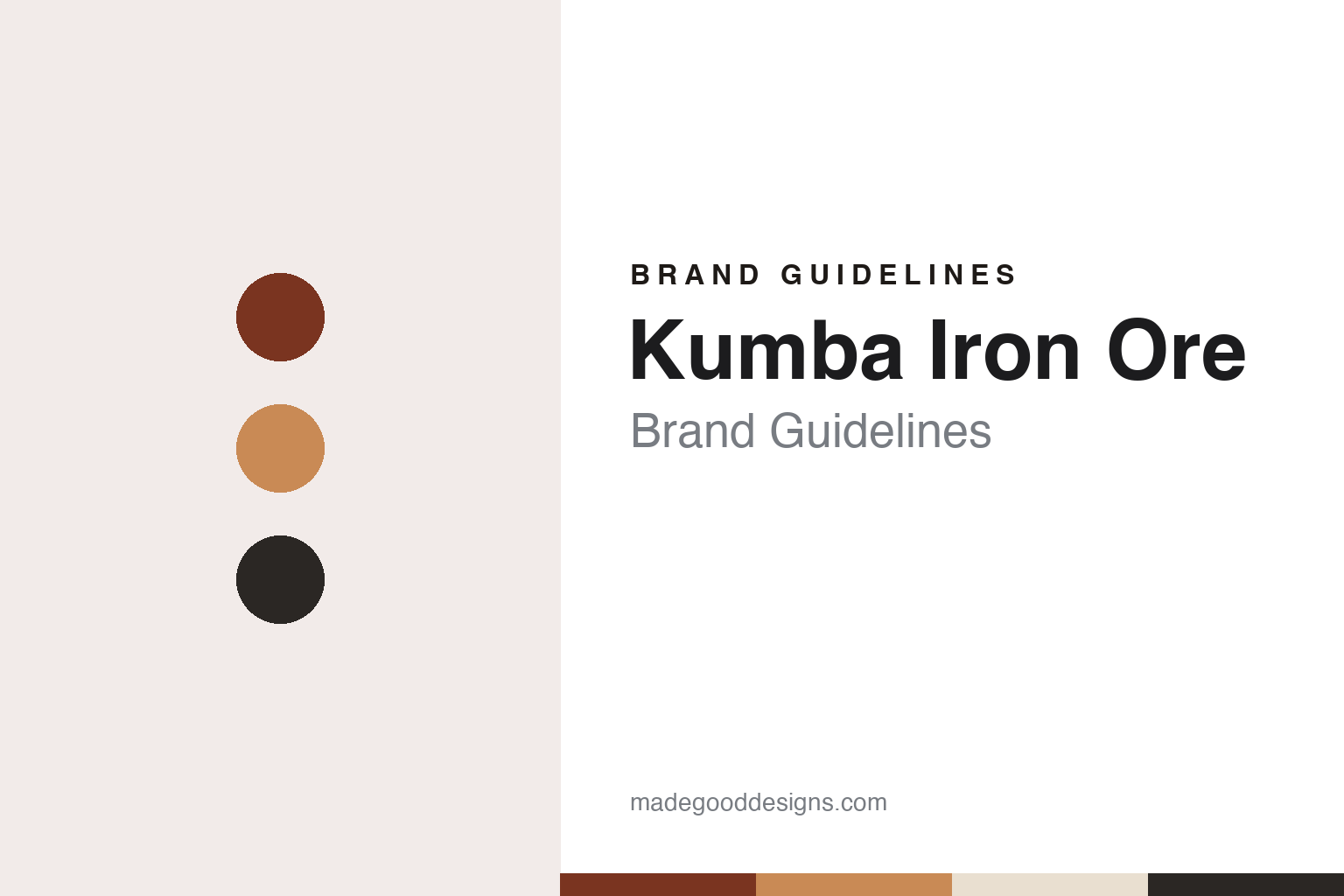
Kumba Iron Ore Brand Guidelines
A Northern Cape iron ore miner with a long ore line to the sea.
Aa
Two constants: an iron-oxide red, ochre and sand palette and an industrial grotesque register. Abstract homage — not a Kumba Iron Ore product or mark; no logo, photograph or document is reproduced.
From Iscor to Kumba
A state steelmaker’s ore fields, a 2001 unbundling and a 2006 split.
Kumba Iron Ore is a young company sitting on old mines. Its ore bodies in the Northern Cape were developed by Iscor, the South African Iron and Steel Industrial Corporation, which Afrikaans Wikipedia says was set up in 1928 as a state organisation under that year’s Iron and Steel Industry Act, with its first works in Pretoria. Iscor needed ore for its furnaces, and the iron-rich hills near the present town of Kathu became its main source.
Sources differ on when mining began at Sishen. English Wikipedia says the mine opened in 1947; Afrikaans Wikipedia, citing a 1995 travel guide, says Iscor began mining iron ore there in 1953, and that a second mine was opened in 1973 for export through Saldanha Bay. To carry that export ore, Iscor built the Sishen–Saldanha railway, an 861-kilometre heavy-haul line to the Atlantic coast that English Wikipedia says opened in 1976 and was handed to the state railways in 1977, when it was electrified; Afrikaans Wikipedia dates its completion to 1977.
Iscor’s workforce reflected the apartheid system of the time. English Wikipedia’s history of the company says roughly half of its workers were black and were barred from skilled or well-paid jobs, that white workers received subsidised housing, training and pensions, and that black workers were housed in single-sex hostels and were not eligible for pensions until the 1980s.
Iscor was privatised and listed on the Johannesburg stock exchange in November 1989, Afrikaans Wikipedia says. In December 2001 it was unbundled into two separately listed companies: Iscor kept steel, and Kumba Resources took the mines Iscor had developed — coal, zinc, industrial minerals, heavy minerals and its two iron ore mines. Iscor itself later became ArcelorMittal South Africa.
The final step came in November 2006. Kumba Resources was reorganised: the iron ore business was listed on the Johannesburg exchange as Kumba Iron Ore, and the remaining company was renamed Exxaro Resources, according to English Wikipedia’s articles on both companies. Anglo American, which had held a large stake in Kumba Resources, became Kumba Iron Ore’s majority shareholder; English Wikipedia lists the state-owned Industrial Development Corporation as the next largest holder.
Colour
Two pits, a jig plant and a port.
Kumba does not own its mines directly. The company says it holds 75.37 percent of Sishen Iron Ore Company (SIOC), which it manages and which owns the operating assets. The rest belongs to black economic empowerment partners: Exxaro with 20.37 percent, the SIOC Community Development Trust with 3.06 percent, and an employee share ownership trust.
Sishen, near Kathu, is the flagship. The company calls it one of the largest open pit mines in the world, some 14 kilometres long, and says the bulk of its production comes from there, most of it exported. Ore is mined by opencast methods, then crushed, screened and upgraded by dense media separation and jigging; Kumba says the Sishen jig plant is the largest of its type in the world. It also says Sishen produces ore to different specifications for different customers.
Kolomela, near Postmasburg, has been operating since 2011. Kumba says its name means “to dig deeper” or “to persevere,” and that its lump ore is valued for its physical strength and high iron content. A third mine, Thabazimbi in Limpopo, was worked from 1931; English Wikipedia says that from 2013 its ore went only to ArcelorMittal South Africa, and that in February 2015 Kumba said the mine was no longer economically viable.
The ore leaves by rail. English Wikipedia says the line, also called the Ore Export Line or OREX, has run 342-wagon trains about 3,780 metres long since 2007, which it calls the longest production trains in the world, and that train length rose to 375 wagons in October 2019. At the coast, Kumba says its terminal at Saldanha Bay in the Western Cape is the only dedicated iron ore export facility in South Africa, with two berths able to take two very large ore carriers at once. The company describes its head office as being in Rosebank, Gauteng.
Typography
How iron ore miners present themselves.
Iron ore miners sell a raw material that few people ever see, so their public image is built from the places where it comes out of the ground. The standard picture is aerial: a red-earth open pit cut into benches, haul roads spiralling down its walls, trucks reduced to specks. Underground miners show the opposite view — tunnels, drill rigs and lit caverns far below the surface — but the aim is the same, to make scale legible.
The second set of images is about movement. Iron ore is heavy and cheap to dig but costly to carry, so miners photograph the chain that gets it to customers: ore trains kilometres long crossing dry country or snow, pellet plants and stockpiles, and export jetties where bulk carriers load at the end of a long line. Rail and port pages often get as much space as the mines themselves.
Much of what these companies publish is explanation. Websites and reports carry geology and grade explainers, describe ore types such as lump, fines and pellets, and set out reserves and production as the companies report them. Alongside sit pages on rehabilitation of mined land, water use and tailings, and on newer projects to cut emissions in steelmaking.
The last layer is accountability. Miners publish community and Indigenous-partnership reports, accounts of resettlement where mines reach towns, sustainability reports and, for listed or state-owned groups, detailed annual reports. For a designer, the identity of an iron ore company lives as much in these documents, maps and diagrams as in any logo.
Aa
An industrial grotesque for a bulk miner. (Specimen set in Archivo, a sans STAND-IN; NOT the Kumba Iron Ore or Anglo American logo.)
Kumba Iron Ore
Mineral rights, rail capacity and a pending parent merger.
Kumba’s biggest legal fight was over Sishen itself. English Wikipedia’s articles on Kumba and the mine say that in 2009 ArcelorMittal South Africa failed to convert its 21.4 percent undivided share of the Sishen mineral rights by the deadline, and that the government then awarded the rights to a previously little-known company. Kumba went to court; the award was overturned in 2011, and the case reached the Constitutional Court, whose final ruling went in Kumba’s favour in 2013. Kumba announced in October 2016 that it held the whole Sishen mining right, English Wikipedia says.
Rail is the constraint the company talks about most now. In October 2026 MiningMX reported that Transnet was running a restoration programme on the Sishen–Saldanha line to 2030, and that chief executive Mpumi Zikalala said Kumba had been forced to “reconfigure” its business for “a lower base” because of logistics. The same report gave Kumba’s production forecast as 31 to 33 million tonnes for 2026, rising to 35 to 37 million tonnes in 2027, and said its ultra-high dense medium separation project at Sishen would let lower-grade material previously classed as waste be processed as ore. Zikalala also named Ploegfontein and Heuningkranz, near Kolomela, as areas where exploration continues.
Kumba’s ownership could change at the top. Anglo American agreed in September 2025 to merge with Canada’s Teck Resources; Reuters reported on 7 October 2026 that the deal had been approved everywhere the companies operate except China and was expected to close by March 2027, so it was not completed at the time of writing. Kumba remains a separately listed company in Johannesburg.
For a design guide, Kumba Iron Ore shows a bulk miner whose identity is a chain of places — pit, plant, railway and port — under a parent’s name. Compare Anglo American, its majority shareholder, and ArcelorMittal, whose South African arm grew out of Iscor. For this guide we use an iron-oxide red, ochre, sand and charcoal with a sans, an unofficial interpretation; no product or logo is reproduced.
Explore & save
Keep Kumba Iron Ore’s identity on hand — save it to a board in the Made Good inspiration library.
Kumba Iron Ore identity set
Pin the Kumba Iron Ore iron-oxide red, ochre and sand palette and the industrial grotesque register to your own board.