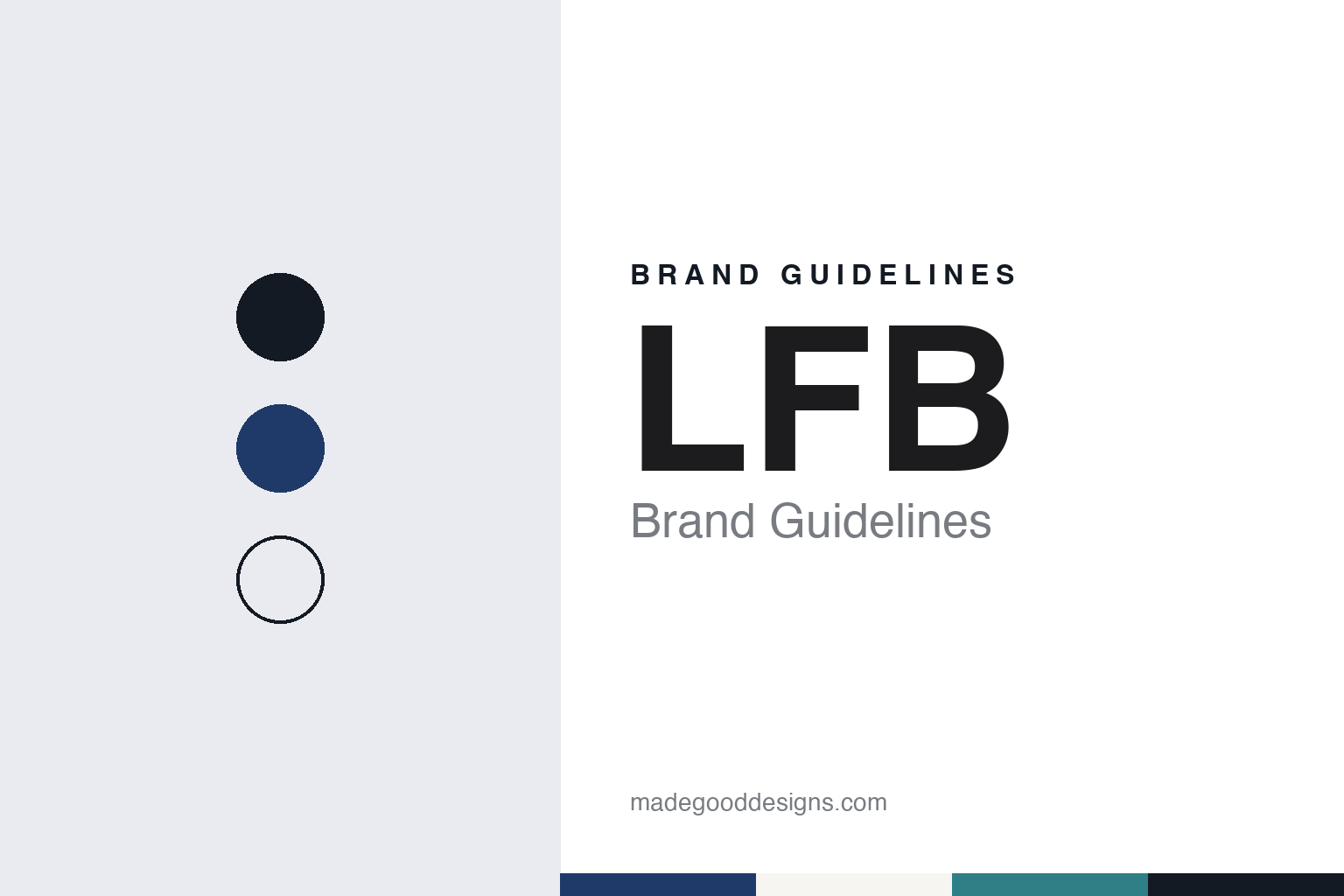
LFB Brand Guidelines
France’s state-owned plasma fractionator, created in 1994.
Aa
Two constants: an LFB blue, teal and straw palette and a clean sans register. Abstract homage — not an LFB product or mark; no vial, logo or label is reproduced.
A 1994 laboratory
Born from the separation of transfusion and fractionation.
LFB, the Laboratoire français du Fractionnement et des Biotechnologies, was created in France in 1994. Its origins lie in a change of law. Until 1993, French Wikipedia says, plasma products were made directly by the country’s blood-transfusion centres. The law of 4 January 1993 separated those activities: a ministry answer to a written question in the Assemblée nationale notes that the law, voted after the contaminated-blood affair, split the collection, preparation and distribution of blood from the fractionation of plasma into medicines, which until then had sat within the same structures.
That affair is the background to LFB’s creation. Larousse’s Journal de l’année for 1992 reported that between 1980 and 1985 about 5,000 people in France, 1,200 of them with haemophilia, had been infected with HIV through transfusion, and that the director of the national transfusion centre, the CNTS, resigned in June 1991 after a press campaign. A government inspection report was made public in September 1991. The trial of four doctors, among them the CNTS’s former director and his deputy, opened on 26 June 1992; on 23 October 1992 the court convicted three of them and acquitted the fourth, the 1993 edition of the same yearbook reported.
The new body was set up as a public interest group, or GIP. French Wikipedia gives the dates: its founding agreement on 20 January 1994 and its definitive creation on 1 June 1994. The company says the GIP had the status of a pharmaceutical establishment, authorised to make medicines. Under the system that followed, the ministry answer explained, France ran a “double monopoly”: one operator, the Établissement français du sang (EFS), for blood products from donors, and one, LFB, for fractionating the plasma the EFS collects — a separation the ministry described as a double internal check on quality.
Colour
Plasma into medicines.
LFB’s work is fractionation: separating human plasma into proteins used as medicines. French Wikipedia says the company holds the exclusive right to fractionate plasma from volunteer donations collected in France by the EFS, and that a 2009 health law wrote into statute its duty to fractionate that plasma first and to supply the French market first. The company groups its medicines in three fields — immunology, haemostasis and intensive care — and says it sells around fifteen medicines in more than thirty countries.
Named products listed by French Wikipedia include the immunoglobulins Clairyg and Iqymun, the albumin Vialebex and the von Willebrand factor Wilfactin. In biotechnology, LFB’s own history page says the US Food and Drug Administration approved its recombinant factor VIIa, Sevenfact, in 2020, and that the European Union approved it as Cevenfacta in 2022.
Production is split between sites. The company says its Les Ulis plant, in the Essonne south of Paris, handles the upstream stages of fractionation, from receiving plasma bags to intermediate products, while Lille, in the north, carries out purification and filling, and Carvin, in the Pas-de-Calais, handles logistics, secondary packaging and quality control. A new plant at Arras, which the company says brings all its production techniques together on one site, received its pharmaceutical-establishment authorisation from the French medicines agency ANSM in 2023, entered operation at the end of 2024 and sold its first batches in 2025, according to LFB.
Recombinant work sits elsewhere. LFB says it bought a site at Alès, in the Gard, in 2007, now the subsidiary LFB Biomanufacturing, which makes proteins and monoclonal antibodies by cell culture, and that a plant at Charlton, Massachusetts, produces recombinant proteins expressed in mammals’ milk.
Typography
Plasma, law and public health.
Plasma companies sell medicines that most people never see on a shelf, so their public image is built around the people at either end of the chain. Websites, annual reports and recruitment pages for the sector tend to open on donors: someone relaxing in a reclining chair in a bright, clean collection centre, a nurse at their side, with the equipment kept small in the frame. The tone is calm and grateful rather than clinical.
The middle of the chain is shown through hands and buildings. Close-ups of gloved hands holding vials, labelled blood bags and racks of tubes signal laboratory care without showing a face, while aerial photographs of large fractionation plants, steel tanks and clean-room corridors stand for scale. Collection-device makers add their own register of machines, tubing sets and touchscreens, usually photographed on white.
At the far end are patients. Several of the conditions these medicines are used for are rare, and the companies’ storytelling often leans on named families, children and long-term patients, often filmed at home or outdoors, alongside patient-organisation partnerships and awareness days. Scientific credibility is carried by medical congresses such as those of the International Society on Thrombosis and Haemostasis (ISTH) and the American Society of Hematology (ASH), and by industry meetings such as the Plasma Protein Forum.
The visual identities themselves are mostly quiet: corporate sans-serif wordmarks, generous white space and restrained palettes, with brand colour used sparingly against photography. This guide sets out what can be checked about each brand — who founded it, who owns it and where it says its products are made — and marks clearly what rests only on the company’s own word.
Aa
A clean sans for three initials. (Specimen set in Manrope, a sans STAND-IN; NOT the LFB logo.)
LFB
A state company with a public mission.
LFB’s legal form has since changed. An ordinance of 28 July 2005 converted the public interest group into a public limited company, and LFB S.A. was formally created on 7 July 2006, wholly owned by the French State, French Wikipedia says; the blood establishments that had been members of the GIP left it, since the law bars a blood-collection body from holding shares in LFB. In September 2006 two subsidiaries were created, LFB Biomédicaments for plasma-derived medicines and LFB Biotechnologies, the company says. A ministry answer to a later parliamentary question described LFB as a public limited company held 100 per cent by the State.
From 2007 LFB expanded abroad, its history page says: an industrial agreement with the Dutch fractionator Sanquin in 2008, the purchase of the plasma collector Europlasma in 2010, sales subsidiaries in Germany in 2013 and in the United Kingdom and Spain in 2015, and sole ownership of CAF-DCF in Belgium in 2016. In 2019 it set out a plan to refocus on plasma-derived and recombinant proteins; French Wikipedia says the cell-therapy unit CellforCure was sold to Novartis on 1 April 2019 as part of that plan. In 2024 the company bought Amber Plasma, an operator of plasma centres in the Czech Republic, and published its statement of purpose, “le LFB, l’expertise engagée au service de la vie.” Its headquarters are at Les Ulis, and it says it employed 3,086 people worldwide in 2025.
For a design guide, LFB shows how a public mission and a technical process can carry an identity built on three initials. Compare Grifols and Biotest, two other European plasma fractionators. For this guide we use a deep blue, a cool teal and a pale straw with a sans, an unofficial interpretation; no product or logo is reproduced.
Explore & save
Keep LFB’s identity on hand — save it to a board in the Made Good inspiration library.
LFB identity set
Pin the LFB blue, teal and straw palette and the clean sans register to your own board.


