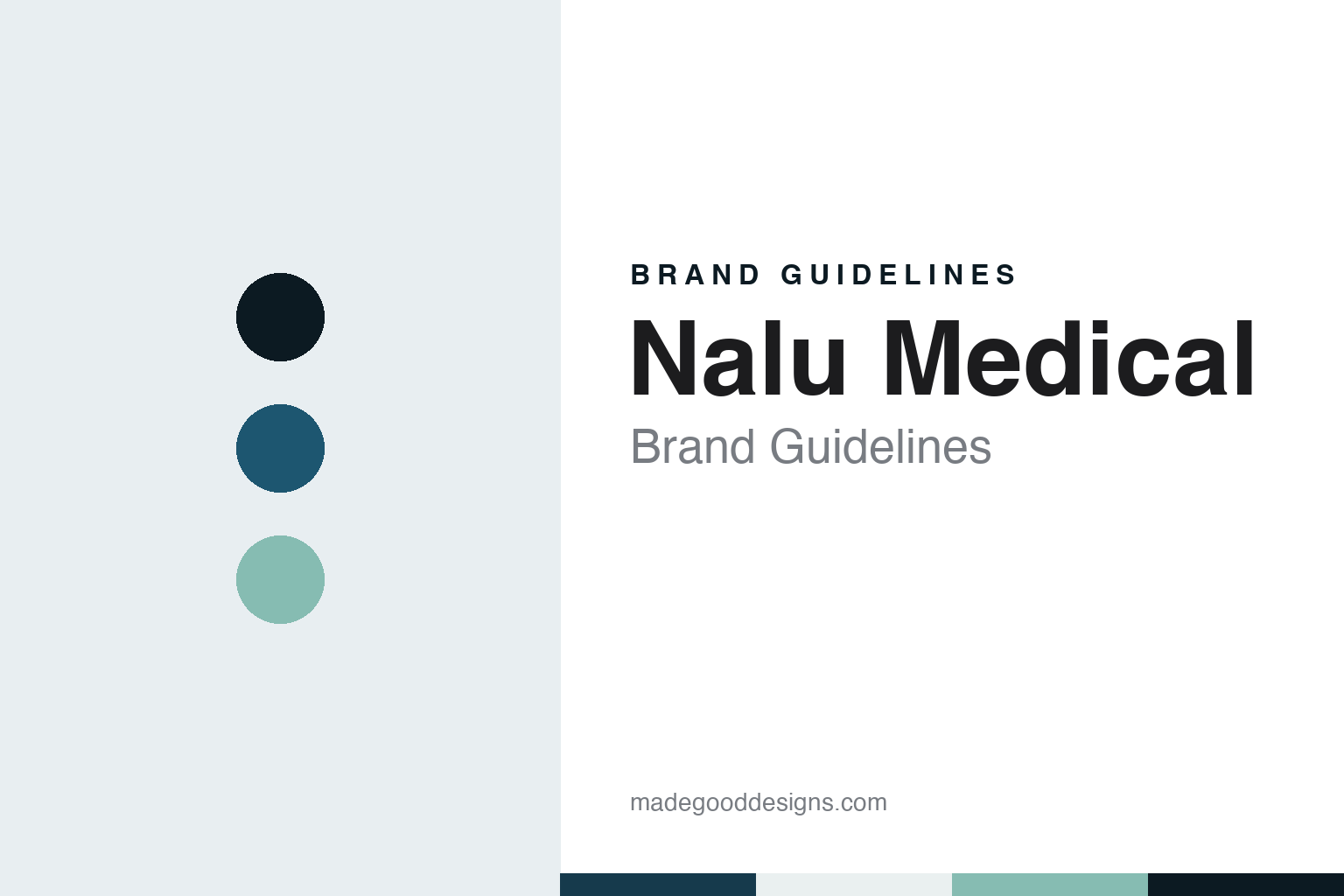
Nalu Medical Brand Guidelines
Carlsbad’s battery-free implant, powered from outside the body.
Aa
Two constants: a deep sea blue and sea-glass palette and a rounded geometric sans register. Abstract homage — not a Nalu Medical product or mark; no device, logo or label is reproduced.
Carlsbad
Three founders and a smaller implant.
Nalu Medical was founded in 2014 in Carlsbad, in San Diego County, California. The Turkish technology news site Webrazzi, reporting on a funding round in January 2024, named its founders as Daniel Pivonka, Lee Hartley and Mike Partsch, and described the company’s focus as miniaturised neurostimulation implants for managing chronic pain. When Nalu filed to go public in July 2021, the IPO research firm Renaissance Capital likewise described it as a Carlsbad-based company founded in 2014.
Its idea was to shrink the implanted part of a neurostimulation system. Nalu’s system, as the company and later Boston Scientific described it, uses a miniaturised, battery-free implantable pulse generator — which Nalu markets as the micro-IPG — powered wirelessly by a small Therapy Disc worn outside the body and controlled through a smartphone app. The company said it designed the system for both spinal cord stimulation and peripheral nerve stimulation, the stimulation of individual nerves outside the spine, and described itself as having miniaturised neurostimulation implants for a variety of targets.
A large partner arrived early: Boston Scientific has said it was a strategic investor in Nalu from 2017. The US Food and Drug Administration’s 510(k) database records the Nalu Neurostimulation System, classed as an implanted spinal cord stimulator, as received in November 2018 and cleared on 22 March 2019. According to Renaissance Capital, the company then delayed its commercial launch to the third quarter of 2020 because of the pandemic.
Colour
An implant without a battery.
The system’s pitch rests on how its parts are divided. In Nalu’s own description, published in late 2023, the implanted pulse generator is “battery-free” and “miniaturized,” the wearable Therapy Disc supplies the power, and a smartphone-based app acts as the remote control. Its chief executive, Tom West, said then that a micro-IPG paired with a wearable battery was an option traditional spinal cord stimulation systems did not provide, and that the FDA had cleared the implant to last at least 18 years — the company’s own account of its labelling.
Nalu built a clinical record in both of its target areas. In November 2023 it announced the publication in the journal Pain Physician of its nPower study, a post-market observational study of the Nalu system for spinal cord stimulation at 15 US pain centres with 35 participants. For peripheral nerve stimulation, Boston Scientific later cited two randomised controlled trials, COMFORT and COMFORT 2. By 2025 the peripheral use was the headline: Boston Scientific described the system as designed for adults with severe, intractable chronic pain of peripheral nerve origin, in areas such as the shoulder, lower back and knee. Webrazzi noted in 2024 that the therapy is first offered through a temporary trial period, so that patients can see how they respond before a long-term implant.
The company also tried the public markets. Renaissance Capital reported on 9 July 2021 that Nalu had filed with the US Securities and Exchange Commission for a Nasdaq listing under the symbol NALU, after a confidential filing that February; J.P. Morgan, BofA Securities and William Blair were named as joint bookrunners. In January 2024 Webrazzi reported a new funding round led by Novo Holdings, with investors including Gilde Healthcare, MVM Partners and Endeavour Vision, and in October 2025 Boston Scientific still described Nalu as a privately held company.
Typography
How neurotech presents itself.
Neuromodulation companies sell devices that most people will never see. Spinal cord stimulators, sacral nerve stimulators, hypoglossal nerve implants and brain-computer interfaces sit under the skin or inside the skull, so the companies that make them have to show something else: the scale of the device, the place it sits in the body, and the people it is meant for.
A few images recur across the category. Implants are often photographed held between fingertips or beside a coin or a key fob, to make their size legible. X-ray-style renders show thin leads running along a spine or curving toward a nerve, with the generator drawn as a small rounded shape. Patient pages tend to use calm portraits at home, on walks or with family, rather than hospital scenes.
Brain-computer interface start-ups lean in another direction: glowing renders of the brain, electrode arrays magnified many times over, and photographs of lab benches, engineers and surgical teams. Their audience includes investors and researchers as much as doctors, and the imagery often reads as a promise about the future rather than a product shot.
The category also has its own meeting places. Trade congresses such as the North American Neuromodulation Society (NANS) meeting, the International Neuromodulation Society (INS) congress and the Society for Neuroscience annual meeting are where companies show booths, posters and new hardware to clinicians and scientists. This guide sets out what can be checked about each company — founding, ownership, products and approvals as dated sources state them — and marks clearly what rests only on the company’s own word.
Aa
A rounded geometric sans for a compact, wireless system. (Specimen set in Outfit, a sans STAND-IN; NOT the Nalu Medical logo.)
Nalu Medical
Now part of Boston Scientific.
Nalu Medical no longer stands alone. On 17 October 2025 Boston Scientific, of Marlborough, Massachusetts, announced a definitive agreement to acquire Nalu Medical, Inc., buying the equity it did not already own, and said the Nalu technology would complement its existing pain treatments, including spinal cord stimulation, basivertebral nerve ablation and radiofrequency ablation. MedTech Dive reported the deal the same day, noting analysts’ view that it continued Boston Scientific’s strategy of expansion through smaller “tuck-in” acquisitions; one RBC Capital Markets analyst counted more than 40 deals by the company in the previous ten years and about 45 active investments in its venture portfolio. In its fourth-quarter results on 4 February 2026, Boston Scientific reported that it had completed the acquisition of Nalu Medical, Inc. The FDA database now lists Boston Scientific Neuromodulation as the applicant for the 2019 clearance.
The Nalu name continues on the product. Boston Scientific’s announcements refer to the Nalu Neurostimulation System and present it within its neuromodulation business, whose president, Jim Cassidy, called peripheral nerve stimulation “an exciting field” in October 2025. Before the deal, Nalu’s own communications leaned on short coined names for parts of the system — micro-IPG, Therapy Disc and nPower among them.
For a design guide, Nalu Medical shows how a small company can build its identity around one physical difference — taking the battery out of the implant — and keep its product name after a larger owner takes over. Compare Boston Scientific, which now owns it, and Saluda Medical, another neuromodulation company built on one technical idea. For this guide we use a deep sea blue, an ink and a sea-glass green with a sans, an unofficial interpretation; no product or logo is reproduced.
Explore & save
Keep Nalu Medical’s identity on hand — save it to a board in the Made Good inspiration library.
Nalu Medical identity set
Pin the Nalu Medical deep sea blue and sea-glass palette and the rounded geometric sans register to your own board.


