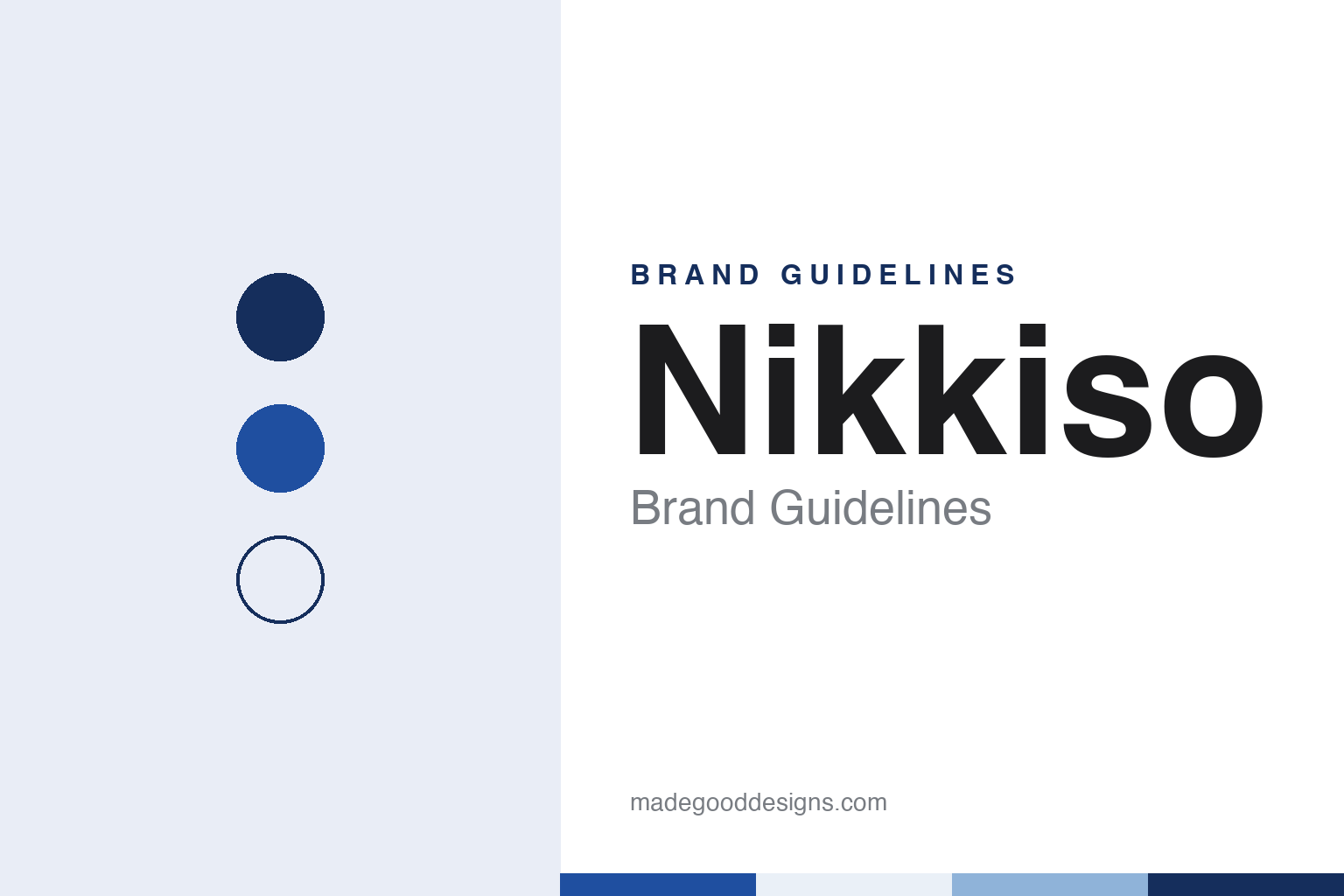
Nikkiso Brand Guidelines
A Tokyo pump maker that moved into dialysis.
Aa
Two constants: a Nikkiso blue and white palette and a geometric sans register. Abstract homage — not a Nikkiso product or mark; no machine, logo or nameplate is reproduced.
Special Pump
Metering pumps, licences and an artificial heart.
Nikkiso began as a pump company. Its history says Special Pump Co. was established in December 1953, and in January 1954 became the exclusive Japanese dealer for the metering pumps of Milton Roy, an American maker; in 1955 it took a licence to build those pumps in Japan and added the canned motor pumps of another American firm, Chem Pump. Its corporate profile gives 26 December 1953 as the date of establishment, while noting that the registered date of the company is 7 March 1950.
In 1956 it built a head office and plant in Shibuya, Tokyo. In October 1959 it became Nippon Kikai Keiso, and in November 1968, after moving its head office to Ebisu, it took the shortened name Nikkiso. Japanese Wikipedia gives the same sequence of names.
The move into medicine came early. Nikkiso says that in July 1960 it supplied what it calls Japan’s first artificial heart to the surgical department of a professor at the University of Tokyo. It began selling dialysis machines in August 1967, and in August 1969, the company says, it completed Japan’s first domestically produced dialysis machines, a model it calls the BN. Dialyzers followed in 1975, and in 1984 it won approval to manufacture an artificial pancreas. In the same decades it grew in other directions: carbon-fibre composites from 1981, and a carbon-fibre technology licence to Boeing in 1986.
Colour
Three businesses, one dialysis core.
Today Nikkiso describes three businesses: special pumps and systems in its industrial business, carbon-fibre-reinforced plastic parts for aircraft in its aerospace business, and haemodialysis products in its medical business. Its medical range, as the company lists it, covers dialysis machines, dialyzers, blood tubing sets, dialysis agents and the artificial pancreas, alongside apheresis and Acrosurg microwave surgical instruments. On its medical pages the company says its share of dialysis machines in Japan is “more than 50%,” a figure we give as its own claim.
Where things are made is set out in the company’s history. It built a medical-device factory at its Shizuoka plant in 1984, set up a Vietnamese company to produce blood tubing lines in 2001, and in 2014 completed a medical factory at its Kanazawa plant, moving some production there from Shizuoka. In 2017 it established Nikkiso Miyazaki, where it opened a medical training institute, M.ReT Miyazaki, in 2021. Abroad it set up a dialysis-machine joint venture in China with the Weigao Group in 2010 and a German medical company in 1997.
Exports grew from the 1990s. The company says it developed a dialysis machine that met new European standards in that decade and that its products have since been used around the world; it obtained a European sales licence for apheresis devices in 2011, and in 2012 the Weigao joint venture won approval to make and sell a single-patient haemodialysis machine in China. Throughout, its own pump work ran in parallel: it developed the MILFLO metering pump in 1966 and licensed Sundyne pump technology from an American company in 1970.
The portfolio has been reshaped several times. In 2010 Nikkiso took over the Japanese dialysis-product marketing of Fresenius Medical Care and transferred its Korean dialysis subsidiary to Fresenius, the company says. In January 2014 it bought the continuous renal replacement therapy (CRRT) business of Baxter. That did not last: the Japanese deals site M&A Online reported in May 2024 that Nikkiso would transfer its German and Chinese CRRT subsidiaries to TYHC International of Singapore, because the business had not produced sufficient results and the company wanted to concentrate on haemodialysis, and updated its report in February 2025 to say the transfer was complete.
The industrial side changed too. Nikkiso bought the German pump group LEWA in 2009 and the Dutch firm Geveke in 2013; in March 2022 Atlas Copco announced it had agreed to acquire LEWA and Geveke, and it completed the purchase on 1 August 2022, and Nikkiso’s history records the transfer of both that August.
Typography
How the category presents itself.
Hospital device makers sell to clinicians, purchasing teams and hospital engineers rather than to shoppers, and their brands are built for that audience. Their catalogues and websites tend to show the equipment where it is used: infusion pumps on poles beside a bed, dialysis machines lined up in a treatment room, monitors and consoles in intensive care.
Much of the product is small and disposable, so the pictures often come close. Gloved hands hold a catheter, a cannula or an infusion set; blood tubing is coiled for a dialysis session; a dialyzer or a single-use endoscope is photographed on plain white so that every connector and label can be read. Product names usually lean on model numbers and technical terms rather than on lifestyle words.
People appear too, usually in uniform: nurses and doctors at the bedside, technicians at a workbench, trainers at a company teaching centre. Several makers in this group run their own training facilities for clinicians, and they present them as part of what they sell alongside the devices.
The trade meets at congresses and fairs. Medica in Düsseldorf gathers hospital suppliers from around the world each autumn; ASN Kidney Week, the American Society of Nephrology’s annual meeting, draws dialysis makers; and Digestive Disease Week brings together gastroenterologists and endoscopy suppliers. Stands, booth graphics and congress brochures are where many of these brands are seen at their largest, and this guide sets out what can be checked about each company: who founded it, who owns it, and where it says its products are made.
Aa
A geometric sans for an engineering company with a dialysis core. (Specimen set in Sora, a sans STAND-IN; NOT the Nikkiso logo.)
Nikkiso
A diagonal line and a colour of its own.
Nikkiso explains its own mark. Its history says it introduced a new logo and corporate statement in December 2003. According to its corporate profile, a diagonal line running up and down from the space between the two K’s of the name stands for “progress, development, and growth,” and the logo is printed in a shade the company calls “Nikkiso blue,” which it says it uses to unify its corporate image. The statement that goes with it is “Original Technologies,” which the company says supplements the logo in catalogues, display panels and advertising.
The company is listed on the Prime Market of the Tokyo Stock Exchange and has its head office in Yebisu Garden Place Tower in Ebisu, Tokyo, where it moved in 2011. Its American medical arm, Nikkiso Medical America, was set up in 2020, and in December 2025 the company announced the US launch of a haemodialysis machine, the DBB-06 PRO, as part of its push into the American market.
For a design guide, Nikkiso shows how an engineering company can carry one documented colour and one simple geometric idea across pumps, aircraft parts and dialysis machines. Compare Nipro, another Japanese dialysis maker, and Fresenius, whose dialysis arm took over Nikkiso’s Korean dialysis subsidiary in 2010. For this guide we use a strong blue, a navy and a pale sky with a sans, an unofficial interpretation; no product or logo is reproduced.
Explore & save
Keep Nikkiso’s identity on hand — save it to a board in the Made Good inspiration library.
Nikkiso identity set
Pin the Nikkiso blue and white palette and the geometric sans register to your own board.