Sandoz Brand Guidelines
The Basel dye works that became a generics brand.
Aa
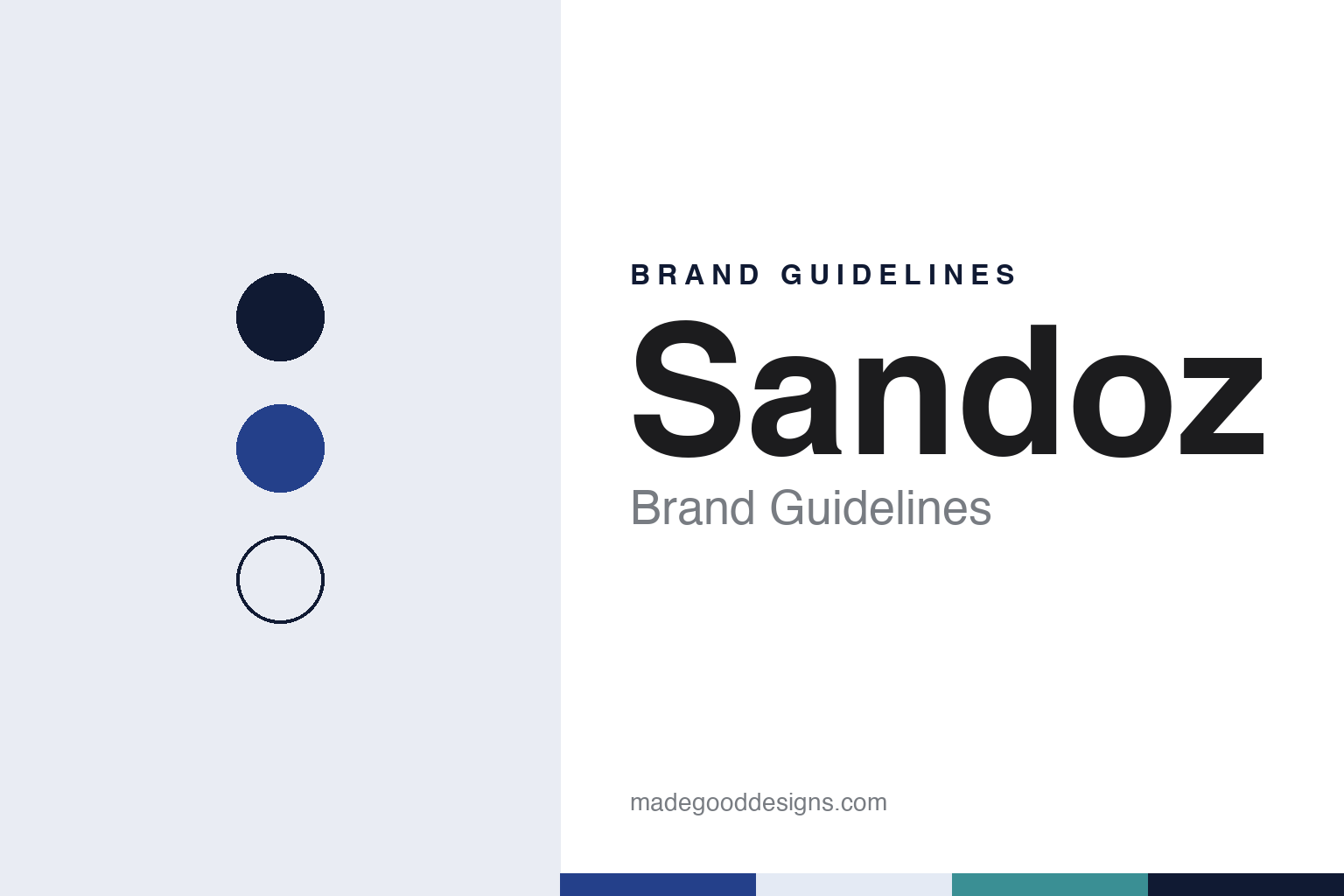
Two constants: a Sandoz blue, ink and mist palette and a clean sans register. Abstract homage — not a Sandoz product or mark; no pack, logo or nameplate is reproduced.
Kern & Sandoz
A chemist, a merchant and a dye works in Basel.
Sandoz began in Basel in 1886. The Historisches Lexikon der Schweiz records that the chemist Alfred Kern and the merchant Edouard Sandoz founded the partnership Chemische Fabrik Kern & Sandoz that year to make dyes; by 1892 it offered 28 dyes for wool, silk, cotton and linen. English Wikipedia names alizarin blue and auramine among its first colours. From 1893 Edouard Sandoz ran the firm alone, and in 1895 it became a joint-stock company, Chemische Fabrik vormals Sandoz. The shorter name Sandoz AG followed in 1939.
Medicines came early. English Wikipedia says the firm made its first pharmaceutical substance, antipyrine, in 1895 and began producing saccharin in 1899. The lexicon dates Sandoz’s own pharmaceutical research to 1917, when the chemist Arthur Stoll joined; Wikipedia adds that Stoll isolated ergotamine in 1918, launched as Gynergen in 1921, and that Calcium Sandoz followed in 1929. In 1938 the chemist Albert Hofmann first made lysergic acid diethylamide, LSD, at Sandoz; the company sold it as Delysid from 1947 and withdrew it in 1965, Wikipedia says.
The firm also grew abroad. The lexicon records a first foreign branch in England in 1911 and, between 1919 and 1926, subsidiaries in the United States, Italy, France, Spain and Germany. From 1918 to 1951 Sandoz formed the “Basler Interessengruppe,” a far-reaching cartel, with its Basel neighbours Ciba and Geigy.
Its German subsidiary tied it to the economy of the Third Reich. In 2001 Switzerland’s Independent Commission of Experts, led by the historian Jean-François Bergier, published studies of Swiss business in Nazi Germany, including one by Lukas Straumann and Daniel Wildmann on Swiss chemical subsidiaries. swissinfo reported in August 2001 that the commission found Sandoz had replaced the Jewish chairman of its German subsidiary with an “Aryan” businessman, and in December 2001 that Ciba, Geigy and Sandoz had “Aryanised” their German subsidiaries of their own accord as early as 1933 and 1934. Novartis, which opened the archives to the commission, called its report a “balanced assessment.”
Colour
Kundl, Schweizerhalle and Novartis.
After the war, pharmaceuticals became the largest part of the business from 1952, according to the lexicon. In 1963 Sandoz bought Biochemie GmbH of Kundl, in Tyrol, which had begun producing penicillin there in 1946; the lexicon calls it the foundation of Sandoz’s strength in making active ingredients by biotechnology, and German Wikipedia dates the integration to 1964. The group widened well beyond medicines: the Bern food maker Wander AG, with Ovomaltine, in 1967; the Swedish crispbread maker Wasa in 1982; and the American baby-food maker Gerber in 1994. In 1982 it launched the transplant medicine Sandimmun.
On 1 November 1986 fire broke out in a Sandoz warehouse holding chemicals at Schweizerhalle, near Basel. Water used to fight it carried pollutants into the Rhine, which the lexicon describes as serious ecological damage; English Wikipedia notes that the later court cases ended without a conviction. In 1995 the specialty chemicals arm was spun off as Clariant, and on 20 December 1996 Sandoz merged with Ciba-Geigy to form Novartis, a step the lexicon counts among the most decisive events in Swiss industrial history.
The name did not vanish. After the merger it lived on mainly on over-the-counter products such as Calcium-Sandoz, German Wikipedia says. In May 2003 Novartis gathered its generics companies, which had traded under different names around the world, under the single brand Sandoz, and German Wikipedia adds that the logo used before the merger came back with the name. The relaunch reached pharmacies market by market: in the Philippines, The Philippine Star reported in September 2004, Biochemie products were to be relabelled gradually to adopt “the new global Sandoz design.”
Acquisitions built the division: Lek of Slovenia in 2002, Hexal of Germany and Eon Labs in 2005, after which it was based in Holzkirchen, Bavaria; the specialty injectables of EBEWE Pharma in 2009; and Fougera, in dermatology, in 2012. In 2006 its growth hormone Omnitrope was approved in Europe and, English Wikipedia says, became the first biosimilar approved by the US Food and Drug Administration.
Typography
Generic medicine.
Generic-medicine makers sell products that are, by design, meant to match medicines already on the market. That leaves their visual identity with an unusual job: it has to signal reliability and scale rather than novelty, and it often has to work on thousands of packs at once.
The pictures these companies publish tend to repeat a small set of scenes. There are close-ups of blister packs and plain white tablets, shot clean and bright against pale backgrounds. There are pharmacists at a counter handing a box across to a customer, a moment that puts a person between the product and the patient. And there are wide views of large production sites, with long corridors, stainless steel and staff in white coats and hairnets, used to suggest capacity and control.
Packaging is where the system shows most clearly. Because one company may carry a very large range of molecules and strengths, its packs usually rely on a fixed layout with colour bands, stripes or blocks that separate one product or dose from another, while the company name stays in the same place on every box. Corporate material then widens the frame: maps, globes and lines linking continents, meant to picture supply reaching many countries.
The same language appears on the trade-show floor. At industry fairs such as CPHI, where ingredient suppliers, contract manufacturers and generics companies meet, stands lean on large logos, simple colour fields and photographs of laboratories and plants. For a designer, the category is a study in restraint: a clear name, a disciplined colour system and imagery that keeps attention on trust and access.
Aa
A clean sans for a Basel name. (Specimen set in Manrope, a sans STAND-IN; NOT the Sandoz logo.)
Sandoz
Independent again since 2023.
In November 2018 Novartis said it would turn Sandoz into a stand-alone unit, and in August 2022 it said Sandoz would be spun off as a separate listed company. Shareholders approved the plan in September 2023, and on 4 October 2023 the spin-off was completed: Sandoz Group AG listed on the SIX Swiss Exchange, with Novartis shareholders receiving one Sandoz share for every five Novartis shares, English Wikipedia says. The head office moved from Holzkirchen to Basel, where a new headquarters opened in November 2024, while Kundl in Austria is home to the unit that supplies active ingredients and contract manufacturing to other companies.
The record since then includes a settlement reached in February 2024 by Sandoz’s US business and its subsidiary Fougera in a US class action brought by direct purchasers of generic medicines, and an agreement with Amgen in April 2024 resolving patent disputes over Sandoz’s denosumab biosimilars. Sandoz joined the Swiss Market Index in September 2026, according to both English and German Wikipedia. The company describes itself as “the global leader in generic and biosimilar medicines” and gives its purpose as “to pioneer access to medicines for patients globally”; those are its own words.
For a design guide, Sandoz shows how a founder’s name can step back to over-the-counter packs and then return, with its earlier logo, as the name of a worldwide generics business. Compare Novartis, the group it left in 2023, and Viatris, another generics maker shaped by mergers. For this guide we use a deep blue, ink and a pale mist with a sans, an unofficial interpretation; no product or logo is reproduced.
Explore & save
Keep Sandoz’s identity on hand — save it to a board in the Made Good inspiration library.
Sandoz identity set
Pin the Sandoz blue, ink and mist palette and the clean sans register to your own board.