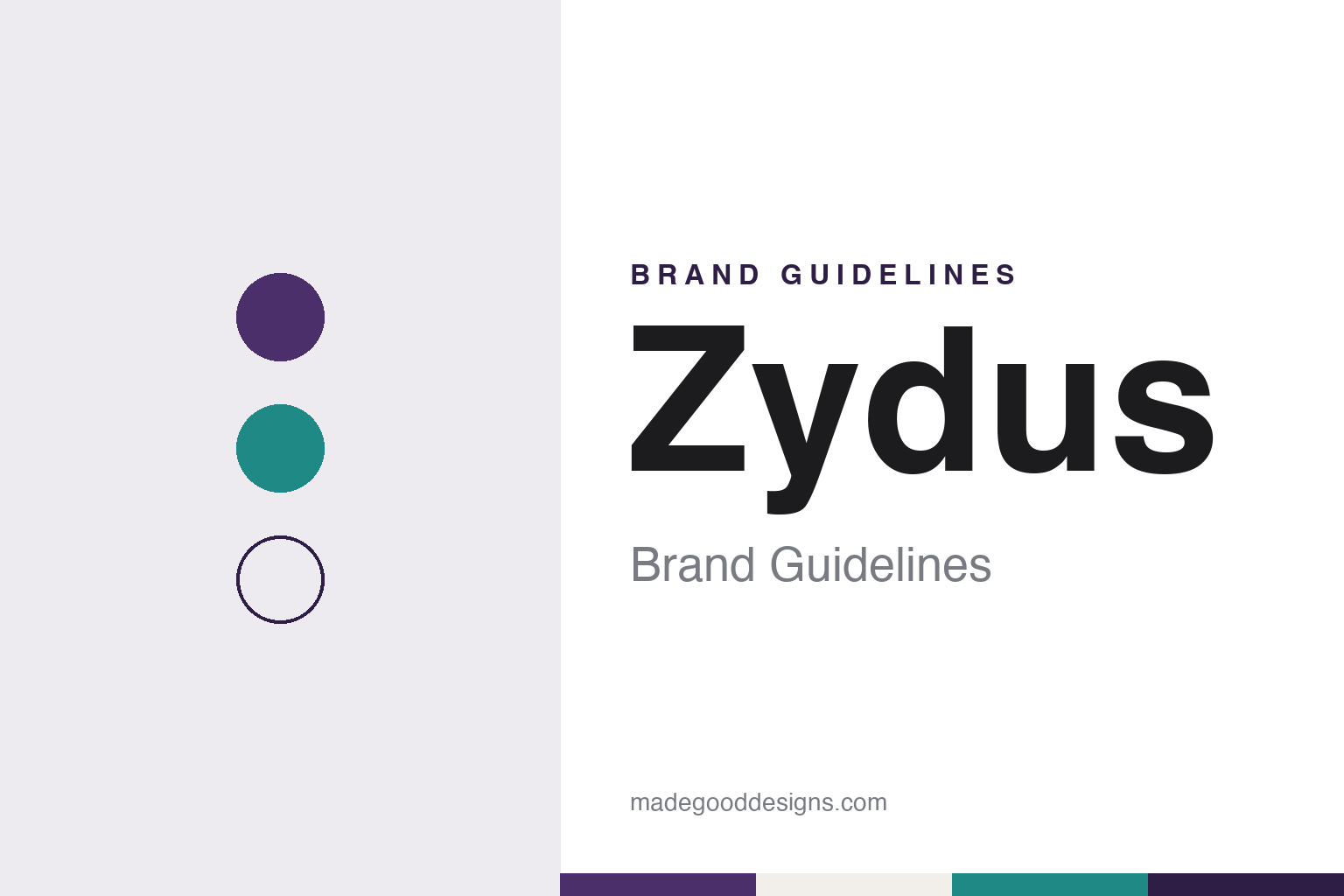
Zydus Brand Guidelines
The Ahmedabad drugmaker that grew out of Cadila and renamed itself around two hearts.
Aa
Two constants: a plum, teal and white palette and a rounded geometric sans register. Abstract homage — not a Zydus product or mark; no pack, logo or product is reproduced.
Cadila, 1952
A pharmacy lecturer, a business partner and a company in Ahmedabad.
Zydus traces its history to Cadila, a pharmaceutical business founded in 1952. English Wikipedia names its founders as Ramanbhai Patel, formerly a lecturer at the L.M. College of Pharmacy, and his business partner Indravadan Modi. The company’s own website tells the story more briefly: it says the business was founded in 1952 by Ramanbhai B. Patel, whom it calls a first-generation entrepreneur, and it dates the group’s origins to the 1950s.
The partnership lasted more than four decades. In 1995, English Wikipedia says, the Patel and Modi families split: the Modi family’s share went into a new company, Cadila Pharmaceuticals, and Cadila Healthcare became the Patel family’s company. Zydus describes the same moment as a restructuring that formed Cadila Healthcare “under the aegis of the Zydus group.” From then on two separate companies carried the Cadila name, and the Patel side gathered its businesses under the Zydus name, the company says.
Cadila Healthcare went public in February 2000, with a listing on the BSE in Mumbai, English Wikipedia says. In 2003 it merged in German Remedies, another Indian drug company, and in June 2007 it bought the Brazilian maker Química e Farmacêutica Nikkho do Brasil as part of Zydus Healthcare Brasil. The Patel family remains the major shareholder, according to Wikipedia; Pankaj R. Patel, the founder’s son, is chairman, and in 2022 Sharvil Patel was managing director, IIFL reported.
Colour
Generics, biosimilars and a vaccine.
Zydus is mainly a maker of generic medicines, but it also sells branded medicines in India and has worked on biologics and new molecules of its own. The company describes itself as “a fully integrated, global healthcare provider,” working across formulations, active pharmaceutical ingredients, animal health and wellness products. Its India business is run by Zydus Healthcare, based in Mumbai, and its biologics business sells biosimilars and vaccines, the company says.
Several products mark its move into more complex medicines. In 2014, English Wikipedia says, Cadila Healthcare launched Exemptia, which both Wikipedia and the company describe as the world’s first biosimilar of adalimumab. Its own research molecule, saroglitazar, is sold in India as Lipaglyn. Wikipedia adds that from late 2015, under a voluntary licence agreement with Gilead, the company made generic sofosbuvir for hepatitis C under the name SoviHep.
During the Covid-19 pandemic the company developed ZyCoV-D. On 20 August 2021, BioSpectrum Asia reported, Zydus Cadila received Emergency Use Authorization from the Drug Controller General of India for the vaccine, which the report described as the world’s first plasmid DNA vaccine for Covid-19, given in three doses with a needle-free applicator made by PharmaJet. Wikipedia adds that Cadila was among the Indian companies licensed by Gilead to make remdesivir.
Its generics also go to the United States. English Wikipedia says that in October 2024 Zydus received approval from the US Food and Drug Administration to make enzalutamide tablets, a medicine used in treating prostate cancer, at its facility in Ahmedabad, as part of a wider push into cancer medicines for the American market.
The group also runs Zydus Animal Health, which the company says serves the livestock and poultry markets in India and has added products for pets. Among the awards it lists on its website are a place among the top five companies in the Developing Markets category of the FT ArcelorMittal Boldness in Business Awards in 2014, and the Economic Times title of “Emerging Company of the Year” for 2010. Its community programme, Zydus Srishti, covers health, education, research and outreach, the company says.
Typography
Generic medicine makers.
Generic-medicine makers sell products that are, by design, meant to match medicines already on the market. That leaves their visual identity with an unusual job: it has to signal reliability and scale rather than novelty, and it often has to work on thousands of packs at once.
The pictures these companies publish tend to repeat a small set of scenes. There are close-ups of blister packs and plain white tablets, shot clean and bright against pale backgrounds. There are pharmacists at a counter handing a box across to a customer, a moment that puts a person between the product and the patient. And there are wide views of large production sites, with long corridors, stainless steel and staff in white coats and hairnets, used to suggest capacity and control.
Packaging is where the system shows most clearly. Because one company may carry a very large range of molecules and strengths, its packs usually rely on a fixed layout with colour bands, stripes or blocks that separate one product or dose from another, while the company name stays in the same place on every box. Corporate material then widens the frame: maps, globes and lines linking continents, meant to picture supply reaching many countries.
The same language appears on the trade-show floor. At industry fairs such as CPHI, where ingredient suppliers, contract manufacturers and generics companies meet, stands lean on large logos, simple colour fields and photographs of laboratories and plants. For a designer, the category is a study in restraint: a clear name, a disciplined colour system and imagery that keeps attention on trust and access.
Aa
A rounded geometric sans for a company that rebuilt its name around a symbol. (Specimen set in Manrope, a sans STAND-IN; NOT the Zydus logo.)
Zydus
Two hearts around “us”.
The current name arrived in February 2022. The Zydus group announced a new brand identity and said its listed company, Cadila Healthcare, would be known as Zydus Lifesciences, IIFL reported on 25 February 2022. In the new logo, the company said, two hearts come together to enclose the letters “us” at the core; the hearts stand for inclusiveness, and the two colours, teal and purple, stand for science and for care. The “us,” it said, stands for everyone with a part in the company, from employees and patients to doctors, investors and business partners. The company now calls itself “Zydus Lifesciences Limited (Formerly known as Cadila Healthcare Limited)” on its website.
The company is headquartered in Ahmedabad, in Gujarat. Its website says its manufacturing sites and research facilities are spread across five Indian states — Gujarat, Maharashtra, Goa, Himachal Pradesh and Sikkim — and that it has more than 30 manufacturing plants worldwide, including in India, Germany, Brazil and the United States. American sites named there include Nesher Pharmaceuticals and Hercon Pharmaceuticals, a maker of transdermal products in Emigsville, Pennsylvania. Among its plants the company also lists a cytotoxic injectables joint venture with Pfizer. English Wikipedia says the company makes active pharmaceutical ingredients at three Indian sites: Ankleshwar, Vadodara and Patalganga. The company names the United States, France, Spain, Latin America and South Africa among its markets, along with 25 other emerging markets.
For a design guide, Zydus shows a renamed company building its identity around a single symbol and two named colours. Compare Sun Pharma and Cipla, two other Indian generic-medicine makers. For this guide we use a deep plum, a teal and soft whites with a sans, an unofficial interpretation; no product or logo is reproduced.
Explore & save
Keep Zydus’s identity on hand — save it to a board in the Made Good inspiration library.
Zydus identity set
Pin the Zydus plum, teal and white palette and the rounded geometric sans register to your own board.