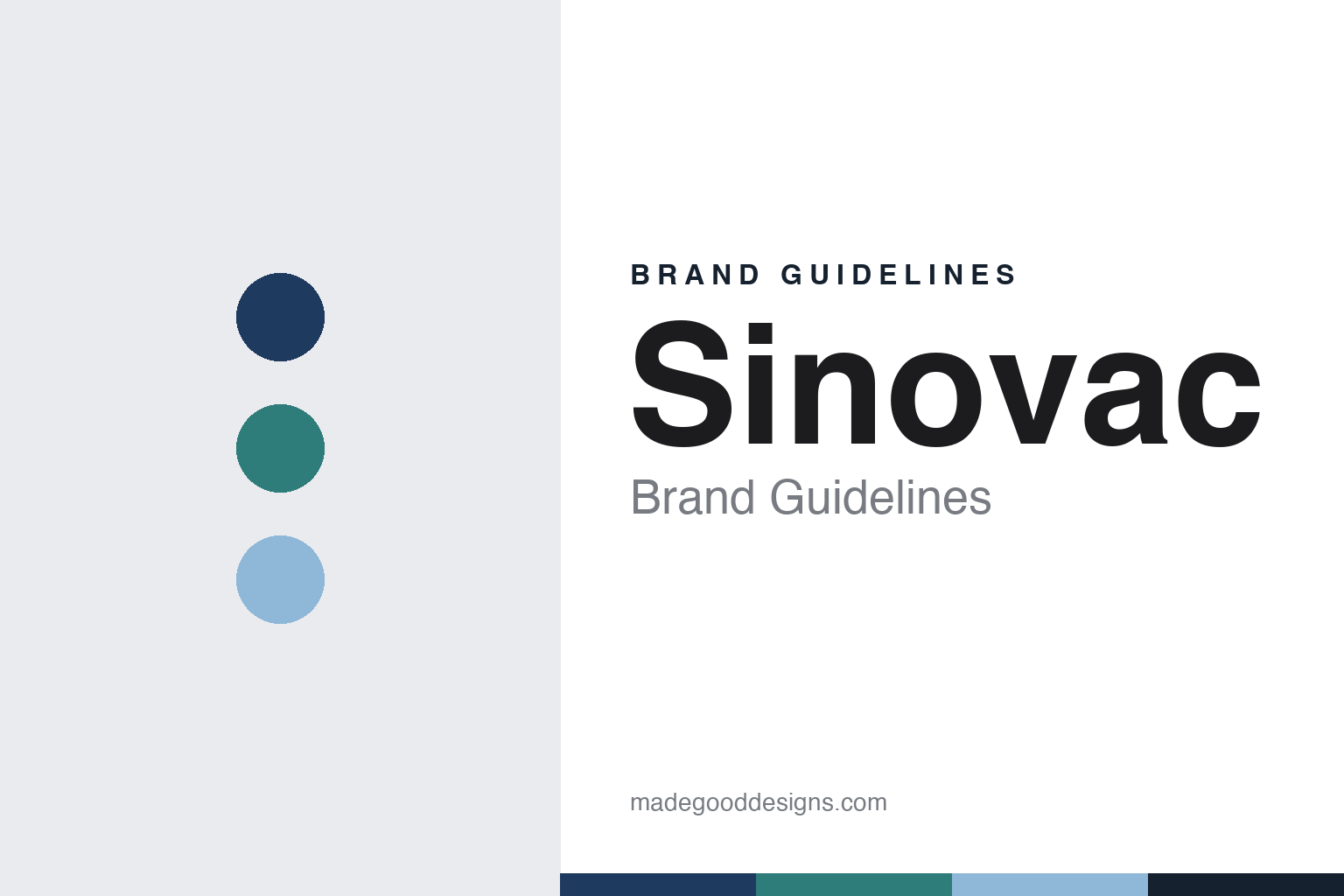
Sinovac Brand Guidelines
The Beijing vaccine maker built on hepatitis A research.
Aa
Two constants: a navy, teal and pale blue palette and a technical sans register. Abstract homage — not a Sinovac product or mark; no vial, pack or logo is reproduced.
From a hepatitis A strain
A Beijing company built on one virus.
Sinovac’s story begins with hepatitis A. The company’s own timeline says its scientists isolated a hepatitis A virus strain, named TZ84, in 1984, developed China’s first enzyme-linked diagnostic reagent for the disease in 1987, and in 1996 began work on an inactivated hepatitis A vaccine together with China’s National Institutes for Food and Drug Control. The vaccine received a new-drug certificate in 1999.
The Beijing operating company was established in 2001, according to the same timeline, and in 2002 it launched Healive, which Sinovac describes as China’s first inactivated hepatitis A vaccine. The business reached American investors quickly: in 2003 its holding company was listed on the OTC Bulletin Board through a reverse acquisition, in 2004 it moved to the American Stock Exchange, and in 2009 it moved again, to the Nasdaq Global Select Market, the company says.
The listed parent, Sinovac Biotech Ltd., is a company incorporated in Antigua and Barbuda whose business, directors and shareholder meetings have been based in China, the Judicial Committee of the Privy Council noted in a judgment of January 2025. Sinovac describes itself as “a global biopharmaceutical company headquartered in China,” working under the mission “Supply Vaccines to Eliminate Human Diseases.”
The company has grown by adding sites and subsidiaries. Its timeline lists Sinovac Zhongwei in Beijing, registered in 2009; a company in Dalian and a new production base at Changping, north of Beijing, in 2010; a fourth production base, at Daxing in Beijing, and a Singapore holding company in 2020; and a joint venture in Türkiye, KeyVac, which it says began production in 2023. In 2025 it opened what it calls Sinovac Life City.
Colour
Hepatitis, influenza and a pandemic vaccine.
Sinovac’s range is made up of vaccines for common infectious diseases. The company lists products for influenza, viral hepatitis, varicella, hand, foot and mouth disease, polio, rabies, tetanus and pneumococcal disease. Its timeline dates Bilive, a combined hepatitis A and B vaccine, to 2005; the seasonal influenza vaccine Anflu to 2006; a pandemic influenza vaccine, Panflu, approved in 2008 for China’s national reserve; and Panflu.1, for H1N1 influenza, to 2009. The company calls Panflu.1 the first H1N1 influenza vaccine in the world. In 2016 it launched Inlive, a vaccine for enterovirus 71, which it describes as an innovative product in China’s “Category 1” for preventive biological products. Varicella, quadrivalent influenza and 23-valent pneumococcal polysaccharide vaccines followed in 2020, and a Sabin-strain inactivated polio vaccine in 2021.
The company began to sell abroad in 2009, when, its timeline says, Healive and Anflu were exported to Mongolia and the Philippines. In 2007 it joined the International Federation of Pharmaceutical Manufacturers and Associations, the global industry body, which Sinovac says made it the first company from a developing country to do so. World Health Organization prequalification, the WHO’s listing of vaccines for purchase by United Nations agencies, came for Healive in 2017, for the polio and varicella vaccines in 2022, and, according to company news of 4 November 2026, for Anflu on 2 November 2026; Sinovac now says four of its vaccines are prequalified.
The product that made the name widely known was CoronaVac, an inactivated COVID-19 vaccine. Sinovac’s timeline says development began in 2020, that the vaccine was granted emergency use that year, and that in 2021 it was included in the WHO’s Emergency Use Listing, with conditional or emergency approvals in dozens of countries including Chile, Türkiye, Brazil and Indonesia. In a March 2025 statement the company said CoronaVac had been approved for use in more than 60 countries and regions.
Recent company news points to partnerships rather than a single product: in September 2026 Sinovac and the Egyptian company GENNVAX launched a technology-transfer project for local production of the polio vaccine in Egypt, and in October 2026 an RSV antibody developed with the Institute of Biophysics of the Chinese Academy of Sciences received clearance for clinical trials in China, the company says.
Typography
How vaccine makers present themselves.
Vaccine makers sell to health ministries, procurement agencies, hospitals and clinicians long before any patient sees a pack, and their visual language reflects that audience. The imagery tends to stay close to the work itself: gloved hands holding a vial up to the light, rows of filled vials on a stainless line, and researchers in lab coats at a bench or a microscope. The point of these pictures is to show process and care rather than spectacle.
Production is a second recurring subject. Company photographs often show clean production suites, with staff in full gowns, hoods and masks behind glass, and long views of filling lines, bioreactors and freezers. For mRNA companies in particular, the plant itself has become part of the story, and new sites tend to be photographed and announced as milestones in their own right.
A third strand is global health. Vaccine makers frequently show clinics, community health workers and the cold chain: insulated boxes, refrigerated trucks and storage rooms that keep doses within a temperature range on the way to where they are used. Maps, partner logos and the names of public bodies often sit alongside these images, because much of the business runs through governments, international agencies and non-profit funders.
The trade has its own meeting places. Conferences such as the World Vaccine Congress and ESCMID Global, the congress of the European Society of Clinical Microbiology and Infectious Diseases, bring companies, researchers and buyers together. In a field where so many pictures show similar vials, gowns and laboratories, a name, a typeface and a single accent colour often do much of the work of telling one company from another.
Aa
A clean technical sans for a laboratory register. (Specimen set in IBM Plex Sans, a sans STAND-IN; NOT the Sinovac logo.)
A contested board
A shareholder dispute that reached London.
For several years Sinovac’s corporate story has been dominated by a dispute over who controls its listed parent. In early 2016 two rival groups offered to take the company private, one led by its management and one including Sinobioway, a minority shareholder in one of the main operating subsidiaries, the Privy Council recorded. In March 2016 the board adopted a shareholder rights agreement, often called a poison pill. At the annual general meeting in February 2018, a group of shareholders including the Delaware company 1Globe Capital voted to remove the sitting directors and elect a new slate without prior notice; the company contested that vote in the courts of Antigua and Barbuda.
On 16 January 2025, hearing the appeal from the Court of Appeal of the Eastern Caribbean Supreme Court, the Judicial Committee of the Privy Council in London allowed 1Globe’s appeal and declared that the new directors had been duly elected at the 2018 meeting. In a statement of 3 March 2025, Sinovac said it had received the formal order on 8 February 2025, that the rights agreement was void and the shares issued under it would be cancelled, and that trading in its shares on Nasdaq had been halted for six years as a result of that agreement; it said its new board was working with Nasdaq on the continued listing of its shares.
The dispute did not end there. The investor SAIF Partners said on 10 July 2025 that at a special meeting on 8 July the company’s chairman had convened and then adjourned the meeting, after which shareholder representatives continued it and, by SAIF’s tally, voted to remove the directors and elect SAIF’s ten nominees. Each side has given its own account in public statements. Through this period the company has kept announcing product and partnership news, including the prequalification of Anflu in November 2026.
For a design guide, Sinovac shows a vaccine maker whose public image rests on named products and long product histories rather than a single mark. Compare Serum Institute of India, another large vaccine maker outside Europe and North America, and GSK. For this guide we use a laboratory navy, a vial teal and a pale cold-chain blue with a sans, an unofficial interpretation; no product or logo is reproduced.
Explore & save
Keep Sinovac’s identity on hand — save it to a board in the Made Good inspiration library.
Sinovac identity set
Pin the Sinovac navy, teal and pale blue palette and the technical sans register to your own board.