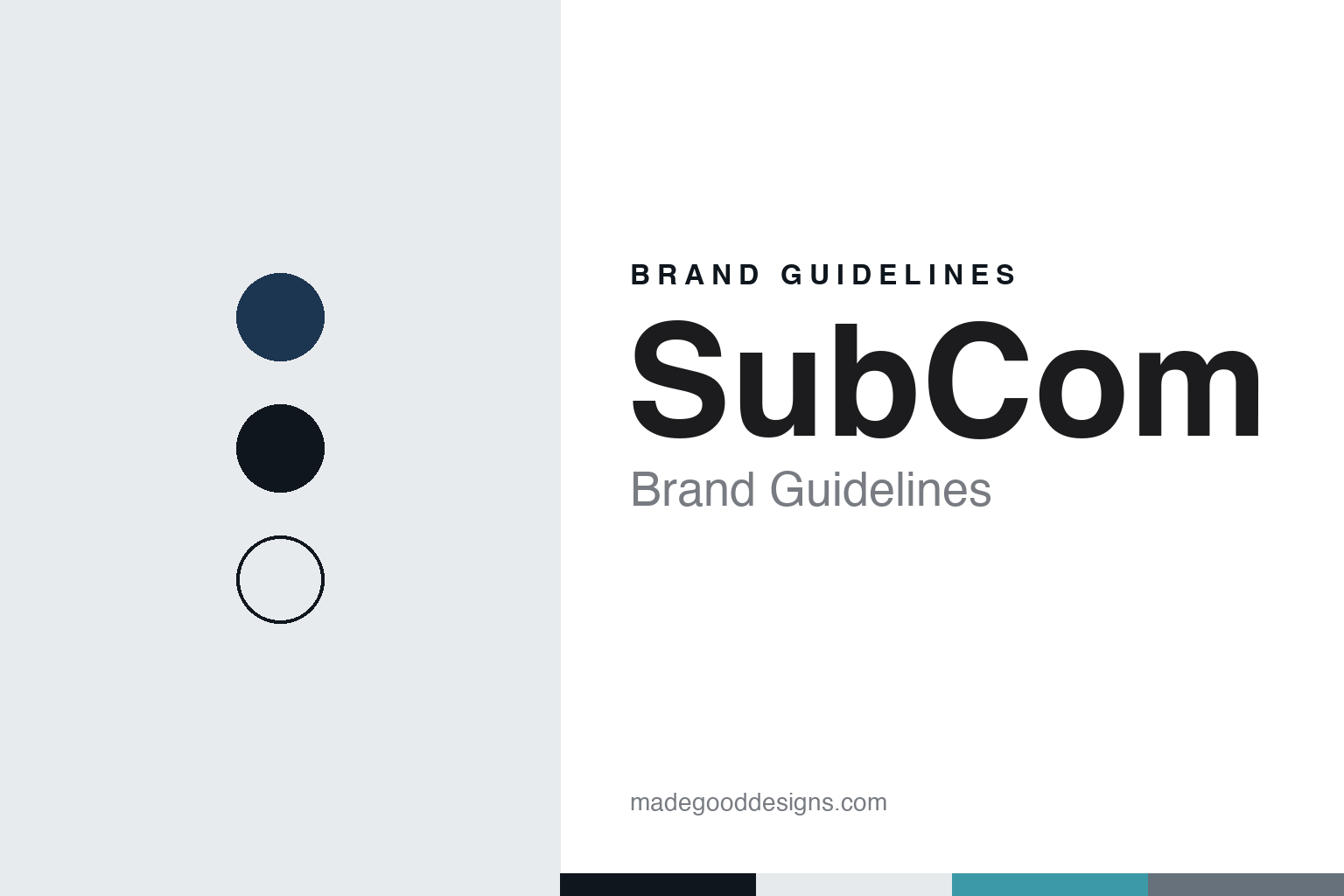
SubCom Brand Guidelines
A Cambridge wire maker’s river plant that became an ocean-cable company.
Aa
Two constants: a navy, steel grey and fibre cyan palette and an engineering sans register. Abstract homage — not a SubCom product or mark; no cable, ship, logo or nameplate is reproduced.
Simplex
A Boston wire shop, a Cambridge cable works and a river plant.
SubCom is the subsea cable company of Eatontown, New Jersey. It designs, makes, lays and maintains the fibre-optic cable systems that cross oceans, and its own website dates its entry into communications to 1955 while speaking of origins in the mid-19th century. The factory behind both claims stands on the Piscataqua River at Newington, New Hampshire.
That factory began under another name. The International Directory of Company Histories (1998) traces the line to 1842, when Charles A. Morss and Oliver Whyte formed a partnership in Boston to make steel-wire goods. Morss turned to insulated electrical wire in the 1880s, and in 1895 the business was incorporated in Cambridge, Massachusetts, as the Simplex Wire & Cable Company. In 1926, the same history says, Simplex applied for a patent on deproteinised rubber, the basis of its Anhydrex-insulated cables, and in 1933 it made an Anhydrex submarine cable for the Coast Guard to link the Florida mainland with Fowey Rocks Light.
During the Second World War, the directory records, Simplex worked mainly for the US services: it laid 3,300 miles of cable for the Signal Corps in Alaska, made submarine cable for the Navy and the Coast Guard, and with Bell Labs produced special submarine cable that was shipped to the Soviet Union in 1944. After the war the Cambridge works was too small, and the services wanted their orders made at a more secure site, so the submarine-cable division moved to a new plant beside a deep-water tidal river. The directory gives the Newington opening as 26 November 1953; NH Business Review wrote in May 2025 that the plant first opened in 1955, the year SubCom uses for its start in communications.
Colour
From TAT-1 to TAT-8.
Newington put Simplex into the transatlantic telephone. According to the directory, Simplex built the American portion of TAT-1, the first transatlantic telephone cable, a joint project of AT&T, the British Post Office and Canadian partners that opened to the public on 25 September 1956, and it had worked with Bell Labs and Western Electric on the repeatered cable designs behind it. From 1953 until about 1976, a Simplex marketing representative is quoted as writing, around nine-tenths of the plant’s business was surveillance cable for the US government.
Fibre came next. The directory says Simplex began research on undersea fibre-optic cable in 1976 and, after a ten-year joint effort with Bell Labs, completed OPTICAN-1 in 1986, which it describes as the first undersea repeatered fibre-optic cable. In 1988 Simplex cable went into TAT-8, which the directory calls the first transoceanic optical-fibre telecommunications cable, linking the United States with the United Kingdom and France.
Ownership had already moved on. Simplex became a wholly owned subsidiary of Tyco International in 1974 and was renamed Simplex Technologies in 1994, and by 1997 it was supplying cable to AT&T Submarine Systems, which the directory notes was later known as Tyco Submarine Systems, for the FLAG system between the United Kingdom and Japan. By 2018 the business traded as TE SubCom, the subsea communications business of TE Connectivity.
Typography
Design and documentation.
Optical fibre and submarine cable are hard things to picture. The working product is a strand of glass thinner than a hair, or a cable that spends its life on the seabed, so the companies that make them borrow images from the process instead. The most familiar is the fibre itself: glowing strands fanned out against a dark ground, light running along their length and spilling from the cut ends.
Factory pictures come next. Fibre makers show preform towers, the tall draw towers where a glass rod is heated and pulled into fibre, and long rows of spools. Submarine cable makers show their ships: cable ships alongside a quay, giant circular tanks of coiled cable in the hold, and ploughs or remotely operated vehicles lowered over the stern. World maps traced with submarine routes, each line ending at a landing point on a coast, carry the same story on a website or a trade-show wall.
People appear mostly at work. Technicians splice fibre inside clean tents on a deck or a beach, engineers check repeaters on a test bench, and crews guide cable ashore at a landing site. The trade also has its own stages, such as the OFC conference for optical communications and the SubOptic conference for the submarine cable industry, where the same strands, cross-sections and route maps return on booths and slides.
This guide looks past those shared images to what can be checked about each company: who founded it, who owns it now, where it makes its fibre or cable, which systems it is known for, and which events in its history, from mergers to changes of owner, shaped the name it trades under. Where a claim rests only on a company’s own word, we say so.
Aa
An engineering sans — Simplex, TE SubCom, SubCom. (Specimen set in Archivo, a sans STAND-IN; NOT the SubCom logo.)
SubCom
A Cerberus company since 2018.
TE Connectivity agreed in September 2018 to sell the business to Cerberus Capital Management, the New York private-equity firm, and Lightwave reported on 5 November 2018 that the purchase was complete. The former TE SubCom would operate as SubCom, LLC, headquartered in Eatontown, with David Coughlan, its general manager from 2001 to 2014, returning as chief executive. In April 2026 Converge Digest reported that Cerberus had raised new capital for SubCom through a continuation vehicle led by CVC Secondary Partners, with Cerberus-managed funds keeping a controlling stake.
At the time of the 2018 sale, Lightwave put SubCom’s record at more than 200 submarine networks built, with more than 1,400 employees across four continents. Converge Digest, reporting in May 2025, listed recent SubCom systems including Havfrue/AEC-2 between the United States and northern Europe, JUPITER between Japan, the Philippines and the United States, and Southern Cross NEXT in the Pacific.
Newington is still the centre of the work. SubCom describes a 50-acre manufacturing campus with a deep-water pier there, and NH Business Review reported in 2025 that about 1,100 of the company’s people work at the plant, with a maritime division and cable-ship operations in Baltimore, Maryland. In May 2025 SubCom marked what it called the first million kilometres of subsea cable deployed by a single company, a distance it compares with circling the Earth more than 25 times. Systems it names on its website include SEA-ME-WE 6, Firmina, IRIS and Grace Hopper.
For a design guide, SubCom shows how a cable maker can trade a long factory name for a short functional one: Simplex Wire & Cable became Simplex Technologies, then TE SubCom, then simply SubCom, while the river plant at Newington stayed in use. Compare Alcatel Submarine Networks, the French maker of the same kind of systems, and NEC, the Japanese group also in the submarine cable trade. For this guide we use a deep navy, steel grey and a cool fibre cyan with a sans, an unofficial interpretation; no product or logo is reproduced.
Explore & save
Keep SubCom’s identity on hand — save it to a board in the Made Good inspiration library.
SubCom identity set
Pin the SubCom navy, steel grey and fibre cyan palette and the engineering sans register to your own board.