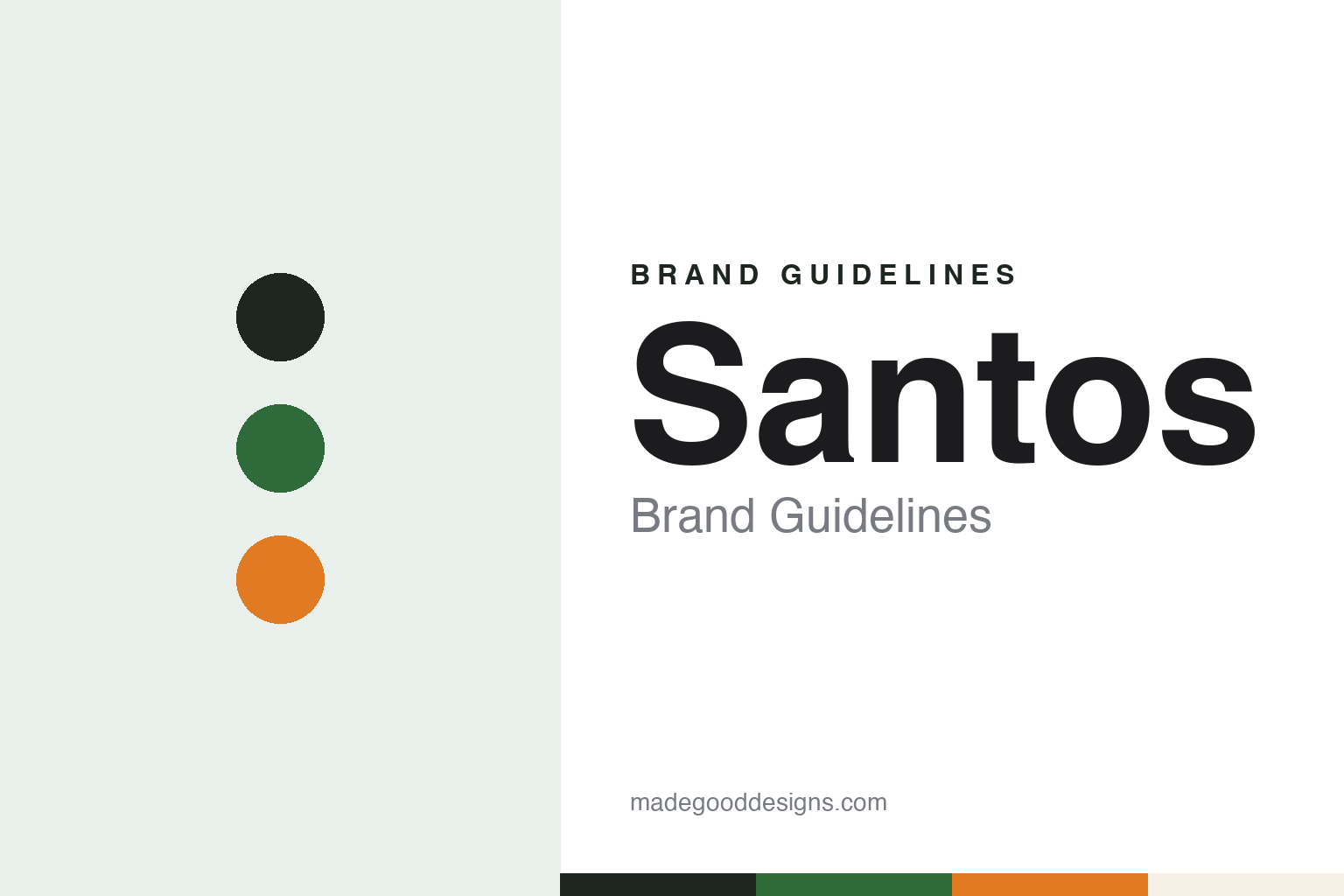
Santos Brand Guidelines
The Lyon maker that gives every machine a number.
Aa
Two constants: a leaf green, citrus orange and cream palette and a warm serif register. Abstract homage — not a Santos product or mark; no machine, logo or nameplate is reproduced.
A Lyon workshop
Coffee grinders and cheese graters first.
Santos is a French maker of juicers, blenders and coffee grinders for bars, cafés and professional kitchens, based on the eastern edge of Lyon. The company says it was founded in 1954 by André Fouquet, and that its first products were professional coffee grinders and cheese graters sold to small shops. Its website carries the line “Manufacturer since 1954,” and the company says its #11 citrus juicer was born that same year.
The French business register records the present company, Santos, as a simplified joint-stock company created in 1956, with its head office at Vaulx-en-Velin, a town in the Lyon metropolitan area, and dates its current site there to 1983. The register classes Santos as a maker of machinery for the food industry, lists it as a small or medium-sized business, and places it in the 50-to-99-employee band in 2024.
The name is shared widely. Santos is also an Australian oil company founded in 1954, the same year the Lyon firm gives for itself, as well as a city in the Brazilian state of São Paulo and a Brazilian football club. None of them has any link to the appliance maker, which signs its website and social accounts simply as Santos and uses the tag #santosaddict.
Over seven decades the company has stayed with small electrical machines. It says its research and development department builds new products on its own know-how in motors, and that this is one reason its machines have a name for robustness; it now sells three ranges, for juice bars, kitchens and coffee.
Colour
Machines known by number.
Santos identifies its machines by number rather than by name, and the numbers have become part of the brand. In the juice-bar range are citrus juicers such as the #11 and the lever-operated #10, centrifugal juice extractors such as the #68, sold as the “Miracle Edition,” and the #50, and a cold-press juicer, the #65, which carries the name Nutrisantos. The company says the #11 is usually recognised by its orange and green colouring; after the Host show in Milan in October 2019, where visitors voted on new colours, it made a limited edition of 200 in a duck blue.
Blenders form a second family. The #62 and #66 use brushless motors, and Santos says it was the first company to put a brushless motor in a blender; it has since added a vibration-absorbing system it calls Flextor to both. The #33 bar blender, the #54 drink mixer and the #53 ice crusher complete the bar range.
Coffee grinders, the company’s oldest line, now run from on-demand espresso grinders such as the #59 and #55 to shop grinders that grind beans to order and specialty models such as the I-Grind #67. The kitchen range adds the #37 kitchen blender, which gained a Chef Stick accessory in September 2021, a 10-litre dough mixer, a grater and a meat mincer. The website also lists a citrus juicer under the Mefra name.
Santos lists among its awards a Host Smart Label, a Grand Prix Sirha Innovation, a Snacking d’Or and a Gulfhost Innovation Award. Its news page says the Nutrisantos #65 received the Host Smart Label in 2017, its fourth award that year. Alongside the catalogue, the website publishes recipes in four groups, fresh drinks, food preparation, coffee and cocktails, written to show the machines in use behind a bar or in a kitchen.
Typography
How the category presents itself.
Makers of commercial food-preparation equipment sell to a practical audience: chefs, bar owners, butchers, bakers and the dealers who fit out their kitchens. Their brands are built less on advertising than on catalogues, spec sheets and demonstrations, and the machines themselves, slicers, mixers, stick blenders, juicers and vegetable cutters, do most of the talking.
The imagery of the category is consistent. Machines are shown as cut-outs on white for the catalogue, or set on stainless-steel counters in a working prep kitchen, often with a chef’s hands at the controls. Close-ups of blades, discs, bowls and whisks stand in for the engineering inside, and a colour on a base or a housing can become part of a machine’s identity.
Trade fairs carry much of the brand work. Host in Milan, Internorga in Hamburg and the National Restaurant Association Show in Chicago are among the shows where makers set up working stands, run live demonstrations and launch new models to importers and dealers; Dynamic says it launched its combined vegetable slicer at Host, and Santos says it chose a limited colour for its #11 juicer after a visitor vote there in 2019.
Some of these makers are independent companies and some sit within larger industrial groups, and several make the place where their machines are built part of their identity. This guide sets out what can be checked about each brand, who founded it, who owns it and what it says about where its products are made, and marks clearly what rests only on the company’s own word.
Aa
A warm serif for a café-counter maker. (Specimen set in Fraunces, a serif STAND-IN; NOT the Santos logo.)
Santos
Made in Lyon, by its own account.
Santos puts its origin at the centre of its brand. Its website says “100% made in France” and states that since 1954 all its machines have been designed and made in its own factory in Lyon, with a network of local suppliers. It says each appliance is assembled by hand by an operator who follows it from the start of production to the final check, and that every machine is tested after assembly. Those are the company’s statements.
It also presents its machines as built to last and to be repaired. Santos says spare parts stay available for more than ten years after a model leaves production, that it favours recyclable stainless steel and aluminium, and that it has moved to packaging in moulded cellulose. Its news pages describe a factory refit, with a new roof, LED lighting throughout and decorative tarpaulins on the building.
Abroad, Santos says it is represented in more than 130 countries through resellers and importers, and that its machines are adapted to local voltages and to standards it names as UL, GS, CE, NSF and KC. Its news page lists a busy round of fairs: Host in Milan in October 2025, Gulfhost in Dubai in November 2026, and, for the coffee range, World of Coffee in Jakarta, Geneva and Brussels and the Paris Coffee Show.
For a design guide, Santos shows how a plain numbering system can work as a brand asset, with the #11 juicer recognised behind bar counters by its number and its colours. Compare Dynamic, another French maker of professional kitchen machines, and Robot-Coupe. For this guide we use leaf green, citrus orange and cream with a serif, an unofficial interpretation; no product or logo is reproduced.
Explore & save
Keep Santos’s identity on hand — save it to a board in the Made Good inspiration library.
Santos identity set
Pin the Santos leaf green, citrus orange and cream palette and the warm serif register to your own board.


