Octapharma Brand Guidelines
A Swiss family company named after a clotting factor.
Aa
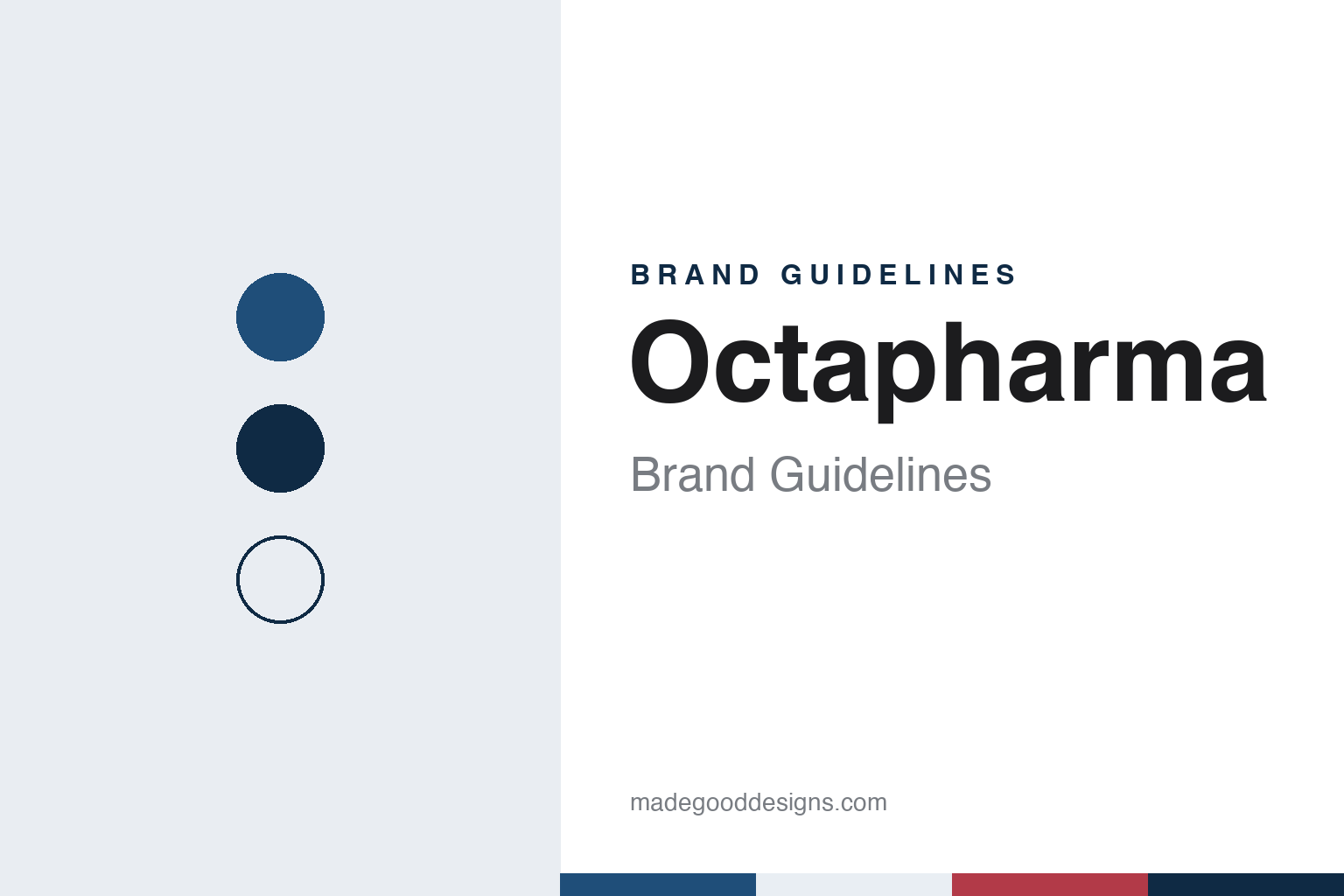
Two constants: a blue, navy and red palette and a clean humanist sans register. Abstract homage — not an Octapharma product or mark; no vial, pack or logo is reproduced.
Factor VIII
Two colleagues, one clotting factor and a licence from New York.
Octapharma was founded in Switzerland in 1983. The trade magazine CHEManager, in an October 2023 article marking the company’s 40 years, dates the founding to 2 June 1983 and names two founders: Wolfgang Marguerre and Robert Taub, long-time friends who had worked together in plasma products. English Wikipedia describes Marguerre as a German businessman who had previously worked in the pharmaceutical industry. The company’s own timeline today names Marguerre alone as the man who established it.
The name is the story. “Octa” is Greek for eight, and it points to Factor VIII, the clotting protein that is deficient in people with haemophilia A, English Wikipedia and CHEManager both say. The early 1980s were the years when hepatitis and HIV were being passed on through blood products, and CHEManager reports that the founders set out to find a way of inactivating such viruses in clotting-factor concentrates.
They found it at the New York Blood Center, where researchers were working on a solvent/detergent method aimed at viruses with a lipid coat. According to CHEManager, Octapharma licensed the method, hired its first full-time employee to adapt it with the New York team, and refined it at a German Red Cross site before working as a contract manufacturer for several European fractionators. The company says it secured a patent and a licence for the method in 1984, and that in 1985 it launched octavi, its first virus-inactivated Factor VIII concentrate.
In 1995, CHEManager reports, the two founders went their separate ways. Wolfgang Marguerre remains chairman and chief executive, and English Wikipedia says the company is still owned by the Marguerre family, with his sons Frederic and Tobias on the management board and Tobias as deputy chairman.
Colour
Plasma in, proteins out.
Octapharma’s business is plasma fractionation: separating donated human plasma into proteins that become medicines. English Wikipedia describes three areas of work, which the company also uses on its website: haematology, with clotting-factor concentrates for haemophilia A and B and von Willebrand disease; immunotherapy, with immunoglobulins; and critical care, with plasma and protein products for intensive care and emergency medicine. Alongside plasma, it works with proteins made in human cell lines; German Wikipedia says the first such product, a recombinant Factor VIII, was approved in Europe in July 2014.
The factories came step by step. CHEManager says Octapharma bought its first fractionation plant, in Vienna, in 1989, growing from a twelve-person business to 150 staff; the company dates the plant’s opening to 1990, the same year it set up a visual inspection and packaging site in Dessau, Germany. Its own timeline continues with a laboratory in Frankfurt in 1992, a plant in Lingolsheim, near Strasbourg in France, in 1999, a plant in Stockholm in 2002 — which it says is the only site making its recombinant products — and a plant at Springe, near Hanover, in 2008. German Wikipedia names the same four fractionation sites and says the Vienna plant, in the Favoriten district, was expanded from autumn 2023 and had more than 1,500 staff by the end of 2024.
The United States became a market in 2003, when the company says the FDA approved its immunoglobulin octagam. Plasma collection followed: the company says it bought five German donation centres in 2006 and founded Octapharma Plasma Inc. in 2007 to run its own centres in the US. German Wikipedia adds that the Deutsche Gesellschaft für Humanplasma, owned since 2006, was renamed Octapharma Plasma GmbH in November 2014. Research is spread across Vienna, Frankfurt, Berlin and Heidelberg, where the company opened an institute for recombinant proteins in 2012.
Typography
Design and documentation.
Plasma companies sell medicines that most people never see on a shelf, so their public image is built around the people at either end of the chain. Websites, annual reports and recruitment pages for the sector tend to open on donors: someone relaxing in a reclining chair in a bright, clean collection centre, a nurse at their side, with the equipment kept small in the frame. The tone is calm and grateful rather than clinical.
The middle of the chain is shown through hands and buildings. Close-ups of gloved hands holding vials, labelled blood bags and racks of tubes signal laboratory care without showing a face, while aerial photographs of large fractionation plants, steel tanks and clean-room corridors stand for scale. Collection-device makers add their own register of machines, tubing sets and touchscreens, usually photographed on white.
At the far end are patients. Several of the conditions these medicines are used for are rare, and the companies’ storytelling often leans on named families, children and long-term patients, often filmed at home or outdoors, alongside patient-organisation partnerships and awareness days. Scientific credibility is carried by medical congresses such as those of the International Society on Thrombosis and Haemostasis (ISTH) and the American Society of Hematology (ASH), and by industry meetings such as the Plasma Protein Forum.
The visual identities themselves are mostly quiet: corporate sans-serif wordmarks, generous white space and restrained palettes, with brand colour used sparingly against photography. This guide sets out what can be checked about each brand — who founded it, who owns it and where it says its products are made — and marks clearly what rests only on the company’s own word.
Aa
A clean humanist sans for a science-led company. (Specimen set in Plus Jakarta Sans, a sans STAND-IN; NOT the Octapharma logo.)
Octapharma
Family-owned since 1983, in its own words.
Octapharma is headquartered in Lachen, Switzerland. It describes itself as “the largest privately owned and independent plasma fractionator in the world,” and uses the line “Family-owned since 1983” on its website; both are its own claims. English Wikipedia puts its workforce at around 11,000 people at the end of 2024, with products used in some 120 countries and more than 190 plasma donation centres across Europe and the US. The company says that 88% of the plasma it uses comes from its own donation centres.
Its US donor network made news in April 2024. Around 17 April the company detected suspicious activity in its computer systems and its US donation centres were temporarily closed, the HIPAA Journal reported in October 2025; English Wikipedia says the attack was reportedly carried out with BlackSuit ransomware. Class actions filed after the breach were consolidated into one case, and in 2025 a settlement received preliminary court approval; Octapharma disputed the claims and maintained there was no wrongdoing, the HIPAA Journal reported.
The company marked its 40th anniversary in 2023. On its website it describes its vision as “new health solutions advancing human life,” and its milestone pages are illustrated with simple drawings of microscopes and medicine bottles.
For a design guide, Octapharma shows how a company name can carry its founding purpose: a Greek number for a clotting factor, kept by a family firm for four decades. Compare Grifols, another plasma fractionator with a founding family, and Biotest, a German plasma-protein maker. For this guide we use a lake blue, a night navy and a muted red with a sans, an unofficial interpretation; no product or logo is reproduced.
Explore & save
Keep Octapharma’s identity on hand — save it to a board in the Made Good inspiration library.
Octapharma identity set
Pin the Octapharma blue, navy and red palette and the clean humanist sans register to your own board.