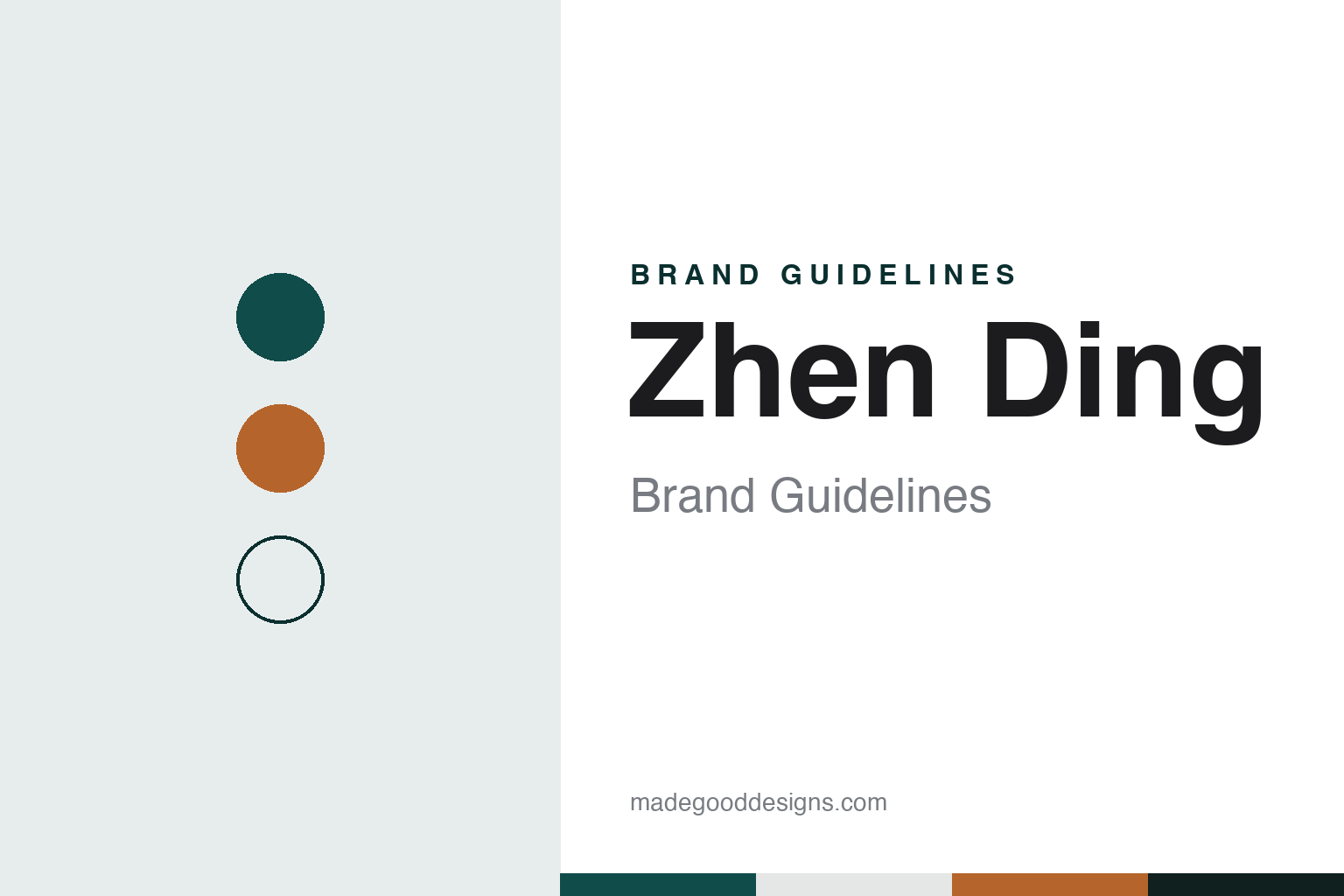
Zhen Ding Brand Guidelines
A Foxconn-born board group that grew around flexible circuits.
Aa
Two constants: a deep teal, copper and pale silver palette and a geometric sans register. Abstract homage — not a Zhen Ding product or mark; no board, logo or nameplate is reproduced.
Foxconn Advanced Technology
A Cayman holding company built from Foxconn’s board plants.
Zhen Ding Technology began life inside the Foxconn group. According to the company’s own history, Foxconn Advanced Technology Limited was established in the Cayman Islands in June 2006, and in October that year it bought all of the shares of Hung Sheng Electric Integration Technology. The company traces its manufacturing roots further back, to a factory at Fuyong in Shenzhen that it says ran from 1999 to 2009 and served as the foothold from which the group built a global circuit-board business.
The holding company grew by gathering plants in mainland China. Its history lists new subsidiaries at Yingkou and Qinhuangdao in January 2007, the purchase of Fu Kui Precision Component (Shenzhen) in April 2007, a plant at Yantai later that year and one at Huai’an in April 2008. In June 2011 shareholders renamed the company Zhen Ding Technology Holding Limited, and in December 2011 it was listed on the Taiwan Stock Exchange. Its Chinese name is 臻鼎, and the group headquarters is at Dayuan in Taoyuan, northern Taiwan, the company says.
The Foxconn link remained. The Taipei Times reported in August 2018 that Hon Hai Precision Industry, the Taiwanese company behind the Foxconn Technology Group, held 38 percent of Zhen Ding, and described the Cayman Islands-incorporated firm as part of Apple’s supply chain. In April 2019 the same paper again put Hon Hai’s holding at about 38 percent.
Colour
Flexible boards first, then almost every kind of board.
Zhen Ding has long been described by its flexible printed circuit boards, the thin, bendable boards it lists first among its products. In 2018 the Taipei Times called it one of Taiwan’s leading flexible board suppliers, and in 2019 “the nation’s leading” one. The 2019 report said its range also took in rigid boards, high-density interconnect (HDI) boards and automotive boards, and that the market research firm Prismark ranked it the world’s largest PCB maker by revenue in 2018, ahead of Japan’s Nippon Mektron and the US company TTM Technologies.
Today the company lists flexible boards, substrate-like PCBs, HDI boards, rigid boards, rigid-flex boards, IC substrates and modules. It presents the group as a “one-stop shop” built around four core subsidiaries: Avary Holding, Leading Tech, Boardtek Electronics and Brai Technology. It says that at the end of 2025 the group employed more than 52,000 people at over 22 locations in Taiwan, mainland China, North America, Japan, South Korea, Vietnam and Thailand. Its website groups the uses of its boards under headings that run from mobile phones, computers and wearables to data centres, base stations, cars, robots and industry.
Avary is the largest piece. The company says Fu Kui Precision Component (Shenzhen) was reorganised and renamed Avary Holding (Shenzhen) in December 2017. The Taipei Times reported in August 2018 that Zhen Ding held 80.9 percent of Avary, which made HDI and flexible and rigid boards in Huai’an, in Jiangsu, and Qinhuangdao, in Hebei, and that China’s securities regulator had approved its share offering; the company says Avary listed on the Shenzhen Stock Exchange on 18 September 2018.
The move into chip packaging came later. The company says Leading Interconnect Semiconductor Technology was founded in Shenzhen in August 2019 to make high-end IC substrates and semiconductor packaging, with a Qinhuangdao unit added in March 2021 for flip-chip chip-scale packages. In Taiwan, Zhen Ding took full ownership of Boardtek Electronics, a Taoyuan board maker founded in 1987 as Yuen Foong Electronics, through a share swap in November 2020, and set up Garuda Technology’s plant in the Southern Taiwan Science Park at Kaohsiung in April 2022.
Typography
Boards and substrates.
Printed circuit boards sit inside almost every electronic product, yet the companies that make them rarely sell to the public. Their brands are written for engineers, buyers and investors, and their pictures tend to come from a short, shared list: a green or black board lit from the side so that its copper traces catch the light, a macro shot of vias and solder pads, or the gold-plated contact fingers along a board’s edge.
The factory is the other recurring subject. Board makers show long plating lines, rows of drilling machines, clean rooms and inspection stations, because scale and process are what they are selling. Flexible circuits get their own pose — a thin amber strip curled over a fingertip — while makers of IC substrates, the fine-lined carriers that sit between a chip and its board, tend to show close-ups of dense, glossy panels rather than finished products.
Names are often short and technical: TTM Technologies, for one, says its initials stand for “time-to-market.” Few makers publish formal colour standards, so the palettes in these guides are our own reading of the trade’s materials — the green of solder mask, the dark of laminate, the warm metal of copper and gold — rather than any company’s specification.
The trade meets at its own shows. The TPCA Show in Taipei gathers Taiwan’s board and substrate makers and their suppliers, and the electronica fairs, in Munich and elsewhere, bring board makers together with the component and equipment trade; TTM Technologies, for one, announced that it would exhibit at electronica India in Bangalore in 2026. The makers in this guide are spread across the United States, Taiwan, mainland China, Japan and Europe, and several of them run plants in more than one of those places.
Aa
A clean geometric sans for a group that sells to other brands. (Specimen set in Sora, a sans STAND-IN; NOT the Zhen Ding logo.)
Zhen Ding
Taiwan, mainland China and now Thailand.
The company’s locations page names manufacturing campuses in Shenzhen, Huai’an and Qinhuangdao in mainland China and plants at Taoyuan and Kaohsiung in Taiwan, and counts five major manufacturing campuses across Taiwan, China and Thailand. In April 2026 Taiwan News reported that the group had begun building 23 factories in a science park in Jiangsu Province, and quoted chairman Charles Shen as saying that Zhen Ding had ranked first in global PCB industry revenue for nine consecutive years and was turning from a traditional board maker into a supplier of components for AI servers. The same report described the group’s smart factory at Kaohsiung as making high-layer, high-density, fine-pitch boards for AI servers, communications equipment, electric vehicles and robotics.
The newest site is in Thailand. Zhen Ding set up Peng Shen Technology (Thailand) in September 2023 as a joint venture between Avary and Thailand’s Saha Group, and began building on more than 40 hectares in Prachinburi Province in December 2023, the company says. The Nation in Bangkok reported the venture as a collaboration between Saha Group, through Saha Pathana Inter-Holding, and Zhen Ding, and Taiwan News reported in April 2026 that the first Thai plant began production in May 2025, making boards for high-end servers, cars and optical communications, with work on a second plant starting the same month.
For a design guide, Zhen Ding shows a holding company whose own name stays in the background while its boards go into other companies’ products. Compare Foxconn, whose Hon Hai held about 38 percent of Zhen Ding in 2018, the Taipei Times reported, and Unimicron, another Taiwanese board maker. For this guide we use a deep teal, copper and a pale silver with a sans, an unofficial interpretation; no product or logo is reproduced.
Explore & save
Keep Zhen Ding’s identity on hand — save it to a board in the Made Good inspiration library.
Zhen Ding identity set
Pin the Zhen Ding deep teal, copper and pale silver palette and the geometric sans register to your own board.