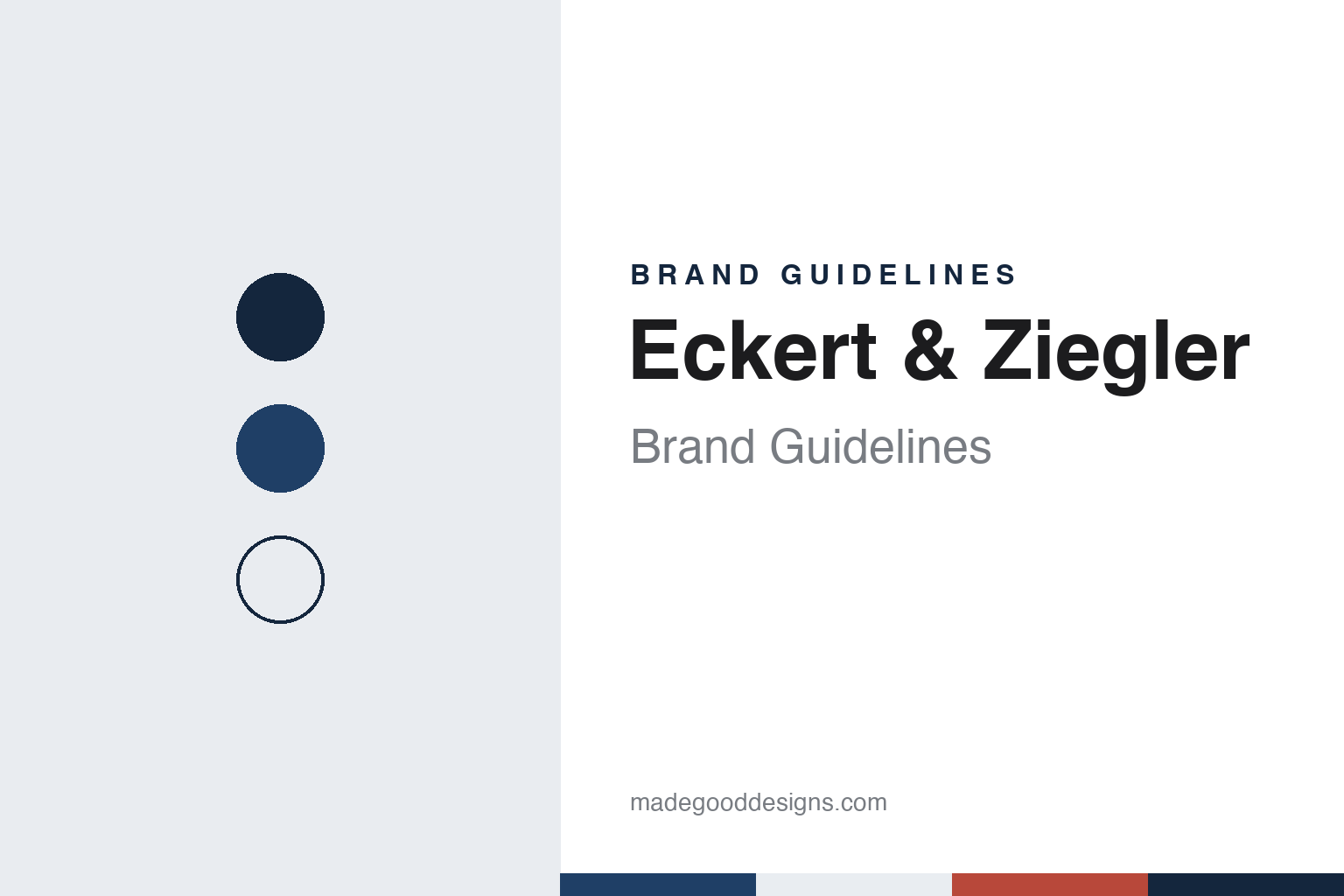
Eckert & Ziegler Brand Guidelines
The Berlin isotope group that grew out of a former East German research institute.
Aa
Two constants: a navy, grey and red palette and a technical sans register. Abstract homage — not an Eckert & Ziegler product or mark; no source, generator, logo or label is reproduced.
BEBIG
Two founders, a wound-up institute and a set of patents.
Eckert & Ziegler began in Berlin in the months after German reunification. German Wikipedia, citing the company’s own history, traces it to the Zentralinstitut für Isotopentechnik, a research institute of the former Academy of Sciences of the GDR. When the institute was wound up, Jürgen Ziegler, who had worked at the Institut für angewandte Isotopenforschung, and Andreas Eckert founded BEBIG Isotopentechnik und Umweltdiagnostik GmbH in 1992. They took over the institute’s premises and patents and began making low-activity radiation sources for industrial and medical use.
The name on the door today came later. In July 1997 the founders set up a holding company, Eckert & Ziegler Strahlen- und Medizintechnik AG, above BEBIG, German Wikipedia says, citing the Süddeutsche Zeitung of May 1999. The company’s own timeline lists, among its early steps, a listing on Frankfurt’s New Market and admission to the Prime Standard segment. Its shares now sit in the TecDAX index, the company says, and German Wikipedia adds the SDAX.
The group grew mostly by buying other firms. The company lists the purchase of Isotope Products Laboratories in California and of DuPont’s worldwide sources business in Boston among its early steps. In 2009 it took over Nuclitec of Braunschweig, once its largest competitor, German Wikipedia says, citing Focus Money in 2011; the site, now Eckert & Ziegler Nuclitec, also takes back low-activity residues from hospitals and research institutes. In 2017 it bought major parts of the Gamma-Service group in Saxony, and in 2024 it became a European company, Eckert & Ziegler SE.
Colour
Sources, generators and an alpha emitter.
The group works in two segments. Isotope Products makes radiation sources for imaging, measurement, quality assurance and environmental monitoring, from calibration sources for PET cameras in hospitals to sources used in industrial fill-level gauges, German Wikipedia says. The Medical segment makes equipment for radiosynthesis and quality control, radiopharmaceuticals and long-lived isotopes for pharmaceutical use.
One of its named products is GalliaPharm, a germanium-68/gallium-68 generator used in preparing radiopharmaceuticals for PET imaging. On 19 September 2025 the company announced a marketing authorisation for it from Japan’s Ministry of Health, Labour and Welfare, with Novartis Pharma K.K. as the designated marketing authorisation holder there. Another is a ruthenium-106 eye applicator, made by Eckert & Ziegler BEBIG, which received a certificate under the EU Medical Device Regulation in April 2026; the company says it has made and sold the applicators for more than 30 years and calls itself their only global provider.
The newest line is actinium-225, an alpha-emitting isotope used in clinical research on radiopharmaceuticals. On 13 May 2022 the Nuclear Physics Institute of the Czech Academy of Sciences announced a long-term agreement with Eckert & Ziegler: the company would fund equipment and hot cells and supply radium-226, drawn from a stock built up in its business of taking back old medical radiation sources, and in return gain exclusive access to a pilot unit being built at Řež, near Prague. The two partners opened the facility in June 2024, the company says, with the Czech prime minister at the ceremony. On 28 October 2026 the company said its subsidiary Eckert & Ziegler Therapeutics had received a GMP manufacturing authorisation for actinium-225, with the irradiated material processed at Braunschweig.
The route has several stages, the company says: radium-226 is irradiated in a cyclotron at Řež and then processed at Braunschweig, and both sites use hot cells built by Isotope Technologies Dresden, the group’s own hot-cell business; unconverted radium is recovered and used again. Around that work the company has announced a run of supply and partnership agreements for actinium-225, among them POINT Biopharma in April 2023, SK Biopharmaceuticals in December 2025 and Thor Medical in May 2026.
The group also builds outward. In June 2026 it opened an isotope production site at Jintan, in Changzhou, through Qi Kang Medical Technology, its joint venture with the Chinese company DC Pharma; the company says production of germanium-68 is scheduled to start in early 2027.
Typography
How isotope makers present themselves.
Radiopharmaceutical companies sell products that most people never see. A dose leaves a production site as a few millilitres in a small glass vial, travels inside a heavy shielded container and is given in a hospital’s nuclear-medicine department. So the industry’s pictures tend to show the places and machines around the product rather than the product itself.
The factory pictures are the most distinctive. Annual reports and websites in this field often show hot cells, the lead-shielded workstations where technicians handle radioactive material through thick windows and manipulator arms, and robotic dispensing systems that fill vials behind glass. Cyclotrons appear as large circular machines in bare concrete rooms, and research reactors are often photographed from above the pool, where the water glows blue around the core.
The second set of pictures comes from the scan itself. PET and SPECT images, usually shown in bright false colour over a grey outline of the body, are the clearest way to show what a tracer is for, and they recur in product pages, investor slides and congress booths. Alongside them sit images of time: couriers, vans and aircraft, because many isotopes decay within hours. Fluorine-18 has a half-life of about 110 minutes and technetium-99m about six hours, so supply chains are drawn as networks of sites and routes.
The trade meets at a small number of congresses, chiefly the annual meeting of the Society of Nuclear Medicine and Molecular Imaging (SNMMI) in North America and the congress of the European Association of Nuclear Medicine (EANM) in Europe, where booths, posters and product launches set much of the year’s visual language. This guide records what can be checked about each company’s history and ownership, and marks what rests only on its own word.
Aa
A technical sans for a company of sources and generators. (Specimen set in IBM Plex Sans, a sans STAND-IN; NOT the Eckert & Ziegler logo.)
Eckert & Ziegler
Two surnames on a listed company.
The group has also let parts of itself go. Its timeline lists the sale of its shares in OctreoPharm Sciences to the French drug maker Ipsen and the later divestment of its HDR tumour-irradiation business. In October 2024 the spin-off of the drug developer Pentixapharm was entered in the Berlin commercial register on 2 October, and Eckert & Ziegler shareholders received shares in Pentixapharm Holding AG one for one, with trading in Frankfurt planned from 3 October. On 22 July 2026 the company said Germany’s financial regulator, BaFin, had opened a special review of how that spin-off was recorded in the 2024 group accounts; the company said any change would not affect its other key figures.
The company names its headquarters as Berlin, on the Campus Berlin-Buch, with branches around the world. The group carries the two founders’ surnames joined by an ampersand, while the BEBIG name lives on in its oldest subsidiary, Eckert & Ziegler BEBIG GmbH, the company says.
For a design guide, Eckert & Ziegler shows how a company of technical components can carry its founders’ names into a listed group. Compare ITM, another German isotope company, and Siemens Healthineers. For this guide we use navy, a light grey and a muted red with a sans, an unofficial interpretation; no product or logo is reproduced.
Explore & save
Keep Eckert & Ziegler’s identity on hand — save it to a board in the Made Good inspiration library.
Eckert & Ziegler identity set
Pin the Eckert & Ziegler navy, grey and red palette and the technical sans register to your own board.