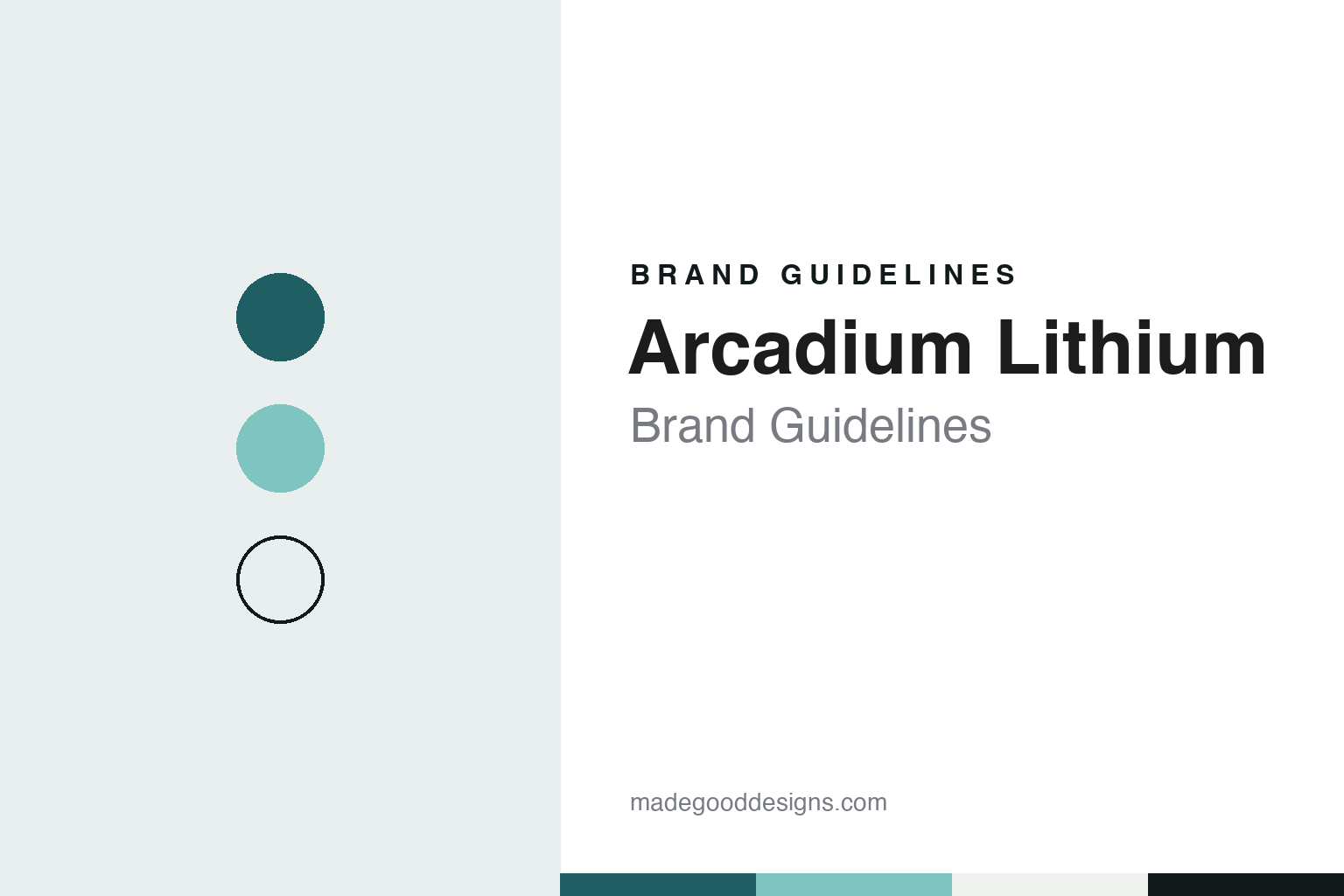
Arcadium Lithium Brand Guidelines
A lithium name made from two companies, used for fourteen months.
Aa
Two constants: a brine-teal, turquoise and salt-white palette and a rounded geometric sans register. Abstract homage — not an Arcadium Lithium or Rio Tinto asset; no product, logo or mark is reproduced.
Two lineages
An American lithium chemicals maker and an Australian miner.
Arcadium Lithium was a listed company for little more than a year. It was formed on 4 January 2024, when the American lithium chemicals maker Livent and the Australian miner Allkem completed what they called a merger of equals, Mining Technology reported the next day. Its shares traded on the New York Stock Exchange under ALTM, and on the Australian Securities Exchange under LTM from 5 January 2024.
The American side reaches back to the mid-twentieth century. English Wikipedia traces Livent to the Lithium Corporation of America, which it dates to 1944 and which mined spodumene and pegmatite ores near Bessemer City, North Carolina, and in the Black Hills of South Dakota. The same article notes that in 1954 the economist Armen Alchian used sudden rises in Lithium Corporation’s share price to deduce that lithium was part of the fuel of the new American hydrogen bomb, one of the first “event studies.” The chemicals and machinery group FMC bought Lithium Corporation of America in 1985, and its lithium business ran for years as FMC Lithium. FMC then separated that business as Livent: English Wikipedia dates the creation of Livent to 2018 in one article and the completed spin-off to 2019 in another.
The Australian side began as Orocobre, which listed on the ASX in December 2007, according to English Wikipedia. Orocobre developed the Olaroz brine project on a salt flat in Jujuy province, in northwest Argentina, under a joint venture agreed with the Japanese trading house Toyota Tsusho in October 2012; earlier, in June 2012, it had agreed that JEMSE, a mining investment company owned by the Jujuy provincial government, would hold an equity interest in the project. In August 2012 Orocobre also bought the borate producer Borax Argentina from Rio Tinto. After merging with Galaxy Resources in 2021 it was renamed Allkem; English Wikipedia says the Orocobre name was used until 30 November 2021. Allkem agreed terms to merge with Livent in May 2023.
Colour
Brine, hard rock and chemical plants.
Arcadium brought together brine operations, hard-rock mines and chemical plants across Argentina, Australia, Canada, Japan and the United States. From Allkem, English Wikipedia lists Olaroz; the Sal de Vida project on the Salar del Hombre Muerto in Catamarca province, Argentina; the Mt Cattlin spodumene mine near Ravensthorpe in Western Australia, where operations restarted in late 2016; the James Bay hard-rock project in northern Québec; and an interest in the Naraha lithium hydroxide plant in Japan, run with Toyota Tsusho, which English Wikipedia describes as the first plant of its kind built in Japan and which was designed to turn lithium carbonate shipped from Olaroz into battery-grade lithium hydroxide. From Livent came the North Carolina roots at Bessemer City.
The company presented itself through that range of methods. At completion its chief executive, Paul Graves, said Arcadium was “a leader in every major lithium extraction process – from hard rock mining to conventional pond and DLE-based brine processing,” and “vertically integrated, from resource to chemical manufacturing, in strategic locations around the world,” Mining Technology reported in January 2024. DLE is short for direct lithium extraction.
The merged group was large from the start: Mining Technology put its workforce at more than 2,600 people. Under the merger terms, Allkem holders received one Arcadium share or depositary instrument for each Allkem share, and Livent holders received 2.406 Arcadium shares for each Livent share, the same report said.
Its single full year as a listed company was busy. English Wikipedia records that in August 2024 Arcadium bought the lithium metal production business of Li-Metal Corp, including a pilot refinery, and that in September 2024 it announced Mt Cattlin would be placed into care and maintenance by mid-2025, citing low spodumene prices.
Typography
How the category presents itself.
Lithium and battery-materials companies sell to other companies, not to shoppers, and their imagery is built for investors, carmakers and governments as much as for the public. Most of it starts at the source. Brine producers show their evaporation ponds from the air: long rectangles of turquoise, green and pale yellow laid out across a white salt flat, with mountains on the horizon. Hard-rock miners show open pits cut in terraces into red or ochre earth, haul trucks on the benches and stockpiles of pale spodumene ore.
The next layer is chemistry. Company photographs move indoors to white lithium carbonate and lithium hydroxide powders held in gloved hands or poured from a scoop, bulk bags stacked in a warehouse, and the long kilns and furnaces of refineries and cathode-material plants. These images carry the industry’s main argument: that a mineral dug or pumped in one country becomes a battery-grade chemical in another.
The end use usually appears last, and it is almost always the same: battery cells, electric cars, charging cables and grid-scale storage containers. The pictures show where the material is meant to go.
Much of the visual language is corporate rather than consumer. Investor-day slides and annual reports lean on world maps dotted with mines, plants and offices, flow charts of the supply chain from resource to cathode, and the logos of listing exchanges. Industry gatherings such as Fastmarkets’ Lithium Supply and Battery Raw Materials conference bring producers, refiners and buyers into the same rooms, and the same maps and pond photographs reappear on stage. In a sector where few people see the product, the identity rests on landscapes, laboratories and the cars at the end of the chain.
Aa
A rounded geometric sans for a short-lived name. (Specimen set in Manrope, a sans STAND-IN; NOT the Arcadium Lithium logo.)
Arcadium Lithium
Bought by Rio Tinto in 2025.
The independent company did not last long. On 9 October 2024 Rio Tinto agreed to buy Arcadium for cash, with the backing of both boards, English Wikipedia records. The purchase was completed on 6 March 2025. Australian Mining Review reported the next day that Rio Tinto had become the ultimate parent of Arcadium Lithium, which would become Rio Tinto Lithium and would also take in Rio Tinto’s Rincon lithium project.
Arcadium Lithium is therefore no longer an independent company: English Wikipedia lists it as a Rio Tinto subsidiary, and on 9 November 2026 the arcadiumlithium.com address redirected to Rio Tinto’s website. There is a circle in the story, too. Rio Tinto sold Borax Argentina to Orocobre in 2012, according to English Wikipedia, and thirteen years later bought the company that Orocobre had become part of.
The name itself was new in 2024, but the businesses beneath it were not. Lithium Corporation of America, FMC Lithium, Livent, Orocobre, Galaxy Resources and Allkem all fed into Arcadium, and its assets now sit inside Rio Tinto, alongside what Rio Tinto’s chief executive called, at completion, its “leading iron ore, aluminium and copper operations.”
For a design guide, Arcadium Lithium shows how a merger name can be built to join two companies and then be absorbed within fourteen months. Compare Rio Tinto, its owner since March 2025, and Albemarle, another American lithium producer. For this guide we use a brine teal, a pond turquoise, a salt white and a slate with a sans, an unofficial interpretation; no product or logo is reproduced.
Explore & save
Keep Arcadium Lithium’s identity on hand — save it to a board in the Made Good inspiration library.
Arcadium Lithium identity set
Pin the Arcadium Lithium brine-teal, turquoise and salt-white palette and the rounded geometric sans register to your own board.