Sigma Lithium Brand Guidelines
A Brazilian lithium mine marketed on its green story.
Aa
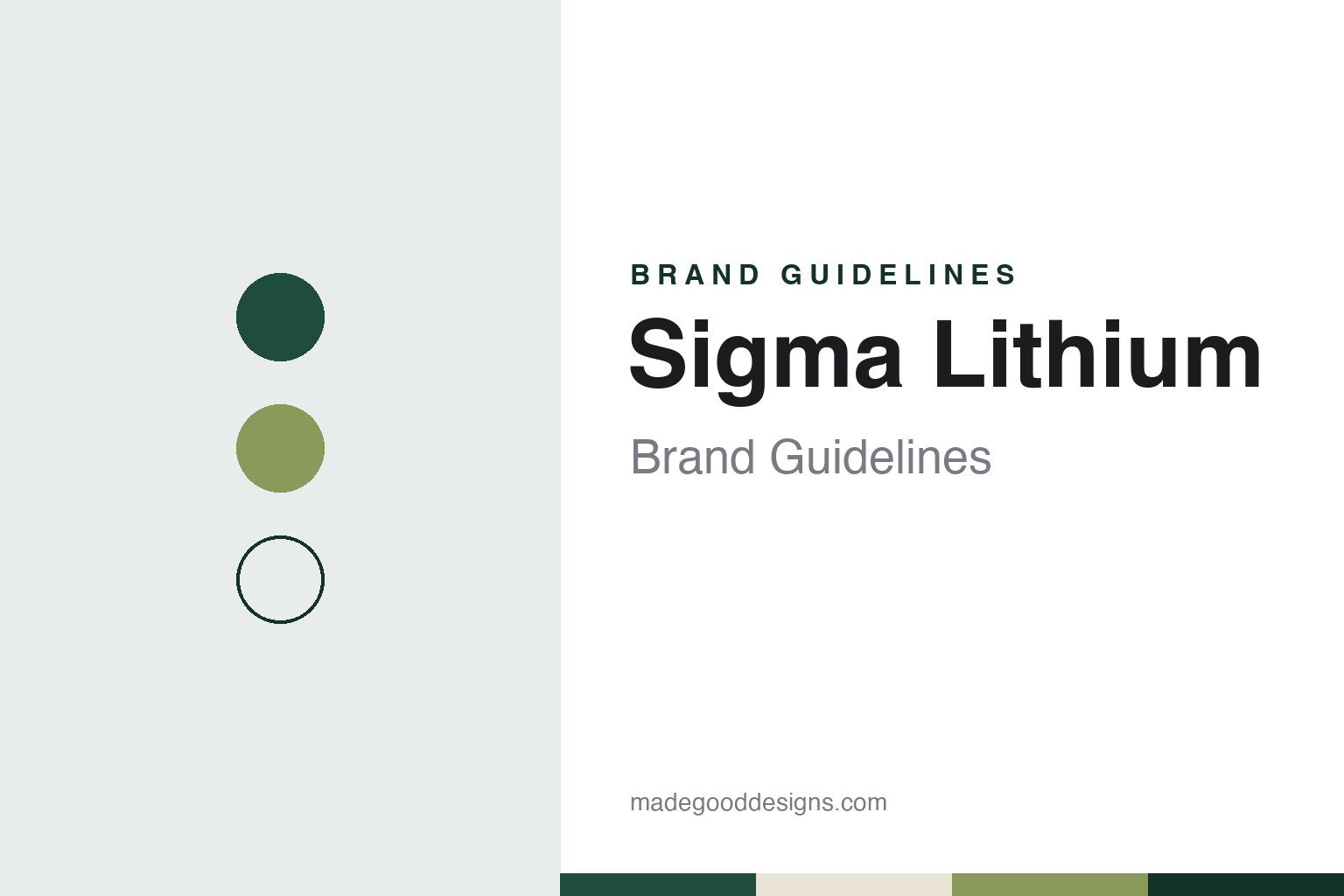
Two constants: a green, sage and pale stone palette and a clean sans register. Abstract homage — not a Sigma Lithium product or mark; no logo, site photograph or nameplate is reproduced.
Grota do Cirilo
A deposit in the Jequitinhonha Valley.
Sigma Lithium is built around one place: Grota do Cirilo, a hard-rock lithium operation in the Vale do Jequitinhonha, in the Brazilian state of Minas Gerais. English Wikipedia’s article on the town of Araçuaí says the largest lithium mine in Brazil lies between Araçuaí and the neighbouring municipality of Itinga, worked by Sigma Lithium Resources, an earlier form of the company’s name; its old web address now redirects to the current site.
The company dates its own start to 2012. Its timeline says that in that year its founder acquired Sigma Lithium alongside Magnesita, the Brazilian maker of refractory products, and that exploration began at Grota do Cirilo. The company describes the site, which it owns outright, as a fully integrated hard-rock lithium mining and industrial beneficiation complex, with mine, crushing and processing in one place. It says A10 Invest made a first investment in 2015 and that the first stage of exploration was completed that year; today the company names a fund managed by A10, A10 FIA, as its largest shareholder.
The public face of the company is Ana Cabral, its co-chair and chief executive. The company says she co-founded A10 Invest; Mining Technology quoted her in both roles in May 2024. Marcelo Paiva, another A10 co-founder, is co-chair. The company also says Cabral was named Mining Person of the Year for 2023 by Canada’s Northern Miner.
Sigma Lithium has gathered listings on several exchanges. Its timeline gives an initial public offering and a listing on the TSX Venture Exchange in 2018 and a Nasdaq listing in 2021, and in September 2026 it said its shares had begun trading on the Australian Securities Exchange on 3 September under the code SAU. Its press releases carry a Toronto dateline.
Colour
From demonstration plant to shipments.
The company’s timeline traces a steady build. A demonstration plant and a pilot plant started in 2018; a definitive feasibility study for the first phase followed in 2019; construction began in 2021; and the first module of what it calls the Cleantech Plant was commissioned in 2022. In 2023, the company says, crusher and plant commissioning ended in May, the first shipment of lithium concentrate left Brazil in July, and commercial production followed by August.
The product is a mineral concentrate rather than a battery chemical: spodumene ore crushed in three stages and upgraded in a dense media separation plant, with water reclaimed and tailings dry-stacked, according to the company. It gives the first phase’s nameplate capacity as 270,000 tonnes of lithium concentrate a year. In May 2024 Mining Technology reported that the company had raised its proven and probable reserves at Grota do Cirilo by 40% and that a second processing line was under construction. The company says its board approved that second phase in 2024 and that earthworks for it were finished in 2025.
The language around the product is part of the brand. The company sells what it calls “Quintuple Zero Green Lithium” and describes its process in a set of “zero” claims about power, tailings dams, water and chemicals; those are its own descriptions, and the guide repeats none of them as fact.
Typography
How the sector presents itself.
Lithium and battery-materials companies sell to other companies, not to shoppers, and their imagery is built for investors, carmakers and governments as much as for the public. Most of it starts at the source. Brine producers show their evaporation ponds from the air: long rectangles of turquoise, green and pale yellow laid out across a white salt flat, with mountains on the horizon. Hard-rock miners show open pits cut in terraces into red or ochre earth, haul trucks on the benches and stockpiles of pale spodumene ore.
The next layer is chemistry. Company photographs move indoors to white lithium carbonate and lithium hydroxide powders held in gloved hands or poured from a scoop, bulk bags stacked in a warehouse, and the long kilns and furnaces of refineries and cathode-material plants. These images carry the industry’s main argument: that a mineral dug or pumped in one country becomes a battery-grade chemical in another.
The end use usually appears last, and it is almost always the same: battery cells, electric cars, charging cables and grid-scale storage containers. The pictures show where the material is meant to go.
Much of the visual language is corporate rather than consumer. Investor-day slides and annual reports lean on world maps dotted with mines, plants and offices, flow charts of the supply chain from resource to cathode, and the logos of listing exchanges. Industry gatherings such as Fastmarkets’ Lithium Supply and Battery Raw Materials conference bring producers, refiners and buyers into the same rooms, and the same maps and pond photographs reappear on stage. In a sector where few people see the product, the identity rests on landscapes, laboratories and the cars at the end of the chain.
Aa
A clean sans for a company that sells a green story. (Specimen set in Libre Franklin, a sans STAND-IN; NOT the Sigma Lithium logo.)
Sigma Lithium
Pauses, a state agreement and a court of appeals.
The last year has been uneven. Benchmark Mineral Intelligence reported in July 2026 that Sigma Lithium had paused the mine in October 2025 for upgrades, and that the restart was complicated when three waste piles were shut down after a government inspection at the start of 2026, a matter it described as since resolved. Its analyst, visiting in July 2026, reported the mine operating at full capacity.
On 21 August 2026 the company said it had signed a Termo de Ajuste de Conduta, an agreement on adjusted procedures, with the State of Minas Gerais, and that mining and processing were fully back online. In early September Industrial Info Resources reported that a Minas Gerais judge had ordered activities at Grota do Cirilo suspended; the company said on 7 September that its operations were unaffected by what it called a preliminary ruling. On 1 October it announced that all mining and industrial production had been temporarily suspended on 30 September 2026 while it awaited a federal court of appeals, in a lawsuit brought by a non-governmental organisation asking state authorities to suspend its environmental licences. On 6 October 2026 it said the court of appeals had upheld those licences and that operations had resumed, which Industrial Info Resources also reported. In the same announcement it repeated its target of an annualised rate of 330,000 tonnes of lithium oxide concentrate by the end of 2027, a company forecast rather than a result.
The company frames itself around the valley as much as the mine, citing jobs across a dozen municipalities in the Jequitinhonha, which it calls one of the most economically underserved regions of the state.
For a design guide, Sigma Lithium shows a single-asset miner whose brand rests on sustainability language and on one valley. Compare PLS, another hard-rock spodumene producer, and Mineral Resources. For this guide we use deep greens, sage and a pale stone tone with a sans, an unofficial interpretation; no product or logo is reproduced.
Explore & save
Keep Sigma Lithium’s identity on hand — save it to a board in the Made Good inspiration library.
Sigma Lithium identity set
Pin the Sigma Lithium green, sage and pale stone palette and the clean sans register to your own board.