Sinopec Brand Guidelines
A Beijing state group that grew out of two ministries and runs on refining.
Aa
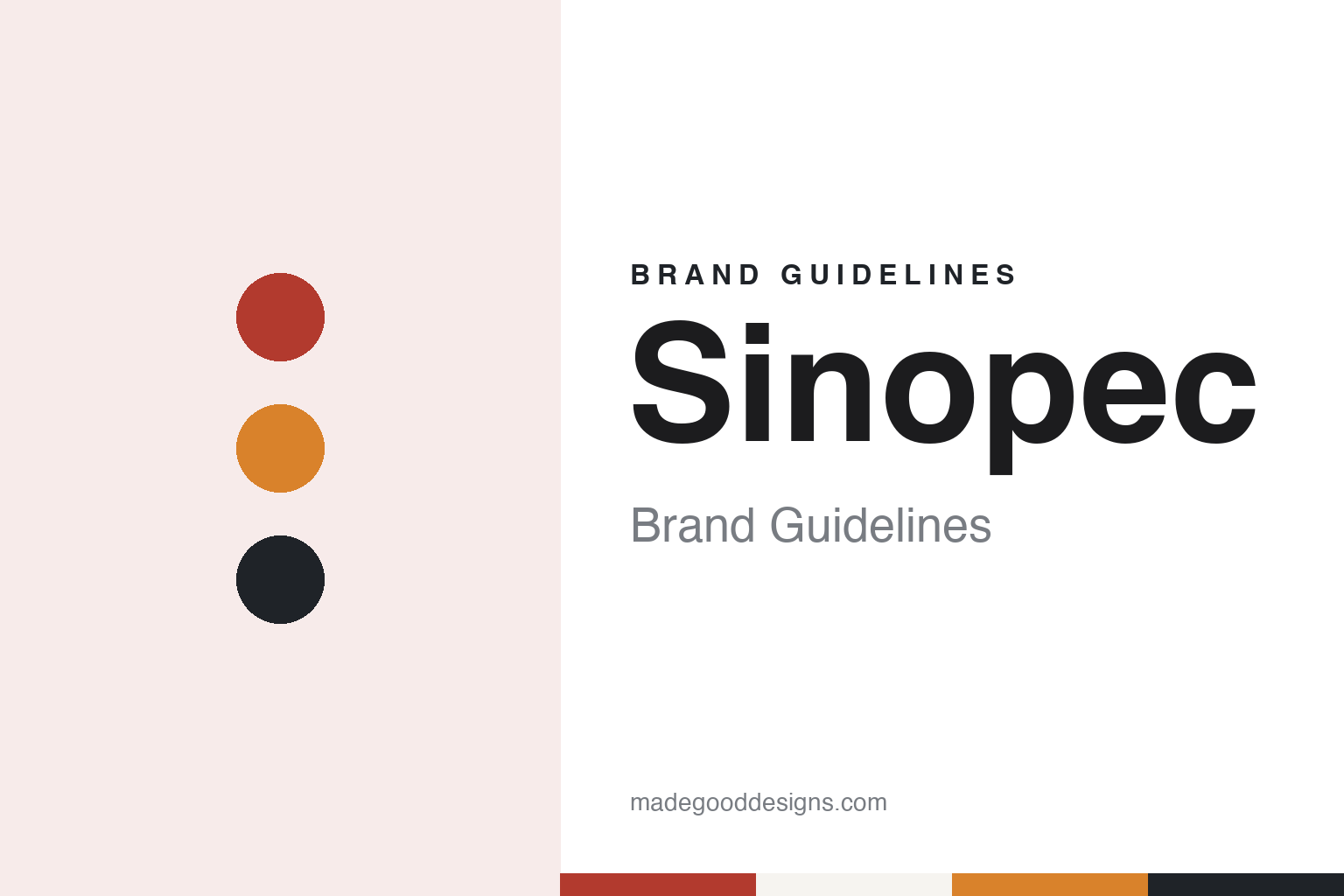
Two constants: a red, ink and orange palette and an industrial sans register. Abstract homage — not a Sinopec product or mark; no logo, sign or station livery is reproduced.
Two ministries
A state company built from the petroleum and chemical ministries.
Sinopec is the English short name for two linked state companies in Beijing: China Petrochemical Corporation, known as Sinopec Group, and its listed subsidiary China Petroleum & Chemical Corporation, known as Sinopec Corp. English Wikipedia says the first version of the group was created in 1983 by China’s State Council out of the Ministry of Petroleum Industry and the Ministry of Chemical Industry, with Chen Jinhua, appointed from outside the industry, as its first president.
The present group dates from July 1998. The company says it was established then “on the basis of the former China Petrochemical Corporation,” as the central government restructured the petroleum and petrochemical industry, and Chinese Wikipedia says the reorganisation was approved by the State Council. The same reshuffle divided the sector into two integrated groups, Sinopec and the China National Petroleum Corporation, or CNPC. English Wikipedia describes a state-mandated asset swap in 1998 that gave some Sinopec refineries to CNPC and some CNPC upstream assets to Sinopec, so that each group held both oilfields and refineries.
The listed arm followed. Chinese Wikipedia dates the founding of Sinopec Corp. to 25 February 2000, with the group as its sole promoter, and English Wikipedia says its shares were listed in Hong Kong, New York and London in October 2000 and in Shanghai in 2001. The group itself is wholly state-owned and is supervised by the State-owned Assets Supervision and Administration Commission of the State Council, or SASAC. The company says it was incorporated as a limited liability corporation in August 2018; Chinese Wikipedia dates the public notice of its new company name to February 2020.
Colour
Refining, chemicals and the fuel forecourt.
Sinopec’s weight sits downstream, in refining, chemicals and fuel retail. English Wikipedia calls it a more downstream company than PetroChina and says that through 1997 it held most of China’s refining capacity. The group describes itself as the largest supplier of oil and petrochemical products in China, the world’s largest refining company and its second-largest chemical company, and says its number of fuel stations ranks second in the world; those rankings are the company’s own.
Its research base is older than the group. English Wikipedia says the Research Institute of Petroleum Processing began work in 1956, and that Sinopec also develops lubricants for automotive, industrial and marine use. The brand page on the group’s website lists sub-brands including Sinopec EasyJoy, its non-fuel retail chain, the industrial e-commerce platform Epec.com, Sinopec Lubricant and Donghai asphalt.
Foreign partners run through the story. English Wikipedia says BP and Sinopec built the SECCO ethylene plant in the Shanghai Chemical Industry Park from 2005, that Sinopec bought out BP’s remaining stake in 2017, and that Ineos took half of Sinopec’s share in 2022. Chinese Wikipedia lists joint-venture fuel retailers with Total, now TotalEnergies, with BP and with Shell in eastern and southern China, and says Sinopec opened its first service station in Singapore in December 2018.
Abroad, English Wikipedia records the purchase of Addax Petroleum, with assets in West Africa and Kurdistan, in 2009; a stake in the Canadian oil-sands venture Syncrude in 2010; and an April 2023 agreement with QatarEnergy that gave Sinopec a 5% stake in one liquefied natural gas train of the North Field East expansion. At home, Chinese Wikipedia says that from December 2019 the trunk pipelines, LNG terminals and gas storage of the three state oil groups were moved into a new national pipeline company, PipeChina, in which the Sinopec group holds a minority share alongside SASAC, CNPC and CNOOC.
Typography
State oil in the national register.
National oil companies present themselves differently from the listed majors. Most are owned or controlled by a state, and their identities often sit close to the national story: a flag or national colours placed beside a refinery skyline, a company name that includes the country, and a founding date tied to a concession, a nationalisation or a new state. The imagery tends to repeat across the category: offshore platforms photographed at dawn, drilling rigs in desert or jungle, tanker terminals and pipelines running to the horizon.
The brand also reaches the street. Many national oil companies run fuel retail networks at home, and sometimes abroad, so the identity has to work on a petrol-station canopy, a pump, a lubricant bottle and a forecourt sign as well as on a corporate tower. That puts a premium on a simple mark and a small set of strong colours that read from a moving car.
A third strand is people and the public. Engineering academies, scholarships and graduate programmes appear prominently in their communications, alongside sponsorship of national sports teams, marathons, motor racing, museums and cultural centres. These programmes carry the company name into places far from the oilfield, and they often appear in annual reports next to production figures.
Finally, the financial documents matter more than they used to. As several national oil companies have listed shares or floated subsidiaries, their annual reports, sustainability reports and IPO prospectuses have become major brand documents in their own right, with consistent typography, photography and colour. This guide reads each company through those public materials, separating what independent dated sources document from what the company says about itself.
Aa
An industrial sans for a refining group. (Specimen set in Archivo, a sans STAND-IN; NOT the Sinopec logo.)
Sun & circle
A sun-shaped figure joined to two names.
The company explains its own mark. The group’s brand page says the Sinopec logo is made of a sun-shaped figure with abbreviations of the company’s Chinese and English names, and that a red circle connects the two names. It links the design to an integrated industrial chain and to the aim of “refueling for a better life,” and gives its value proposition as “Shaping a Bright Future with Innovation, Building a Better Life with Responsibility.”
Its record includes serious events. On 22 November 2013 oil leaking from a Sinopec crude pipeline in Qingdao, Shandong, ignited and exploded while workers were cleaning up the spill, Al Jazeera reported that day, and the city’s oil terminal stopped operations. In January 2014 the State Council published its findings and penalised 63 people, including Sinopec’s board chairman, according to a report collected by the Business and Human Rights Centre; China’s work-safety watchdog named corrosion of the pipeline as the main cause, and Sinopec said it would accept the penalties. English Wikipedia also says that in 2017 the Geneva office of its Addax subsidiary closed after Sinopec settled a Swiss bribery investigation into operations in Nigeria.
The listings have changed too. Chinese Wikipedia says Sinopec Corp. announced in August 2022 that it would voluntarily delist its American depositary shares from the New York Stock Exchange, and that the depositary shares left the London Stock Exchange in November 2022; its shares are listed in Hong Kong and Shanghai. Chinese Wikipedia also says that on 8 January 2026 SASAC announced a restructuring of Sinopec Group with China National Aviation Fuel; Caixin reported on 13 July 2026 that the restructuring had been completed on 10 July.
For a design guide, Sinopec shows how a state group can carry one sun-and-circle mark across refineries, chemical plants and roadside fuel stations. Compare CNOOC, China’s offshore oil group, and BP, its partner in Shanghai chemicals and Chinese fuel retail. For this guide we use a sun red, a refinery ink and a flare orange with a sans, an unofficial interpretation; no product or logo is reproduced.
Explore & save
Keep Sinopec’s identity on hand — save it to a board in the Made Good inspiration library.
Sinopec identity set
Pin the red, ink and orange palette and the industrial sans register to your own board.