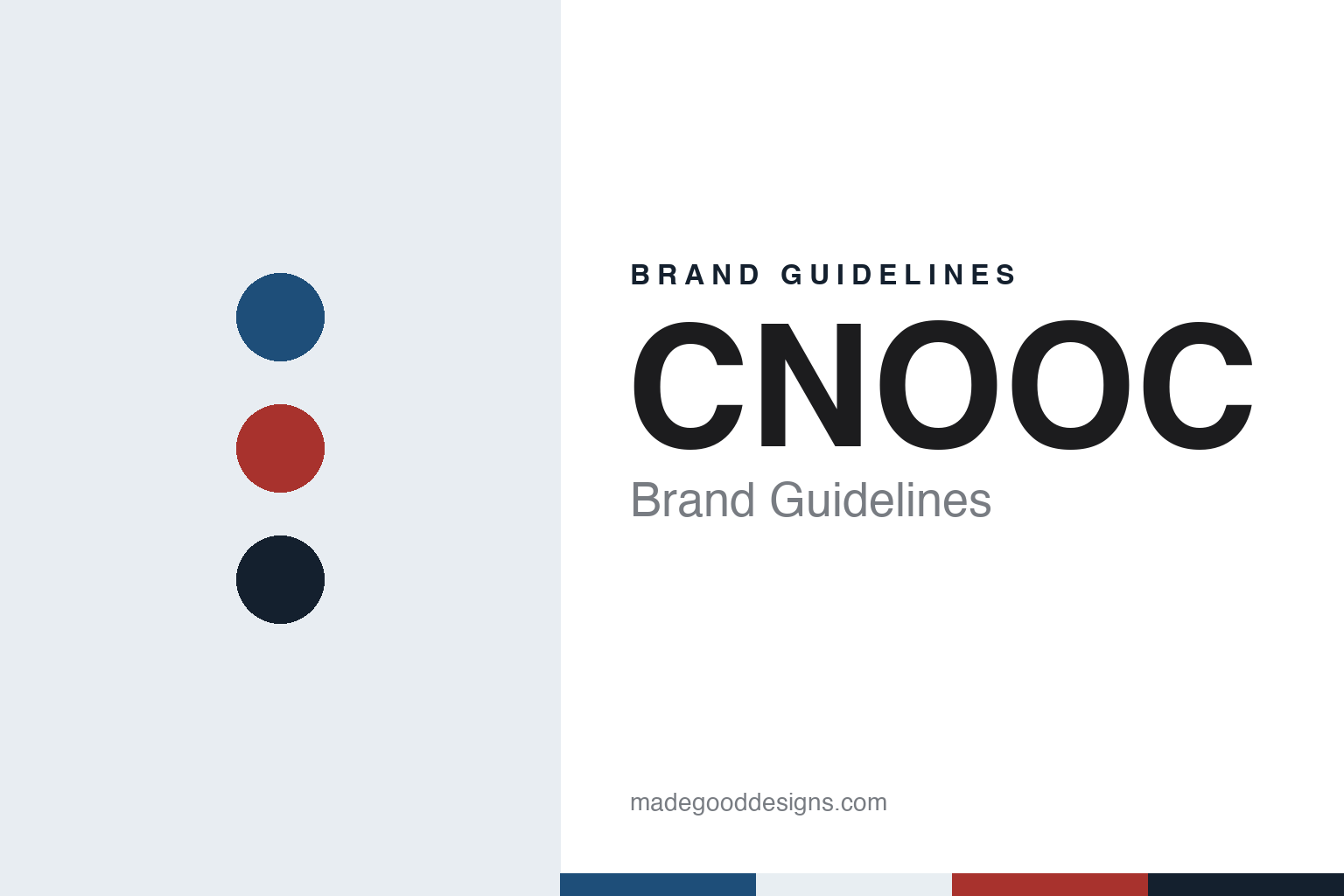
CNOOC Brand Guidelines
A Beijing state group built to find oil under China’s seas with foreign partners.
Aa
Two constants: a sea blue, navy and red palette and an engineering sans register. Abstract homage — not a CNOOC product or mark; no logo, platform livery or vessel marking is reproduced.
Offshore
A state company set up to work China’s seabed with foreign partners.
CNOOC, short for China National Offshore Oil Corporation, is the state oil and gas group that develops China’s offshore fields, with its headquarters in Beijing. Chinese Wikipedia says the State Council decided on 6 October 1981 to set up a national offshore oil company to handle the joint development of seabed oil and gas with foreign partners, and that the corporation was formally founded on 15 February 1982. English Wikipedia links its creation to State Council regulations of 30 January 1982 on cooperation with foreign enterprises in offshore petroleum, which gave it overall responsibility for that work.
Offshore fields that had been run by an offshore branch of the petroleum industry, and projects already under way with foreign oil companies, moved to the new corporation, Chinese Wikipedia says. It records a run of firsts with foreign partners: the Chengbei field in the Bohai Sea, developed with Japan Petroleum Exploration and partly in production from September 1985, as China’s first Sino-foreign joint-venture offshore oilfield; the Weizhou 10-3 field in the Beibu Gulf, with France’s Total, in trial operation from August 1986; and the Yacheng 13-1 gas field south of Hainan, developed from 1992 with partners including the American company ARCO to supply a power station in Hong Kong by pipeline, which Chinese Wikipedia calls China’s first pipeline export of natural gas.
In 1999 CNOOC and Phillips Petroleum found the Penglai 19-3 field in the southern Bohai Sea, which Chinese Wikipedia says became China’s largest offshore oilfield. The group is wholly owned by the state, with SASAC exercising shareholder rights, English Wikipedia says; Chinese Wikipedia describes it as China’s third-largest state oil company, after CNPC and the Sinopec group.
Colour
A Hong Kong red chip that went abroad.
The listed arm, CNOOC Limited, was incorporated in Hong Kong in August 1999, Chinese Wikipedia says, and listed in New York on 27 February 2001 and in Hong Kong on 28 February 2001; it joined the Hang Seng Index in July 2001. English Wikipedia describes it as a “red chip,” a company with a mainland state background incorporated outside mainland China. CNOOC Limited says it is China’s largest producer of offshore crude oil and natural gas and one of the world’s largest independent oil and gas exploration and production companies; Reuters also called it China’s largest offshore oil producer in April 2022.
Growth abroad brought the group into international deal-making. In June 2005 CNOOC Limited made a cash offer for the American oil company Unocal, topping an earlier bid by ChevronTexaco; English Wikipedia says Unocal accepted the ChevronTexaco offer in July and CNOOC Limited withdrew its bid on 2 August 2005. In July 2012 CNOOC agreed to buy the Canadian producer Nexen. English Wikipedia says the Canadian government approved the purchase on 7 December 2012 and United States regulators on 12 February 2013, and the Oil & Gas Journal reported on 26 February 2013 that the acquisition was complete, adding oil sands and shale gas in Canada and fields in the North Sea and the Gulf of Mexico. English Wikipedia says CNOOC Limited was also listed in Toronto from 2013 to 2021.
Gas is a second pillar. English Wikipedia says CNOOC brought liquefied natural gas to China through the Dapeng terminal in Guangdong, which received its first cargo, from Australia’s North West Shelf project, in July 2006, and that CNOOC and Shell formed the Nanhai petrochemical joint venture in Guangdong, approved in 2004. Chinese Wikipedia records the Shenhai-1 gas field starting production in June 2021 as China’s deepest-water offshore gas field, and the group’s first offshore wind project, in Jiangsu, feeding the grid from September 2020. Since December 2019 CNOOC has held a share in the national pipeline company PipeChina, alongside SASAC, CNPC and Sinopec.
Typography
State oil in the national register.
National oil companies present themselves differently from the listed majors. Most are owned or controlled by a state, and their identities often sit close to the national story: a flag or national colours placed beside a refinery skyline, a company name that includes the country, and a founding date tied to a concession, a nationalisation or a new state. The imagery tends to repeat across the category: offshore platforms photographed at dawn, drilling rigs in desert or jungle, tanker terminals and pipelines running to the horizon.
The brand also reaches the street. Many national oil companies run fuel retail networks at home, and sometimes abroad, so the identity has to work on a petrol-station canopy, a pump, a lubricant bottle and a forecourt sign as well as on a corporate tower. That puts a premium on a simple mark and a small set of strong colours that read from a moving car.
A third strand is people and the public. Engineering academies, scholarships and graduate programmes appear prominently in their communications, alongside sponsorship of national sports teams, marathons, motor racing, museums and cultural centres. These programmes carry the company name into places far from the oilfield, and they often appear in annual reports next to production figures.
Finally, the financial documents matter more than they used to. As several national oil companies have listed shares or floated subsidiaries, their annual reports, sustainability reports and IPO prospectuses have become major brand documents in their own right, with consistent typography, photography and colour. This guide reads each company through those public materials, separating what independent dated sources document from what the company says about itself.
Aa
An engineering sans for an offshore group. (Specimen set in Barlow, a sans STAND-IN; NOT the CNOOC logo.)
New York to Shanghai
Listings that moved, and a spill in Bohai Bay.
The group’s position in the United States changed in 2020 and 2021. English Wikipedia says that in December 2020 the US Department of Defense named CNOOC as a company “owned or controlled” by the People’s Liberation Army, and that in February 2021 the New York Stock Exchange began the process of delisting CNOOC Limited. Reuters, in a report carried by Offshore Engineer on 21 April 2022, said the company had been delisted in New York after the US government added it to a trade blacklist, and that CNOOC said it had operated in accordance with local laws.
That same day CNOOC Limited’s A shares began trading on the Shanghai Stock Exchange, Reuters reported, joining state-backed peers PetroChina and Sinopec, which were already listed there. The company now describes itself as listed in both Shanghai and Hong Kong.
Its operations have also had serious incidents. In June 2011 oil and oil-based drilling mud leaked into Bohai Bay from the Penglai 19-3 field, which CNOOC owned with ConocoPhillips, the field’s operator, holding 51% and 49% respectively. English Wikipedia says the first leak began on 4 June 2011, a second followed on 17 June, and the first was not made public until 5 July; Chinese Wikipedia says the leaks were still continuing in early September 2011 and calls them China’s most serious marine ecological disaster to that date. English Wikipedia also records an offshore vessel that capsized while under construction at a dock in January 2012, which CNOOC said caused no pollution.
For a design guide, CNOOC shows a state brand built at sea, through decades of joint ventures with foreign partners. Compare Sinopec, China’s refining-led state group, and Shell, CNOOC’s partner in the Nanhai petrochemical venture. For this guide we use a deep sea blue, a navy ink and a platform red with a sans, an unofficial interpretation; no product or logo is reproduced.
Explore & save
Keep CNOOC’s identity on hand — save it to a board in the Made Good inspiration library.
CNOOC identity set
Pin the sea blue, navy and red palette and the engineering sans register to your own board.