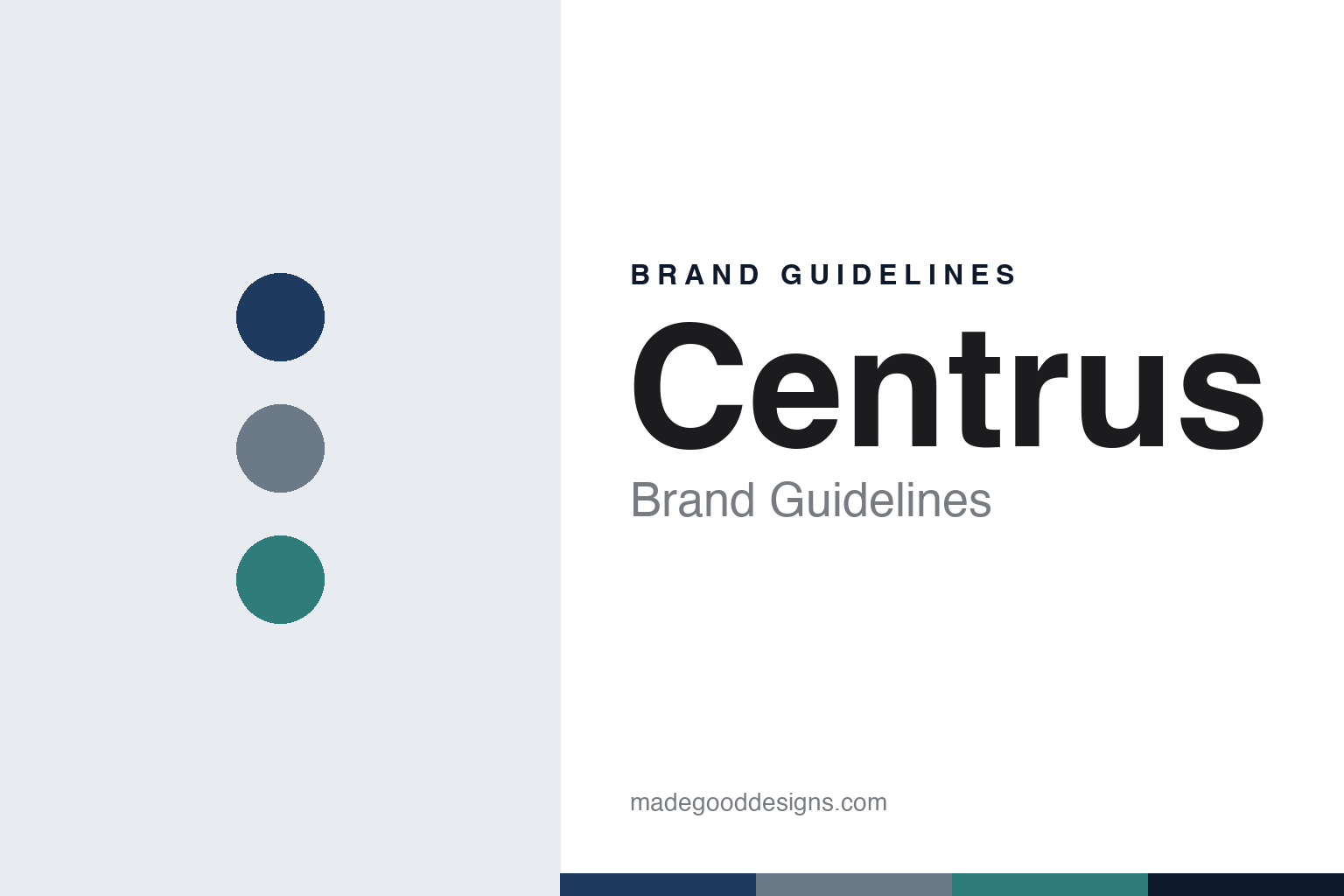
Centrus Brand Guidelines
A government enricher turned listed company, rebuilding centrifuges in Ohio.
Aa
Two constants: a deep navy, steel grey and teal palette and an institutional serif register. Abstract homage — not a Centrus product or mark; no logo, centrifuge or plant image is reproduced.
USEC
From a government corporation to a listed company.
Centrus Energy began as a government business. The company says the U.S. government enriched uranium from the 1940s for defence and began selling enriched uranium to the commercial nuclear power industry in the 1960s. The Energy Policy Act of 1992 created the United States Enrichment Corporation, a government corporation, out of the Department of Energy’s uranium enrichment enterprise, and it began operating in July 1993.
Privatisation followed. English Wikipedia dates the initial public offering to 28 July 1998, after which USEC Inc. traded on the New York Stock Exchange as an investor-owned company. It ran two Cold War-era gaseous diffusion plants: Portsmouth, near Piketon, Ohio, and Paducah, in McCracken County, Kentucky. Wikipedia’s article on the Portsmouth plant says it was built between 1952 and 1956, first produced highly enriched uranium for the Atomic Energy Commission, the weapons programme and naval propulsion, and moved to low-enriched fuel for commercial power plants in the mid-1960s. USEC stopped enriching at Piketon in May 2001 and consolidated at Paducah, which ceased enrichment on 31 May 2013, Wikipedia records; the company says the last plant shut down for economic reasons.
For two decades USEC was the U.S. executive agent for the Megatons to Megawatts programme, under which material from former Soviet nuclear weapons was down-blended into reactor fuel. The company says the programme ran from 1993 to 2013 and that USEC marketed the down-blended uranium to U.S. utilities and arranged deliveries.
Its successor technology took longer. USEC planned a gas-centrifuge plant at Piketon, the American Centrifuge, but in July 2009 it suspended work after the Department of Energy declined a loan guarantee, Wikipedia says. In December 2013 USEC announced a prearranged Chapter 11 restructuring agreed with most of its debt holders, and on 30 September 2014 it emerged with a new name: Centrus Energy Corp.
Colour
HALEU at Piketon, centrifuges from Oak Ridge.
As Centrus, the company is based in Bethesda, Maryland, with sites at Piketon, Ohio, and Oak Ridge, Tennessee, and its shares trade on the New York Stock Exchange under the ticker LEU. It says it demonstrated low-enriched uranium enrichment at the American Centrifuge Plant from 2014 to 2016, and that it continues to supply utilities with low-enriched uranium bought from other primary and secondary suppliers.
Its revival rests on HALEU, high-assay low-enriched uranium, which is enriched beyond the roughly 5% uranium-235 used in existing light-water reactors and is required by many advanced reactor designs. In 2019 Centrus signed a Department of Energy contract to build a cascade of 16 centrifuges at Piketon to demonstrate HALEU production, and in June 2021 the Nuclear Regulatory Commission approved a licence amendment allowing enrichment up to 20%, which Wikipedia describes as making it the first U.S. facility licensed for HALEU production. The Department of Energy reported on 11 October 2023 that American Centrifuge Operating, a Centrus subsidiary, had started enrichment at the Piketon facility, and on 7 November 2023 that Centrus had produced the nation’s first 20 kilograms of HALEU, nearly two months ahead of schedule. The department said annual output was expected to rise to 900 kilograms in 2024. Wikipedia notes that after the 2019 contract Centrus signed agreements with advanced reactor developers including TerraPower, X-energy and Oklo, and in September 2026 the company announced HALEU supply arrangements with two more, Radiant and Antares.
The next step is scale. On 19 December 2025 Centrus said it had begun domestic centrifuge manufacturing to support commercial low-enriched uranium enrichment at Piketon, with new capacity expected to come online in 2029; its centrifuge model is the AC100M. On 29 October 2026 the company said its Oak Ridge plant had completed and shipped the first new centrifuge to Ohio for final assembly. Earlier that month Centrus completed its purchase of Westerman Holdings, a fabricator founded in 1909 that supplies centrifuge casings and other major components and also makes UF6 cylinders and oil and gas equipment at four plants in Ohio, Oklahoma and Wyoming.
Typography
How uranium companies present themselves.
Uranium companies sell a commodity that few of their audiences will ever see, so their visual material leans on the stages around it. Mining reports and investor decks in this sector commonly show drill core laid out in trays, drums of uranium concentrate, the yellowcake of the trade, and the plants where ore is milled. The product itself is a powder; the imagery is of the places and steps that produce it.
Geography does much of the work. In-situ recovery, the method Kazatomprom uses for all of its production in Kazakhstan, pumps solution through wells rather than digging a pit, so its pictures tend to be wellfields of wellheads and pipework laid across open steppe and prairie. In northern Saskatchewan, the Athabasca Basin, where Cameco mines McArthur River and Cigar Lake, appears as lakes, forest and snow, with headframes and camps in winter light.
The fuel story widens the frame. Companies that sell uranium into conversion, enrichment and fuel fabrication often finish their presentations with nuclear power plants, cooling towers and control rooms, and with the language of low-carbon, reliable electricity; when Cameco and Brookfield completed their purchase of Westinghouse in November 2023, World Nuclear News quoted Cameco’s chief executive on demand for nuclear power and energy security.
Much of this material is made for investors and for the industry itself. Producers and developers publish decks and annual reports for listings in markets such as Toronto, New York, London and Astana, and present at industry events, among them those of the World Nuclear Association, whose public information service is World Nuclear News. This guide sets out what can be checked about each company — its origins, owners and mines — and treats its colours and type as an unofficial interpretation.
Aa
An institutional serif for a company born from a federal agency. (Specimen set in Source Serif 4, a serif STAND-IN; NOT the Centrus logo.)
Centrus
An acronym retired, a ticker kept to the point.
Centrus presents itself through infrastructure and public policy rather than consumer products. Its website divides the business into nuclear fuel, HALEU, manufacturing and national security, its history page opens with more than fifty years of supplying low-enriched uranium to utilities around the world, and its news releases often carry statements from state governors, senators and local mayors alongside the company’s own. Its newsroom points journalists to photographs and video of the Piketon facility, and the Department of Energy illustrated its October 2023 announcement with an image of the centrifuge cascade there.
The 2014 rename retired the USEC acronym, which came from the United States Enrichment Corporation. The stock ticker, LEU, is the common abbreviation for low-enriched uranium, the fuel the company sells.
For a design guide, Centrus shows how a company that began inside a federal department can present a long institutional history, a restructuring and a manufacturing restart in one sober voice. Compare Urenco, the three-nation enricher born in Almelo, and Orano, the French fuel-cycle group that took its name in 2018. For this guide we use a deep navy, steel grey and a cool teal with a serif, an unofficial interpretation; no product or logo is reproduced.
Explore & save
Keep Centrus’s identity on hand — save it to a board in the Made Good inspiration library.
Centrus identity set
Pin the Centrus deep navy, steel grey and teal palette and the institutional serif register to your own board.