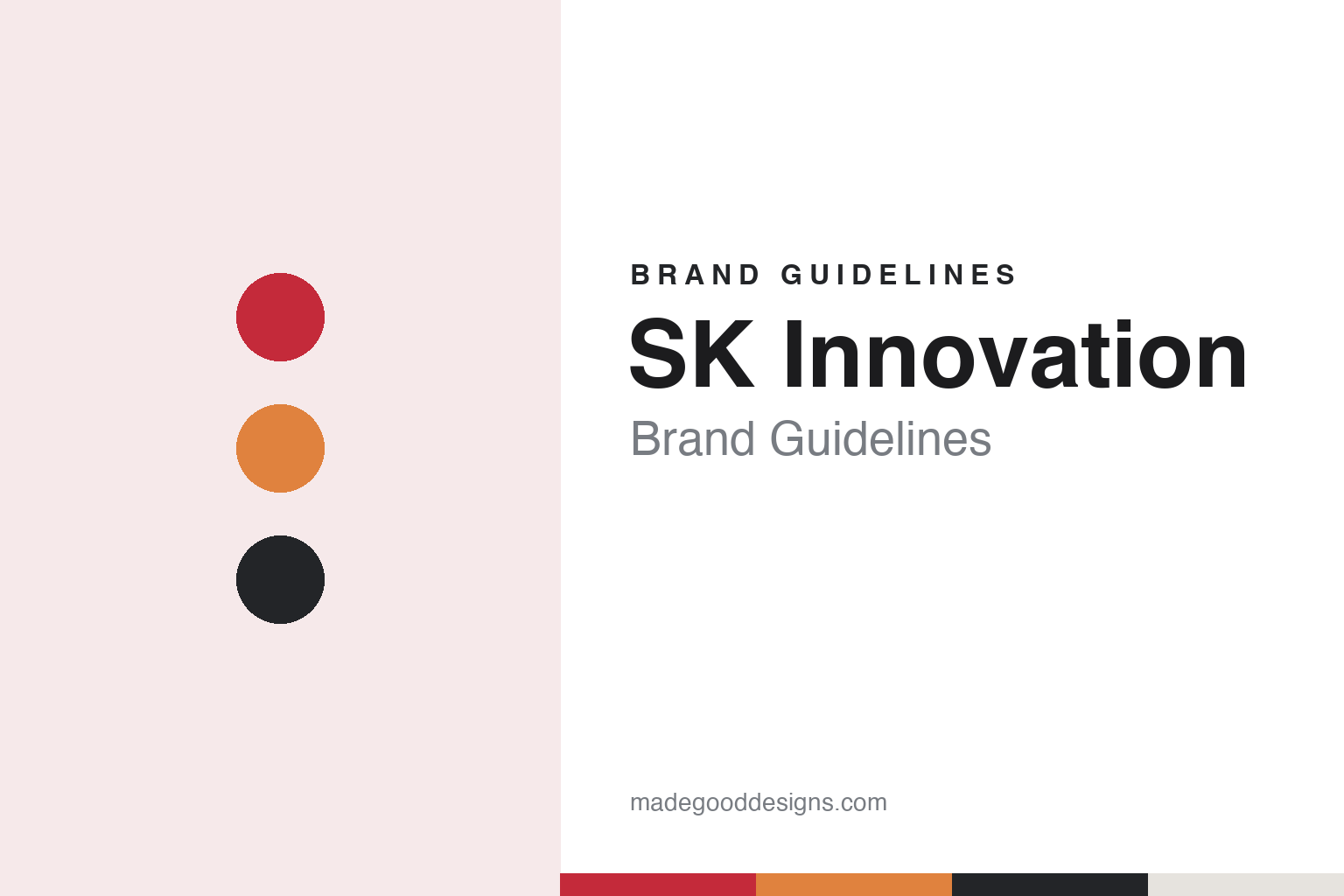
SK Innovation Brand Guidelines
The state refinery of 1962, renamed four times, now an SK energy holding company.
Aa
Two constants: a red and orange palette and a humanist sans register. Abstract homage — not an SK Innovation product or mark; no logo, symbol or signage is reproduced.
Korea Petroleum Corporation
A state refiner, a 1980 sale and a string of names.
SK Innovation traces its history to 1962. That July South Korea enacted a law creating the Korea Petroleum Corporation, and the state company was launched in October, according to SK Innovation’s own timeline. Korean Wikipedia describes it as the country’s first oil refining company. Its first atmospheric distillation unit began operating in July 1964, and the company’s timeline adds an aromatics plant in 1970 and a naphtha cracking centre in 1972.
In December 1980 the corporation was acquired by the Sunkyong Group, the conglomerate now called SK Group, a step Korean Wikipedia describes as privatisation. In July 1982 it was renamed Yukong. Under that name it looked for oil abroad: the company says it struck oil at the Marib block in Yemen in 1984 and imported crude from there in 1988, and it listed on the Korea Stock Exchange in November 1984. In 1991 it held a joint ceremony for nine refining and petrochemical plants that, it says, completed its vertical integration.
The names kept changing as the group reorganised. Yukong became SK Corporation in October 1997. In December 2005 the company bought the Incheon refinery, which it relaunched in 2006. In July 2007, as SK moved to a holding-company structure, the energy and chemical business was split off as SK Energy, English Wikipedia says. In January 2011 SK Energy renamed itself SK Innovation and handed its refining, lubricants and chemicals operations to new wholly owned subsidiaries: a new SK Energy for refining, SK Lubricants (now SK Enmove) and SK Global Chemical (now SK Geo Centric). In 2013 the Incheon refinery and the trading business followed as SK Incheon Petrochem and SK Trading International.
Colour
From refining to batteries and gas.
Today SK Innovation is an intermediate holding company within SK Group, with its head office in Jongno, central Seoul. Its website lists the subsidiaries SK Energy, SK Geo Centric, SK On, SK Incheon Petrochem, SK IE Technology and SK Earthon, alongside the in-house unit SK Innovation E&S. Refining sits with SK Energy and with SK Incheon Petrochem; The Asia Business Daily referred in November 2024 to the group’s main refining and chemicals site as the SK Ulsan Complex. The company’s family of product sites includes the ZIC engine oils and the YUBASE lubricant base oils.
Over the 2010s the company built a battery business. It says it completed a battery plant at Seosan in 2012, began mass production at Komárom in Hungary in January 2020 and at a plant in the US state of Georgia in January 2022. On 1 October 2021 the battery and exploration units were spun off as SK On and SK Earthon. In September 2021 Ford and SK Innovation announced a battery joint venture for plants in Kentucky and Tennessee; English Wikipedia says that in December 2025 SK said it had decided to end it.
The battery business also brought a legal dispute. In 2019 LG Chem filed a trade-secrets complaint against SK Innovation at the US International Trade Commission, which sided with LG Chem and issued a limited exclusion order covering some of SK Innovation’s battery imports; the two companies later settled, English Wikipedia says.
The largest change came in 2024. SK Innovation and its sister company SK E&S, an LNG, power and renewables business, announced a merger in July, and the combined company launched on 1 November 2024, Yonhap reported in The Korea Times. It kept the SK Innovation name, and SK E&S continues as a company-in-company called SK Innovation E&S, The Asia Business Daily reported the same day. On that date SK On also absorbed SK Trading International. On 1 November 2025 SK On completed a merger with SK Enmove, the lubricants business, which now runs as a company-in-company within SK On, The Asia Business Daily reported.
Typography
How refiners present themselves.
Refiners and fuel marketers sit between the oil field and the driver, and their identities have to work at very different scales. The same name may appear on a refinery gate, the side of a tanker truck, a forecourt canopy, a pump display, a lubricant bottle and a page of an investor presentation, so marks tend to be simple shapes and short words that survive distance, weather and night lighting.
Much of the public image is still built on the forecourt. Station brands carry the colour and the logo, while the company behind them may run several names at once: Phillips 66, for example, says it sells fuel in the United States under the Phillips 66, Conoco and 76 brands and in Britain under JET. Payment cards, loyalty schemes and apps extend the forecourt to the phone; Phillips 66 promotes one app, Fuel Forward, across its three US brands.
Lubricants give refiners a second, shelf-sized identity. Bottles and drums are often sold under their own names rather than the corporate one, such as Indian Oil’s Servo or Phillips 66’s Kendall, and they sit beside competitors in shops and workshops, where a pack has to be recognised quickly.
The newest part of the story is told in announcements and reports. Companies present renewable diesel, sustainable aviation fuel and electric-vehicle charging through press releases, sustainability pages and investor material; Phillips 66 describes converting a California refinery to renewable fuels, and Indian Oil has added charging points at its fuel stations. Safety pages, refinery photographs lit at night and annual reports complete a register that is usually more technical than the forecourt. The guides in this group set out what can be checked about each company: its origins, owners, plants and brands.
Aa
A humanist sans — the SK logotype is set in Bliss Bold, the company says. (Specimen set in Fira Sans, a sans STAND-IN; NOT the SK Innovation logo.)
Happy Wing
A group symbol beside a Bliss Bold logotype.
SK Innovation does not have a mark of its own: like other SK companies it uses the group identity, which it sets out on its website. The symbol, called the “Happy Wing,” is described there as two soaring wings drawn on the motif of a communication satellite or a kite, meant to stand for the growth of SK’s energy, chemicals and telecoms businesses; the company says the white line inside the wings represents the letters S and K. The logotype is set in Bliss Bold, with curved ends on the S and the K that the company says give a gentle, friendly image.
The rules are specific. The company says the logotype should normally appear together with the symbol, which sits at its upper right and is tilted at a fixed angle, and it gives clear-space rules measured from the height of the K. Each subsidiary, from SK Energy to SK Earthon, has its own signature in Korean and English built on the same pattern. The company names SK Red and SK Orange as the main colours and lists yellow, green, teal, blue, navy, purple, black and white as sub-colours.
For a design guide, SK Innovation shows how a refiner can live inside a group identity while its own name changes around it. Compare SK Group, its parent, and S-OIL, another refiner with a complex at Ulsan. For this guide we use a red and an orange with charcoal and a soft grey, with a humanist sans, an unofficial interpretation; no product or logo is reproduced.
Explore & save
Keep SK Innovation’s identity on hand — save it to a board in the Made Good inspiration library.
SK Innovation identity set
Pin the SK Innovation red and orange palette and the humanist sans register to your own board.


