HF Sinclair Brand Guidelines
A Dallas refiner that took its name and its mascot from a 1916 oil company.
Aa
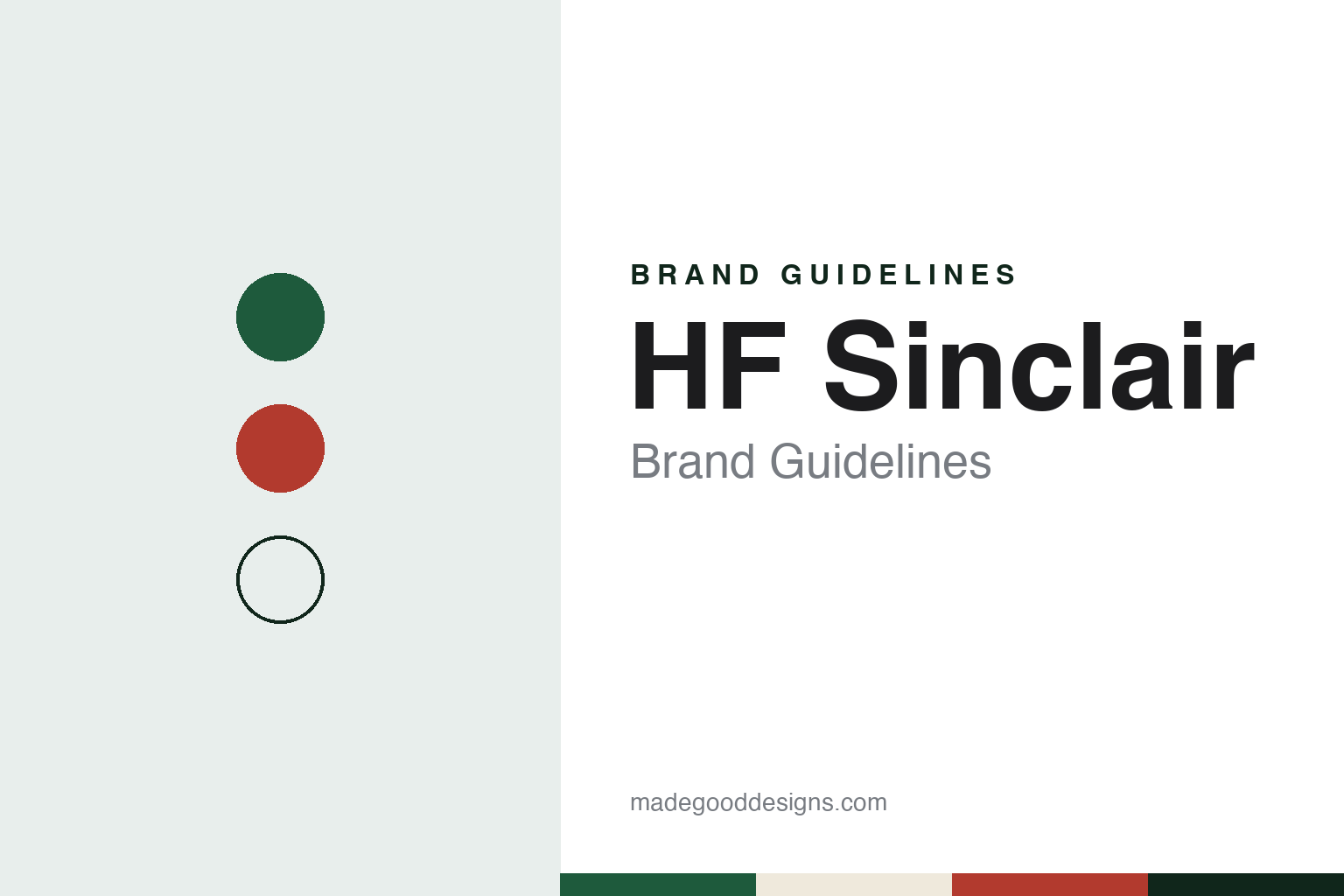
Two constants: a green, cream and red palette and a wide grotesque sans register. Abstract homage — not an HF Sinclair or Sinclair product or mark; no dinosaur, logo or station sign is reproduced.
Holly, Frontier and Sinclair
Three oil companies and one dinosaur.
HF Sinclair is a young name built from old companies. English Wikipedia traces the Holly side to the General Appliance Corporation, incorporated in 1947, which changed its name to Holly Corporation in 1952. In July 2011 Holly merged with Frontier Oil to form HollyFrontier Corporation, based in Dallas. Over the following decade HollyFrontier added lubricants and refineries: Suncor’s Petro-Canada Lubricants business in Mississauga, Ontario, in February 2017; Sonneborn, a maker of white mineral oils and waxes in Petrolia, Pennsylvania, in early 2019; and Shell’s refinery at Anacortes, Washington, agreed in May 2021, according to English Wikipedia. In June 2020 it said its Cheyenne refinery in Wyoming would stop processing crude oil and turn to renewable fuel.
The other half of the name is far older. Sinclair Oil was founded by Harry F. Sinclair on 1 May 1916, English Wikipedia says, bringing together the assets of eleven small oil companies. In 1921 and 1922 Sinclair leased oil production rights at Teapot Dome, the naval oil reserve in Wyoming, without competitive bidding, which led to the Teapot Dome scandal. Through the Depression the company bought other businesses, among them Prairie Oil and Gas’s pipeline and producing companies in 1932.
In 1969 Sinclair merged into the Atlantic Richfield Company, ARCO. In 1976 ARCO sold certain assets, including regional retail operations and the rights to the Sinclair brand and logo, to Earl Holding, and Sinclair was run as a private company from Salt Lake City, with refineries at Casper and Sinclair, Wyoming. In 2009 it sold its Tulsa refinery to Holly Corporation.
HollyFrontier announced its purchase of Sinclair Oil in August 2021. The deal was completed in March 2022, when HollyFrontier and Holly Energy Partners created a new parent company, HF Sinclair Corporation, on completing their purchases of Sinclair Oil and Sinclair Transportation from The Sinclair Companies, CSP Daily News reported on 18 March 2022.
Colour
A dinosaur on the forecourt.
The brand asset that came with the deal is a dinosaur. English Wikipedia says Sinclair adopted a green Brontosaurus as its mascot in 1930, as a way of pointing to the great age of petroleum; the company’s own literature, it notes, said its lubricants came from crude oils that had been “mellowing in the ground” during the age of the dinosaurs, not from dinosaurs themselves.
The mascot was promoted in three dimensions. At the Chicago World’s Fair of 1933–1934 Sinclair sponsored a dinosaur exhibit with an animated model of a Brontosaurus, which led to rubber dinosaurs handed out at its stations. At the New York World’s Fair of 1964–1965 it sponsored Dinoland, with life-size replicas of nine dinosaurs; after the fair the models travelled, and several are now displayed at parks, museums and a zoo, English Wikipedia says. A Sinclair dinosaur balloon first appeared in the Macy’s Thanksgiving Day Parade in 1963 and returned to it in 2015.
The fuel names followed the mascot. Since 1961 Sinclair has called its regular and premium fuels Dino and Dino Supreme, according to English Wikipedia, and it has sold motor oils under the Dino, Dino Supreme and Opaline names.
The new parent kept the reference. From 15 March 2022 HF Sinclair replaced HollyFrontier on the New York Stock Exchange under the ticker “DINO,” which CSP Daily News said reflected Sinclair’s dinosaur logo. The Sinclair website today describes the brand with the line “Legendary DINO. Next-level fuel.” and says it became a subsidiary of HF Sinclair in 2022.
Typography
Refineries, forecourts and fuel cards.
Refiners and fuel marketers sit between the oil field and the driver, and their identities have to work at very different scales. The same name may appear on a refinery gate, the side of a tanker truck, a forecourt canopy, a pump display, a lubricant bottle and a page of an investor presentation, so marks tend to be simple shapes and short words that survive distance, weather and night lighting.
Much of the public image is still built on the forecourt. Station brands carry the colour and the logo, while the company behind them may run several names at once: Phillips 66, for example, says it sells fuel in the United States under the Phillips 66, Conoco and 76 brands and in Britain under JET. Payment cards, loyalty schemes and apps extend the forecourt to the phone; Phillips 66 promotes one app, Fuel Forward, across its three US brands.
Lubricants give refiners a second, shelf-sized identity. Bottles and drums are often sold under their own names rather than the corporate one, such as Indian Oil’s Servo or Phillips 66’s Kendall, and they sit beside competitors in shops and workshops, where a pack has to be recognised quickly.
The newest part of the story is told in announcements and reports. Companies present renewable diesel, sustainable aviation fuel and electric-vehicle charging through press releases, sustainability pages and investor material; Phillips 66 describes converting a California refinery to renewable fuels, and Indian Oil has added charging points at its fuel stations. Safety pages, refinery photographs lit at night and annual reports complete a register that is usually more technical than the forecourt. The guides in this group set out what can be checked about each company: its origins, owners, plants and brands.
Aa
A wide grotesque sans for a refiner with a forecourt brand. (Specimen set in Archivo, a sans STAND-IN; NOT the HF Sinclair or Sinclair logo.)
HF Sinclair
Seven refineries and a licensed brand.
HF Sinclair describes itself as an independent energy company headquartered in Dallas that makes and markets gasoline, diesel, jet fuel, renewable diesel, lubricants and specialty products. English Wikipedia lists seven refineries: El Dorado in Kansas, Artesia in New Mexico, Tulsa in Oklahoma, Woods Cross in Utah, Anacortes in Washington, and Casper and Sinclair in Wyoming. At the launch, CSP Daily News reported, the group’s lubricants were sold under the Petro-Canada Lubricants, Sonneborn, Red Giant Oil and HollyFrontier Specialty Products brands, and its management kept Dallas as headquarters with combined business offices in Salt Lake City.
The logistics side was folded in as well. In December 2023 HF Sinclair announced the completed acquisition of Holly Energy Partners, whose units then stopped trading on the New York Stock Exchange, English Wikipedia says. In a company release of 18 February 2026, HF Sinclair said it produces renewable diesel at two facilities in Wyoming and at Artesia, supplies fuel to more than 1,700 branded stations and licenses the Sinclair brand to more than 350 further locations.
The same release announced Green Trail Fuels, a joint venture with UPOP Holdings in which HF Sinclair holds a 50 per cent non-operating interest, covering 30 retail sites in Colorado and New Mexico. HF Sinclair supplies the fuel from its refineries and UPOP runs the sites; the company says the venture is meant to add Sinclair-branded locations.
For a design guide, HF Sinclair shows how a refiner can borrow an older consumer brand and let its mascot carry the whole group, down to the stock ticker. Compare Marathon, another American refiner with its own forecourt brand, and Valero. For this guide we use a prairie green, cream and a signal red with a wide sans, an unofficial interpretation; no product or logo is reproduced.
Explore & save
Keep HF Sinclair’s identity on hand — save it to a board in the Made Good inspiration library.
HF Sinclair identity set
Pin the HF Sinclair green, cream and red palette and the wide grotesque sans register to your own board.