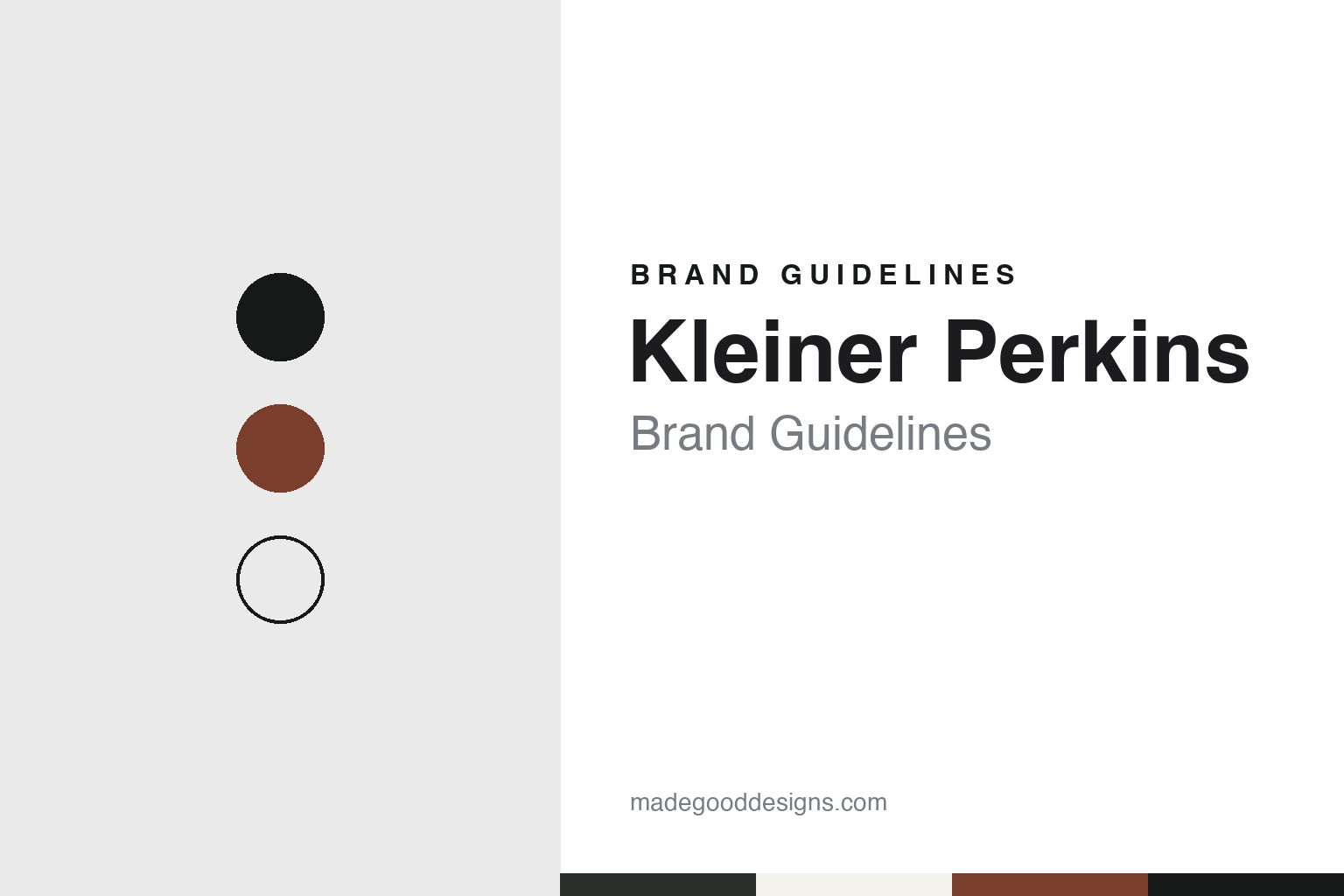
Kleiner Perkins Brand Guidelines
The Sand Hill Road firm that made a short name its brand.
Aa
Two constants: a graphite, paper and redwood palette and a plain wordmark sans register. Abstract homage — not a Kleiner Perkins asset or mark; no logo or wordmark is reproduced.
Kleiner and Perkins
Two founders and an office on Sand Hill Road.
Kleiner Perkins was formed in 1972 in Menlo Park, California, by Eugene Kleiner and Tom Perkins. English Wikipedia describes Kleiner as one of the founders of Fairchild Semiconductor and Perkins as an early Hewlett-Packard executive, and credits the firm with being the first venture capital firm to open an office on Sand Hill Road, the street that later became shorthand for Silicon Valley investors. When TechCrunch reported on the firm’s new funds in January 2022, it described Kleiner Perkins as celebrating five decades in business, and a partner told the site that the focus was the same as when the firm started in 1972: “Venture is a non-scalable, boutique craft that requires incredibly dedicated practitioners.”
The name grew with the partnership. When Frank J. Caufield and Brook Byers became partners — Byers in 1977, English Wikipedia says — the firm took the name Kleiner, Perkins, Caufield & Byers, which the technology press often shortened to KPCB; a TechCrunch headline in June 2015 still used the initials. English Wikipedia gives the legal name today as Kleiner Perkins Caufield & Byers, LLC, while the firm’s own website, its downloadable brand files and recent press coverage all use the shorter Kleiner Perkins.
Its early record is much of what the name carries. English Wikipedia lists early backing for companies including Genentech, Netscape, Amazon.com and Google, and says the firm has been an early investor in more than 900 technology and life-sciences companies since its founding. The firm’s own website tells the Google story as an introduction in 1999 to two Stanford graduates who had built a search algorithm. Partners named by Wikipedia over the decades include John Doerr, listed as chairman, Vinod Khosla and Bill Joy, and Wikipedia still lists Brook Byers among the firm’s partners as a founder.
Colour
A wordmark, a logo grid and a two-word line.
Kleiner Perkins presents itself with very little decoration. The homepage of its website opens on a grid of company names from its history — Google, Amazon, Genentech and Netscape among them — and a two-word line, “Make History”. Each name opens a short story about the company, written by the firm, and the same line appears in its mission: “To be the first call for founders who want to make history and to partner with them as company builders in pursuit of that goal.”
The About page sets out the firm’s ethos in short headed paragraphs — a moral compass, empathy, humility and “winning as a mindset” — followed by values such as “One Team, One Dream” and “Operating in Real Time.” The writing addresses founders directly and describes the firm as “a service organization supporting the companies in which we invest.” A Perspectives section collects essays and case studies about portfolio companies, from Glean to Harvey, and the footer links to a Fellows programme and to the firm’s profiles on LinkedIn, X and YouTube.
The firm also publishes its mark for others to use. A Brand Assets page on its website offers the Kleiner Perkins logo in black and in white, in RGB and CMYK versions and as PNG files, with separate horizontal, stacked and wordmark versions. This guide does not name the typeface; the specimen below is a stand-in.
Typography
How venture firms present themselves.
Venture capital firms sell no products, so their identities rest on a name, a few lines of copy and the companies they back. Their websites can be strikingly spare. Sequoia Capital’s homepage opens on a single sentence, “We help the daring build legendary companies,” and Andreessen Horowitz uses its motto, “Software Is Eating the World,” as the tagline that runs across its site.
The founder is usually the hero. Sequoia describes the people it wants to back rather than the money it manages, and its ethos page lists “the creative spirits” and “the underdogs,” and both firms give over large parts of their sites to founder stories and to portfolio pages that gather the names and marks of the start-ups they have funded. Wikipedia noted in November 2025 that the a16z website listed more than a thousand portfolio companies.
Publishing has become part of the job. Andreessen Horowitz runs a podcast network of about a dozen shows, newsletters, a books list and a New Media team that, in its own words, offers “go-direct as a service” to founders; Tech Times wrote in June 2026 that its thesis urges founders to speak through their own channels. Sequoia’s site mixes partner essays and videos with its Training Data podcast. Essays matter too: Marc Andreessen’s 2011 piece “Why Software Is Eating the World” gave his firm a motto.
Place and name do the rest. Sand Hill Road in Menlo Park, where Andreessen Horowitz lists its headquarters office, has given its name to a book by one of the firm’s partners, Secrets of Sand Hill Road. Names are chosen with care: Sequoia says its founder picked a long-lived tree rather than his own name, while Andreessen Horowitz compressed two surnames into a16z, a short handle it now uses across its website address, podcasts and social accounts.
Aa
A plain sans for a short, two-word name. (Specimen set in Inter Tight, a sans STAND-IN; NOT the Kleiner Perkins logo.)
Kleiner Perkins
A growth spin-off, a reboot and new funds.
The firm has changed shape several times. English Wikipedia says it expanded into growth-stage investing in 2010. In September 2018 TechCrunch reported that the partner who led that growth practice was leaving to start a new firm and taking the growth team with her; a Kleiner Perkins spokesperson described an intentional decision to create “two separate firms with different people and operations.” Wikipedia names the new firm Bond and says Kleiner Perkins began a new strategy in January 2019 under partners Mamoon Hamid and Ilya Fushman, with an 18th venture fund.
The firm also went through a closely watched court case. In May 2012 an employee filed a gender-discrimination suit against it; on 27 March 2015 a San Francisco Superior Court jury found for Kleiner Perkins on all four claims, TechCrunch reported, and in September 2015 the plaintiff said she would not appeal.
Since the reboot the firm has kept raising paired funds: in January 2022 TechCrunch reported two new funds, KP20 for early-stage companies and Select2 for later rounds, and on 24 March 2026 it reported that the firm had raised its 22nd early-stage fund and a separate growth vehicle. That report named early stakes in AI companies including Together AI, Harvey and OpenEvidence, said the firm is also an investor in Anthropic and described a lean team of five partners. Kleiner Perkins remains headquartered in Menlo Park, with offices in San Francisco and Shanghai, according to English Wikipedia.
For a design guide, Kleiner Perkins shows how a firm can let a shortened name, a two-word line and a list of companies do the work of a visual identity. Compare Sequoia Capital, the other Menlo Park firm founded in 1972, and Lightspeed Venture Partners. For this guide we use graphite, warm paper and a redwood red with a sans, an unofficial interpretation; no product or logo is reproduced.
Explore & save
Keep Kleiner Perkins’s identity on hand — save it to a board in the Made Good inspiration library.
Kleiner Perkins identity set
Pin the Kleiner Perkins graphite, paper and redwood palette and the plain wordmark sans register to your own board.