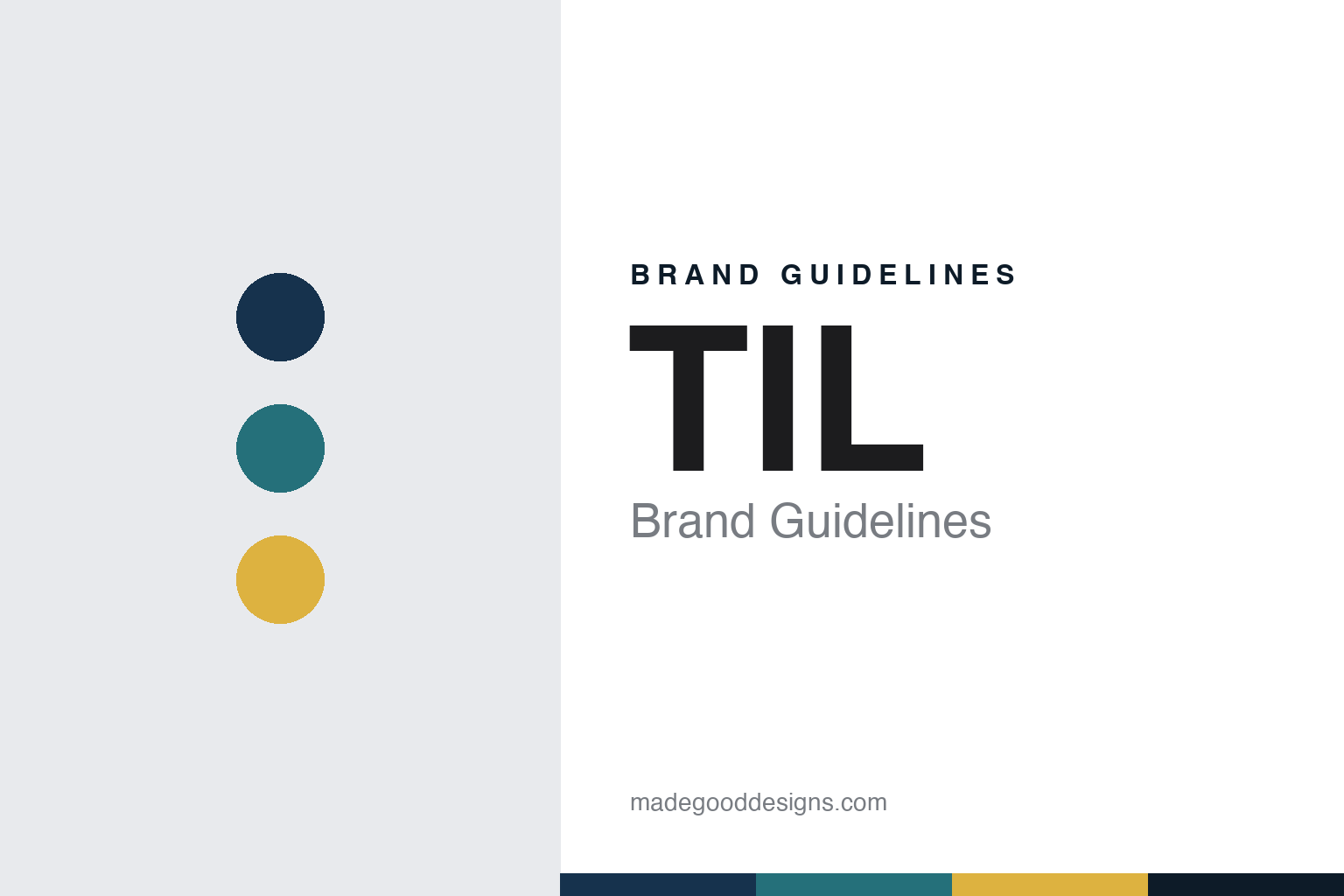
TIL Brand Guidelines
The Geneva company behind MSC’s container terminals.
Aa
Two constants: a harbour navy, quay teal and crane yellow palette and a geometric sans register. Abstract homage — not a TiL asset or mark; no logo, crane or terminal image is reproduced.
TiL
MSC’s terminal company, with partners.
Terminal Investment Limited, which writes its short name as TiL, is the container-terminal company of the Mediterranean Shipping Company group, and it is based in Geneva, the city that is also home to MSC. TiL dates its portfolio to 2000: the company says it has added two to three container terminal businesses a year on average since then, through acquisitions, increases in existing stakes and greenfield developments, and it describes 25 years of consistent growth. gCaptain, writing in August 2026, called it the terminal investment arm of MSC.
Its first terminal story is French. TiL says the Bougainville terminal at Le Havre, now run as Terminaux de Normandie, was the first container terminal investment of the MSC group, in 2001, and that in 2018 it brought in Terminal Porte Océane and extended the wharf to 2.1 kilometres. On the American West Coast, Total Terminals International at Long Beach started operations in 2002, the company says.
Ownership opened up in 2013. According to analysis by the shipping consultancy Drewry, quoted by gCaptain on 6 March 2025, Global Infrastructure Partners (GIP) bought an initial 35% stake in TiL in 2013, later reduced to 20%, while MSC held 70%. TiL’s own shareholder page lists three owners: MSC, through SAS Shipping Agencies Services, an indirect wholly owned MSC subsidiary; GIP, which it says combined with BlackRock in 2024 and is now “a part of BlackRock”; and GIC, the Singapore investment firm that manages the country’s foreign reserves.
The board reflects that mix. TiL’s leadership page lists members of the Aponte family and senior MSC executives alongside directors from GIP and GIC, with Diego Aponte, president of the MSC group, as chairman. Ammar Kanaan has been chief executive since April 2018, the company says.
Colour
Quays on the main trade routes.
TiL describes its business in plain terms. It invests in, develops and manages container terminals, whose job is to move boxes between a main trade-route ship and the next leg of the journey by road, rail, barge or a smaller vessel: lifting them on and off ships with ship-to-shore cranes, and storing them in the yard while they wait for customs clearance and onward transport.
The portfolio is wide. The company says it has a significant presence at many of the busiest container ports, naming Singapore, Ningbo, Busan, Los Angeles, Long Beach, Rotterdam, Antwerp, New York and New Jersey, and Valencia. Its own estimates for 2023 give more than 62 kilometres of quay, more than 500 ship-to-shore cranes, more than 30,000 employees and throughput of about 65 million TEU, the twenty-foot unit in which containers are counted.
A handful of terminals carry the story on its website. MPET in Antwerp is a joint venture with PSA, which TiL describes as Europe’s largest container terminal. In Brazil, Portonave at Navegantes, in Santa Catarina, began operating in 2007 and includes Iceport, an automated cold store. Lomé Container Terminal in Togo was a greenfield project developed by TiL itself. At King Abdullah Port in Saudi Arabia, where NCT is the only container terminal operator, TiL points to a first-place ranking in the 2021 Container Port Performance Index published by the World Bank and S&P Global Market Intelligence. MSC Terminal Valencia, operating since 2006, handles Spanish import and export boxes and transshipment in the western Mediterranean, and MPAT operates at Pasir Panjang in Singapore.
The company sets out its sustainability work under three headings, Environment, People and Business Integrity, and presents automation chiefly as a way to “densify” existing terminals, adding capacity without reclaiming new land. Those are TiL’s own descriptions of its aims.
Typography
Boxes, cranes and quays.
Container lines, box lessors and port operators sell capacity rather than consumer products, and they present themselves mostly to shippers, carriers, investors and job seekers. Their identities travel on large objects. A line’s colours and name are repeated on hulls, on the containers it owns and on terminal equipment. Corporate photography tends to show ships at sea, stacked containers and cranes over quays, often lit at night.
Websites carry much of the practical work. Carriers publish schedules, route maps and booking or tracking tools; lessors such as Triton run sales portals, product sheets and pages on container conditions; terminal operators list their ports, berths and services. Fleet pages and dated timelines matter a great deal: Seaspan’s site, for example, sets out its history as a year-by-year list of ship deliveries, designs and orders.
Fuel and emissions now have pages of their own. Shipowners and lines describe dual-fuel ships, retrofits and new fuels such as LNG and methanol, usually in their own words and with their own figures, alongside sustainability reports and the certificates and policies they choose to publish. Those pages are statements by the companies, and this guide reports them as such.
Ownership changes often. Many companies in this group were formed by merger, are owned by infrastructure or private-equity investors, or are partly held by the carriers they serve, and their annual reports, preference shares and investor pages remain public even after a take-private. This guide sets out what can be checked about each company — when it was founded, who owns it and how it describes its business — and marks clearly what rests only on its own word.
Aa
A geometric sans for a terminal company that mostly trades under its terminals’ names. (Specimen set in Sora, a sans STAND-IN; NOT the TiL logo.)
TiL
New quays, and a deal still in progress.
TiL’s newest American project shows how it works with partners. With the Port of New Orleans and Ports America it is developing the Louisiana International Terminal, a deepwater container terminal planned for St. Bernard Parish on the Lower Mississippi. gCaptain reported on 17 August 2026 that the U.S. Army Corps of Engineers had granted the federal permit needed to build it. The site lies downriver of the Crescent City Connection bridges, so ships of more than 16,000 TEU can reach it, and the project was first announced in 2022, the same report said.
The largest transaction in its name is not finished. In March 2025 CK Hutchison announced that it would sell its 80% stake in Hutchison Ports Holding to a consortium of BlackRock and TiL, gCaptain reported on 6 March 2025, and Drewry expected the regulatory reviews to take at least a year. The sale was agreed in March 2025 and had not been completed at the time of writing.
For a design guide, TiL shows a terminal company whose own name sits in the background: on its website, its terminals appear under their local names, from MPET and Portonave to Terminaux de Normandie, with TiL presented as the investor and operator behind them. Compare Ports America, its partner on the Mississippi, and APM Terminals, the terminal company of the Maersk group. For this guide we use a harbour navy, a quay teal and a crane yellow with a sans, an unofficial interpretation; no product or logo is reproduced.
Explore & save
Keep TIL’s identity on hand — save it to a board in the Made Good inspiration library.
TIL identity set
Pin the TiL harbour navy, quay teal and crane yellow palette and the geometric sans register to your own board.