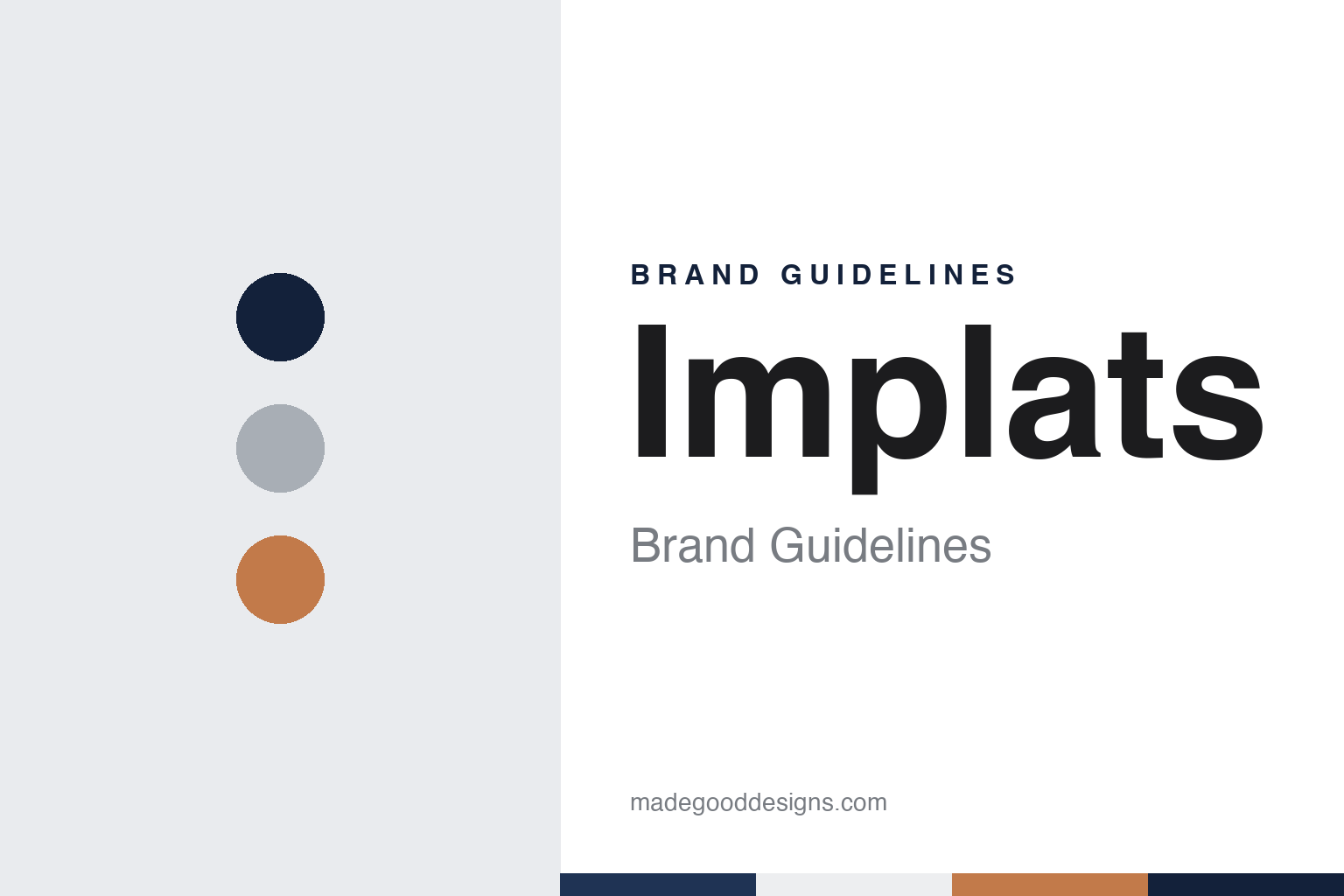
Implats Brand Guidelines
A Rustenburg platinum producer that grew into a three-country group.
Aa
Two constants: an Implats navy, platinum grey and copper palette and a sturdy serif register. Abstract homage — not an Implats product or mark; no logo or wordmark is reproduced.
Impala Platinum
A Union Corporation mine on Bafokeng land.
Implats is the short name of Impala Platinum Holdings, the Johannesburg-listed producer whose main mines sit on the Western Limb of the Bushveld Complex near Rustenburg. English Wikipedia says the company was formed in 1966 as a subsidiary of the mining house Union Corporation, to establish a platinum mine at Rustenburg with an initial capacity of 100,000 ounces a year. The Canadian nickel company Inco gave technical advice and the British bank Hambros financial advice, and the two, along with South Africa’s state-owned Industrial Development Corporation, each took a 10% share.
The ground came through an agreement with the Bafokeng community. In 1968, Wikipedia says, the company signed a prospecting accord with the Bafokeng, now the Royal Bafokeng Nation, and obtained a lease over 12,000 hectares; production began in July 1969. Platinum demand rose in the 1970s as new vehicle-emission rules spread, including those pursued by the US Environmental Protection Agency, and from 1974 the company supplied General Motors with platinum and palladium for exhaust-treatment devices, according to the same article.
The corporate name arrived in stages. Bishopsgate Platinum, of which the operating company was a wholly owned subsidiary, listed on the Johannesburg Stock Exchange on 26 January 1973, and on 19 October 1978 it changed its name to Impala Platinum Holdings. By the early 2000s its parent was Gencor, which completed its unbundling in 2003, handing shareholders 8.8 Implats shares for every 100 Gencor shares, Wikipedia says. The company presents that inheritance as a long one: its website speaks of “100 years in platinum mining.” German Wikipedia places the head office in Illovo, Gauteng.
Colour
Zimbabwe, Canada and the Royal Bafokeng contest.
Expansion followed through stakes and joint ventures. Wikipedia says Implats acquired an effective interest in Lonrho’s platinum division, Lonplats, in 1990; a full merger agreed in 1995 was blocked by the European Union in 1996. Between 2000 and 2004 it gained the mineral rights for Marula on the Eastern Limb, took strategic stakes in Zimplats and Mimosa on Zimbabwe’s Great Dyke, and entered a joint venture with Anglovaal Mining to develop Two Rivers. In late 2019 it bought North American Palladium, whose Lac des Iles mine north of Thunder Bay, Ontario, became Impala Canada.
The most recent large step was at home. Implats and Northam Platinum competed for control of Royal Bafokeng Platinum, the mid-tier producer next to Impala Rustenburg. Moneyweb reported on 31 May 2023 that the Public Investment Corporation had accepted Implats’ offer for its 9.27% stake, which with a further small purchase would give Implats about 55.5% once the transactions were finalised, the controlling position it had pursued since 2021; Northam had withdrawn from the contest earlier that year. The company’s site now lists the business as Impala Bafokeng, “previously known as Royal Bafokeng Platinum,” a subsidiary since its acquisition in 2023, operating the Bafokeng Rasimone and Styldrift mines, with the Maseve operations under care and maintenance.
Today Implats describes itself as a fully integrated PGM producer with six mining operations and a refining business, Impala Refining Services, which buys concentrate and provides smelting and refining for group companies and third parties. Its base and precious metals refineries are at Springs, east of Johannesburg. The company says it contributes about 20% of global primary PGM production a year and counts nearly 68,000 employees and contractors at managed operations, working across three orebodies: the Bushveld Complex, the Great Dyke and the Canadian Shield. Impala itself is 87% owned and Marula 73%, and Two Rivers is a joint venture in which African Rainbow Minerals holds 54% and Implats 46%, the company says.
Typography
How the category presents itself.
Platinum-group, nickel and zinc miners sell to refiners, carmakers, battery makers and investors rather than to shoppers, and their visual identities tend to reflect that. Corporate sites in this group often lean on deep blues, steel and slate greys and copper or bronze accents, tones that echo metal, rock and industrial plant without pointing to any single product. Wordmarks are usually short: a clipped group name, an acronym or a founding name kept through decades of mergers.
Photography does much of the work. Shaft heads, headgear against the sky, concentrators, smelters and refineries are commonly shown at scale, often from a distance and with people small in the frame, so that the size of an operation reads at a glance. Underground images, core trays and molten metal appear as texture beside portraits of employees and community members.
Information is organised by place and by metal. Many producers give each mine its own page, with location, depth, life of mine and headcount, and add explainers on what each metal is used for: platinum and palladium in autocatalysts, platinum in fuel cells, nickel and other metals in batteries, zinc in galvanised steel. Production updates, mineral resource and reserve statements, and annual integrated reports sit close to the surface of the site, because investors and analysts are a core audience.
Sustainability and community pages sit alongside the operations. Sections on tailings storage facilities, water, climate, employee housing, host communities and responsible sourcing are standard, and labour relations, strikes and land agreements form part of many of these companies’ public histories. The result is a register that is sober, data-heavy and place-specific, in which colour and typography stay restrained so that maps, tables and site photographs can carry the identity.
Aa
A sturdy serif for a clipped corporate name. (Specimen set in Source Serif 4, a serif STAND-IN; NOT the Implats logo.)
Implats
Three verbs and pages by mine.
Labour relations are part of the record. English Wikipedia says employees of Impala Platinum and other platinum producers went on strike in late January 2014; the strike, which the article describes as the longest in South Africa’s history, ended in late June 2014 when the Association of Mineworkers and Construction Union signed a three-year settlement with the producers.
The way Implats speaks about itself is compact. Its stated purpose is “to create a better future,” and its values are three verbs: respect, care and deliver. Its website organises the business by mine, giving each operation’s depth, life of mine and headcount, beside pages on tailings storage facilities, climate change, community livelihoods and responsible sourcing, and a section on the uses of platinum-group metals that runs from autocatalysts and fuel cells to electronics and jewellery. A September 2026 report in Miningmx described its five-year capital plan as aimed mainly at sustaining production rather than growth, quoting a Nedbank Securities analyst who said the company was “replacing ounces.”
The naming has a clear hierarchy. The listed holding company uses the short form Implats, while the operating mines keep the older Impala name, now extended to Impala Rustenburg, Impala Canada and Impala Bafokeng. For a design guide, Implats shows how a producer can run a clipped group name above a family of operating names, each tied to a place. Compare it with Northam Platinum, its rival in the Royal Bafokeng contest, and Sibanye-Stillwater, whose Marikana operations also lie near Rustenburg. For this guide we use a Bushveld navy, a platinum grey and a warm copper with a sturdy serif, an unofficial interpretation; no product or logo is reproduced.
Explore & save
Keep Implats’s identity on hand — save it to a board in the Made Good inspiration library.
Implats identity set
Pin the Implats navy, platinum grey and copper palette and the sturdy serif register to your own board.


