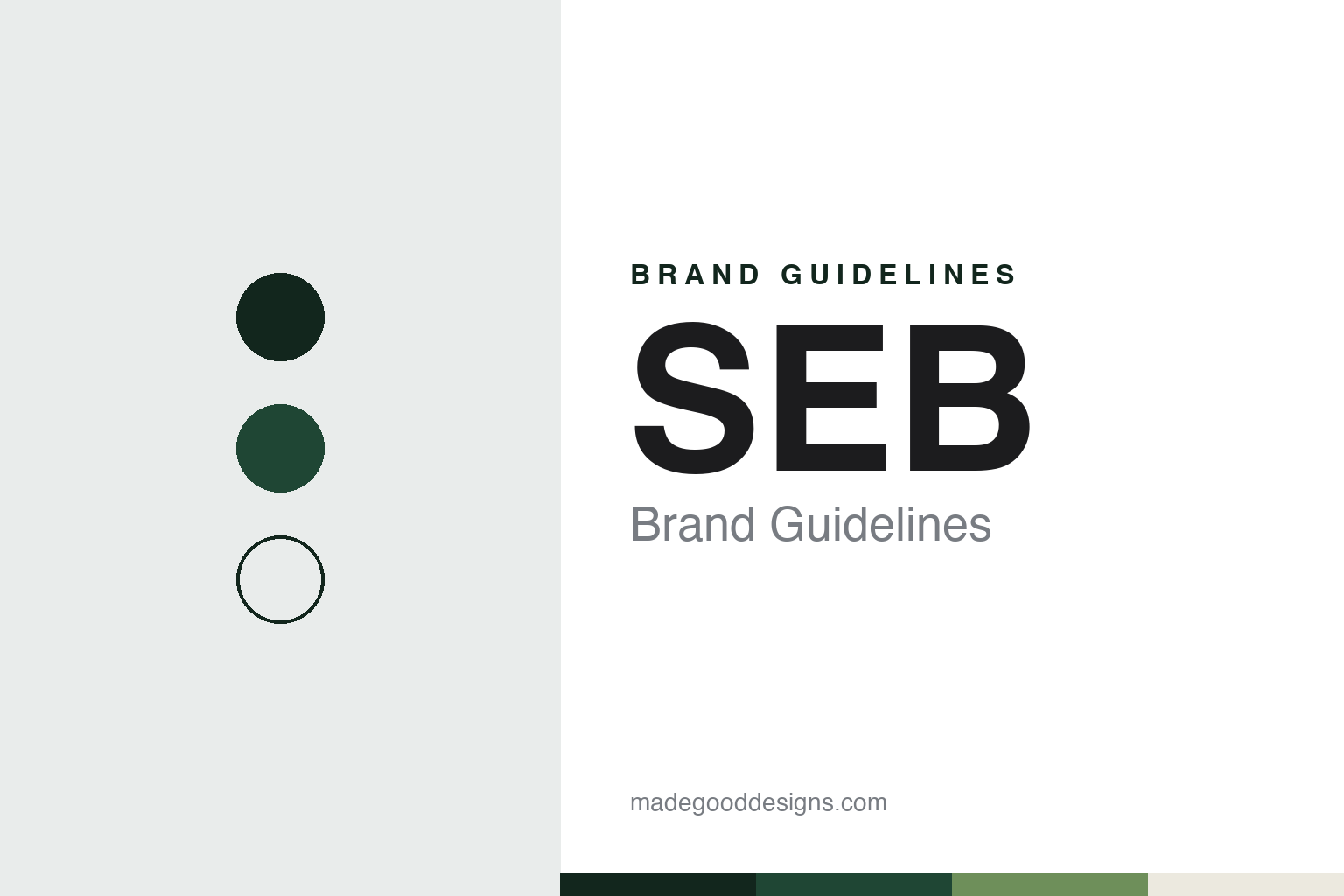
SEB Brand Guidelines
A Stockholm bank built on two nineteenth-century roots, back in its old green.
Aa
Two constants: a banker’s green, moss and linen palette and a clean grotesque sans register. Abstract homage — not an SEB asset; no logo, card or app screen is reproduced.
Stockholms Enskilda Bank
A private bank for industry, 1856.
SEB’s oldest root is Stockholms Enskilda Bank, founded in 1856 by André Oscar Wallenberg. English Wikipedia describes it as Stockholm’s first private bank; SEB calls it one of the first commercial banks in Sweden and says Wallenberg’s aim was to give inventors and entrepreneurs capital for industrial ventures. From the beginning, English Wikipedia says, the bank lent mainly to industry and introduced banker’s drafts to make payments simpler. SEB says it hired its first female employee in 1864 and describes her as the first woman employed anywhere in banking; English Wikipedia gives 1857 as the year the bank began employing women.
The second root is Skandinaviska Kreditaktiebolaget, set up in Gothenburg in 1864 according to SEB and English Wikipedia, and on 6 November 1863 according to Swedish Wikipedia. SEB says the Danish financier Carl Fredrik Tietgen founded it in cooperation with Wallenberg. English Wikipedia links it to the Scandinavian movement of the period and says it was based in Gothenburg rather than Copenhagen; its head office later moved to Stockholm. It competed with Stockholms Enskilda Bank, SEB says, and took the name Skandinaviska Banken in 1939.
Both banks were closely tied to Swedish industry. SEB says that during a crisis in 1878 it chose to help struggling companies back on their feet rather than let them fail, naming Atlas Copco as an example, and that it helped when Volvo was set up; the first Volvo car left the factory on 14 April 1927, the bank says. In the 1930s Skandinaviska Kreditaktiebolaget made heavy losses after the international recession and the Kreuger crash and received state loans, which took four years to repay, according to SEB.
Colour
War years, a merger and a new name.
The Second World War is part of the record. English Wikipedia says that before and during the war the Swedish government drew on the bank’s management for trade negotiations with Germany, the United Kingdom, the United States and Finland. In 1939–1941 Stockholms Enskilda Bank acquired a number of subsidiaries of the German Bosch group, on condition that Bosch could buy them back after the war, and made a similar acquisition of the American Bosch Corporation. The US government regarded those acquisitions as illegal, treated American Bosch as enemy property and confiscated it in 1943; in August 1945 it accused the bank of collaborating with Nazi Germany and placed it under a blockade, which was lifted in 1947, English Wikipedia says.
In 1972 Stockholms Enskilda Bank and Skandinaviska Banken merged as Skandinaviska Enskilda Banken. SEB says a key reason was to give the banks a better chance against growing international competition, and English Wikipedia adds the aim of serving corporate clients. The Wallenberg family remains the largest shareholder, through the investment company Investor AB, according to English Wikipedia.
The market name changed in 1998, when the bank replaced its logo and the name S-E-Banken with SEB, Swedish Wikipedia says. It had bought the insurer Trygg-Hansa in 1997, and at the end of 1998 it took its first stakes in three Baltic banks: Eesti Ühispank in Estonia, Latvijas Unibanka in Latvia and Vilniaus Bankas in Lithuania. In 2000 it bought the German bank BfG and the rest of the Baltic banks. A planned merger with Föreningssparbanken, now Swedbank, was announced in early 2001 and called off when the European Commission demanded large concessions, Swedish Wikipedia says. The German retail branches were sold to Banco Santander in January 2011, and the Ukrainian branch business followed in 2012.
SEB says it became one of the first banks in the world to offer all its services online to private customers, in 1996, and that it worked with the World Bank on the first green bond in 2008; English and Swedish Wikipedia date that work to 2007 and 2008.
Typography
Nordic banks and their identities.
The Nordic banks in this guide share a visual habit more than a single style. Their names tend to appear as clean sans-serif wordmarks, most often in blue, with green and red among the other colours used across the region, and their websites favour plain-language copy over financial jargon. Photography leans towards calm, minimalist scenes of cities, coastlines and forests rather than trading floors.
Their public pages are organised around everyday needs: current accounts and cards, mortgages, pensions and savings, business banking and, increasingly, sustainability. Mobile apps sit at the centre of that offer, and some of the groups here present digital banking as part of their own history. Annual and sustainability reports, published in English as well as the home languages, are among the most detailed public records of how each bank presents itself.
The ownership models differ. Some of these groups are listed companies formed through cross-border mergers in the 1990s and 2000s; others grew out of savings-bank and cooperative traditions in which local banks remain owned by their customers or by foundations, and cooperate under a shared brand. Several carry names and roots that go back to the nineteenth century, and the older names often survive in buildings, museums and corporate histories.
This guide sets out what can be checked about each brand — when it was founded, how it was formed, who owns it today and where its head office sits — with any regulatory findings stated plainly, with dates and outcomes. The palettes and type stand-ins are our own unofficial interpretations; no logo, symbol or official colour value is reproduced.
Aa
A clean grotesque sans for a three-letter name. (Specimen set in Manrope, a sans STAND-IN; NOT the SEB logo.)
SEB
A banker’s green, worn again.
The bank’s Baltic growth also brought regulatory scrutiny. On 25 June 2020 Sweden’s Finansinspektionen issued SEB a remark and an administrative fine for shortcomings in identifying money-laundering risk in its Baltic subsidiaries and in its governance and control of their anti-money-laundering work, in an investigation covering 2015 to the first quarter of 2019. The regulator said the investigation was coordinated with the supervisors in Estonia, Latvia and Lithuania, and it also ordered steps to improve transaction monitoring in the Swedish business.
Colour is the most clearly documented part of SEB’s identity. The bank says it used a dark green between 1972 and 1989, a shade it traces to the early fourteenth century, when the tables of medieval bankers were draped in dark green cloth. SEB says the colour stands for credibility and security, and that it is now wearing it again. Today the bank is headquartered in Stockholm and works as a universal bank in Sweden and the Baltic countries, with a corporate and institutional focus in Denmark, Finland, Norway, Germany and the United Kingdom, English Wikipedia says.
For a design guide, SEB shows how a bank can take a colour from its own archive rather than invent a new one. Compare Swedbank, the Swedish bank it once planned to merge with, and Handelsbanken, another Stockholm-based bank. For this guide we use a deep banker’s green, a moss tone and a warm linen with a sans, an unofficial interpretation; no product or logo is reproduced.
Explore & save
Keep SEB’s identity on hand — save it to a board in the Made Good inspiration library.
SEB identity set
Pin the SEB banker’s green, moss and linen palette and the clean grotesque sans register to your own board.