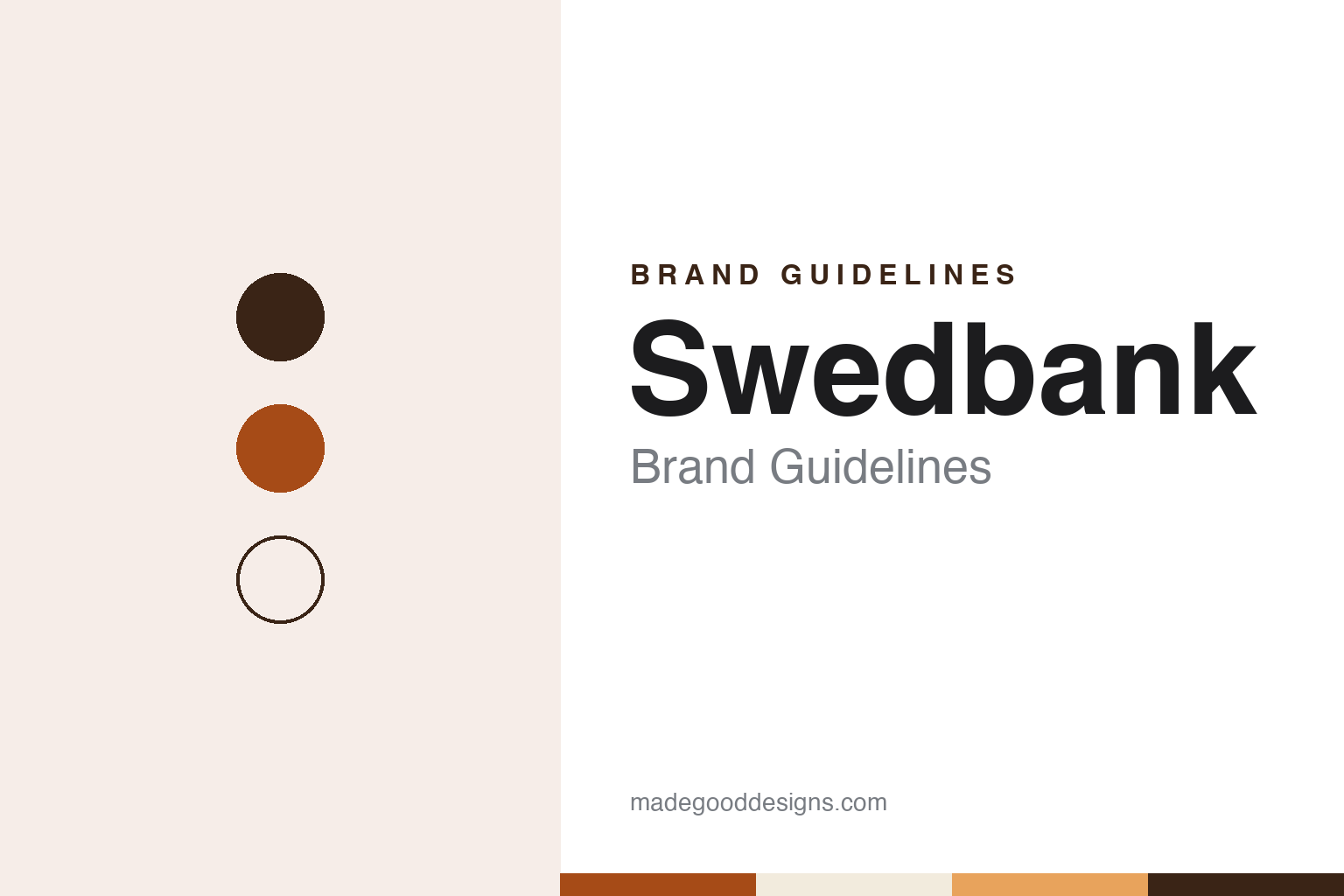
Swedbank Brand Guidelines
From Sweden’s first savings bank in 1820 to the oak tree.
Aa
Two constants: an ember orange, oak brown and birch palette and a rounded sans register. Abstract homage — not a Swedbank mark; no logo, oak tree symbol or branch sign is reproduced.
A savings bank for everyone
Two traditions: savings banks and farmers’ credit societies.
Swedbank traces its roots to 1820, when the first Swedish savings bank opened in Gothenburg. Swedish Wikipedia names its founder as the German-born merchant Eduard Ludendorff. The bank says the idea was that ordinary people should be able to deposit and withdraw small sums at any time, and that the first savings bank was run from the founder’s home, where customers were received directly. Its first depositor, the company says, was a three-year-old girl, and children made up a large share of the 742 customers in its first year.
The idea spread from town to town. The bank says there were 498 savings banks across Sweden at their peak in 1928, and that they funded much of the building of towns in the later 19th century, from streets and power systems to housing. Savings banks also worked on children’s saving habits: one in Enköping gave savings books to newborns in 1894, and the savings banks have published the children’s magazine Lyckoslanten since 1926, which the company calls Sweden’s oldest children’s magazine and which it still distributes to schoolchildren.
A second line came from the countryside. Sweden’s first agricultural cooperative credit society was founded in 1915, the company says: a member-owned society that lent to farmers and encouraged saving. The savings banks set up their own central bank, Sparbankernas Bank, in 1942, and the farmers’ credit societies set up Jordbrukets Bank in 1958. New banking legislation in 1969 allowed both groups to serve businesses outside farming, and the savings banks launched the fund company Robur and its first equity fund in 1967.
The savings banks were also early with technology. In 1977 they launched Minuten, a nationwide network of online cash machines that the company describes as the first in Sweden. Telephone banking followed in the 1980s, online banking in 1995 and Swedbank’s first mobile app in 2009, the bank says.
Colour
Mergers, a new name and the Baltics.
The modern bank was built through mergers in the 1990s. After Sweden’s financial crisis of 1990, eleven of the largest savings banks merged in 1992 to form Sparbanken Sverige, becoming a limited company in place of the old savings-bank structure, the company says. A year earlier twelve regional agricultural cooperative banks had merged to form Föreningsbanken. In 1997 the two combined as FöreningsSparbanken. English Wikipedia says Sparbanken Sverige was listed on the Stockholm exchange in 1995; the company’s timeline dates the listing of Föreningsbanken to 1994.
The Baltic business grew from Hansabank, founded in Estonia in 1991, which started operating in Latvia in 1995 and in Lithuania in 1996. The Swedish bank took more than half of Hansabank in 1999 and all of it in 2005, according to its own timeline. The annual general meeting of 2006 resolved to change the group’s name, and on 8 September 2006 FöreningsSparbanken AB became Swedbank AB, English Wikipedia says. Hansabank began changing its name to Swedbank in the three Baltic countries in 2008.
Not every venture lasted. Swedbank entered Ukraine in 2007 by buying TAS-Kommerzbank and, in 2013, left Russia and sold the Ukrainian subsidiary, the company says. It also writes that the 2008 financial crisis hit the Baltic states hard and that Swedbank, like other banks, had lent too much and too quickly; its work on problem loans in the region was largely finished around 2012.
The savings-bank tie remains. Swedish Wikipedia says Swedbank works with about sixty local banks in Sweden, most of them independent savings banks, and that a group of savings banks is among its largest owners. The company says that, through those owners, part of its profits goes to research, education, sport, business and culture. Since 2014 its head office has stood in Sundbyberg, just outside Stockholm, Swedish Wikipedia says.
Typography
Nordic banking.
The Nordic banks in this guide share a visual habit more than a single style. Their names tend to appear as clean sans-serif wordmarks, most often in blue, with green and red among the other colours used across the region, and their websites favour plain-language copy over financial jargon. Photography leans towards calm, minimalist scenes of cities, coastlines and forests rather than trading floors.
Their public pages are organised around everyday needs: current accounts and cards, mortgages, pensions and savings, business banking and, increasingly, sustainability. Mobile apps sit at the centre of that offer, and some of the groups here present digital banking as part of their own history. Annual and sustainability reports, published in English as well as the home languages, are among the most detailed public records of how each bank presents itself.
The ownership models differ. Some of these groups are listed companies formed through cross-border mergers in the 1990s and 2000s; others grew out of savings-bank and cooperative traditions in which local banks remain owned by their customers or by foundations, and cooperate under a shared brand. Several carry names and roots that go back to the nineteenth century, and the older names often survive in buildings, museums and corporate histories.
This guide sets out what can be checked about each brand — when it was founded, how it was formed, who owns it today and where its head office sits — with any regulatory findings stated plainly, with dates and outcomes. The palettes and type stand-ins are our own unofficial interpretations; no logo, symbol or official colour value is reproduced.
Aa
A rounded sans for a bank rooted in the savings-bank movement. (Specimen set in Nunito Sans, a sans STAND-IN; NOT the Swedbank logo.)
Swedbank
An oak tree from the 1920s, and a long inquiry.
The bank’s most lasting image comes from the savings banks. During the 1920s, the company says, the oak tree began to be used as a shared symbol of the Swedish savings banks, and one artist’s version carried a line that translates roughly as “firmly rooted is the security built on money saved.” Many different oak trees have come and gone since, the bank says.
Swedbank’s recent history includes a long money-laundering inquiry. In 2019 the Swedish public broadcaster SVT’s programme Uppdrag granskning linked Swedbank’s branches in Estonia, Latvia and Lithuania to suspicious transactions with Danske Bank between 2007 and 2015. Investigations followed in Sweden, Estonia and the United States into the bank’s anti-money-laundering work and the information it gave authorities. In July 2026, SVT Nyheter reported, Swedbank reached a settlement with the New York State Department of Financial Services over answers it gave the regulator in 2016 and 2018, a settlement that SVT said closed the last of the investigations opened in 2019. The bank says it launched a wide programme of measures against financial crime in 2019, and that it signed the United Nations Principles for Responsible Banking the same year.
Today the company lists its home markets as Sweden, Estonia, Latvia and Lithuania, and its timeline records international offices in New York, Oslo, Shanghai and Helsinki; it calls its fund company Swedbank Robur one of the larger asset managers in the Nordic region. It describes its history as “200 years of money and life,” a theme it marked in 2020.
For a design guide, Swedbank shows how a bank formed by mergers can carry an older movement’s symbol and its plain message about saving into a new name. Compare Handelsbanken, its Stockholm commercial-bank rival, and Danske Bank, whose Estonian branch was at the centre of a related money-laundering case. For this guide we use an ember orange, an oak brown and a pale birch with a sans, an unofficial interpretation; no product or logo is reproduced.
Explore & save
Keep Swedbank’s identity on hand — save it to a board in the Made Good inspiration library.
Swedbank identity set
Pin the Swedbank ember orange, oak brown & birch palette and the rounded sans register to your own board.