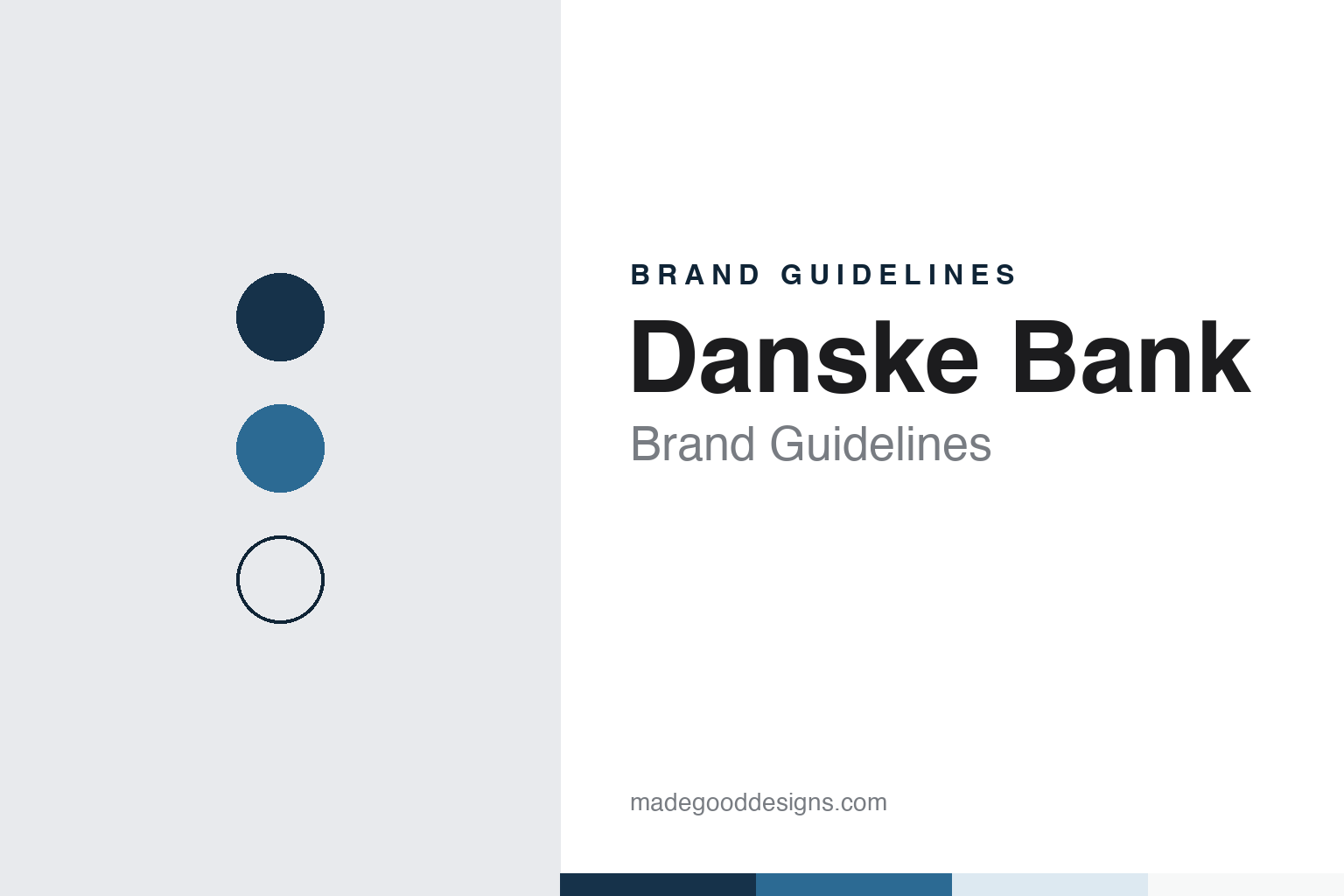
Danske Bank Brand Guidelines
A farmers’ bank of 1871 that became a Nordic group.
Aa
Two constants: a harbour blue, sound blue and ice palette and a plain grotesque sans register. Abstract homage — not a Danske Bank product or mark; no logo or symbol is reproduced.
Landmandsbanken
A Copenhagen bank for farmers, 1871.
Danske Bank was founded in Copenhagen on 5 October 1871 as Den Danske Landmandsbank, Hypothek- og Vexelbank i Kjøbenhavn — “the Danish Farmers’ Bank, Mortgage and Exchange Bank of Copenhagen,” in English Wikipedia’s translation. For more than a century it was known simply as Landmandsbanken. Danish Wikipedia names the politician and economist Niels Christian Frederiksen as the man behind the idea and G.A. Gedalia, a saddler turned money-changer, as a key figure in raising its starting capital. The bank says its purpose was to raise capital for farmers moving from self-sufficiency to production and exports.
The bank opened on 2 January 1872 and, Danish Wikipedia says, bought a property on Holmens Kanal in central Copenhagen in 1873, moving in two years later. Holmens Kanal remained its head office for 149 years, until the move to the new Postbyen district in April 2024. Danish Wikipedia also says the bank opened a safe-deposit facility where private customers could rent boxes in 1881 and helped set up the East Asiatic Company in 1897.
The early growth ended in crisis. After heavy lending losses, the bank was close to bankruptcy in 1922 and was rescued by the Danish government and Danmarks Nationalbank, the bank says, and several of its directors were prosecuted for fraud. Danish Wikipedia adds that a final reorganisation in April 1928 left it a state-owned bank, and that the state sold its shares between 1936 and 1953, returning it to private ownership. The sources used for this guide do not say how the bank operated during the occupation of 1940–1945.
Colour
Den Danske Bank, then Danske Bank.
In 1968 the bank launched the Pondus club, a children’s savings scheme built around a penguin money box, Danish Wikipedia says. The long name became Den Danske Bank in 1976, the year it opened its first foreign branch, in Luxembourg; New York, London and Hamburg followed in the 1980s, according to the bank and Danish Wikipedia. On 6 April 1990 Den Danske Bank merged with Kjøbenhavns Handelsbank and Provinsbanken. Handelsbanken, founded in 1873, had been its neighbour on Holmens Kanal, the bank says.
Expansion across the region followed: Östgöta Enskilda Bank in Sweden in 1997, Fokus Bank in Norway in 1999, BG Bank and Realkredit Danmark in 2001, National Irish Bank and Northern Bank in Northern Ireland in 2004–05, and Sampo Bank in Finland in 2006, a deal that also brought banks in the Baltic states. The name was shortened to Danske Bank in 2000, and local brands were folded in over the following years: BG Bank and Fokus Bank in 2007, then Sampo Bank in Finland and Northern Bank in Northern Ireland, which both began trading as Danske Bank in November 2012, English Wikipedia says. Northern Bank remains one of three commercial banks permitted to issue their own banknotes in Northern Ireland.
The brand is also part of Danish digital life. The bank says it was the first bank in Denmark and Finland to launch mobile banking apps, in 2010, and in 2013 it launched MobilePay in both countries — on 7 May 2013, Danish Wikipedia says. In the 2008 financial crisis it took state capital under the second Danish bank package in 2009 and repaid it in 2014, according to Danish Wikipedia.
Typography
The Nordic banking register.
The Nordic banks in this guide share a visual habit more than a single style. Their names tend to appear as clean sans-serif wordmarks, most often in blue, with green and red among the other colours used across the region, and their websites favour plain-language copy over financial jargon. Photography leans towards calm, minimalist scenes of cities, coastlines and forests rather than trading floors.
Their public pages are organised around everyday needs: current accounts and cards, mortgages, pensions and savings, business banking and, increasingly, sustainability. Mobile apps sit at the centre of that offer, and some of the groups here present digital banking as part of their own history. Annual and sustainability reports, published in English as well as the home languages, are among the most detailed public records of how each bank presents itself.
The ownership models differ. Some of these groups are listed companies formed through cross-border mergers in the 1990s and 2000s; others grew out of savings-bank and cooperative traditions in which local banks remain owned by their customers or by foundations, and cooperate under a shared brand. Several carry names and roots that go back to the nineteenth century, and the older names often survive in buildings, museums and corporate histories.
This guide sets out what can be checked about each brand — when it was founded, how it was formed, who owns it today and where its head office sits — with any regulatory findings stated plainly, with dates and outcomes. The palettes and type stand-ins are our own unofficial interpretations; no logo, symbol or official colour value is reproduced.
Aa
A plain grotesque sans for a long-lived Copenhagen name. (Specimen set in Work Sans, a sans STAND-IN; NOT the Danske Bank logo.)
Danske Bank
The Estonia case and after.
The defining case of recent years concerns the bank’s Estonian branch, which came with Sampo Bank. English Wikipedia says the Estonian Financial Supervision Authority found large-scale violations of anti-money-laundering rules there in 2014. The bank began its own investigation in 2017 and published the results in autumn 2018, the bank says, and its chief executive resigned that September. In February 2019 it announced it would leave Estonia, Latvia, Lithuania and Russia, and its Estonian banking closed in October 2019.
On 13 December 2022 Danske Bank pleaded guilty in the United States to defrauding US banks about the Estonian branch’s controls, the US Justice Department said, as reported by AFP in The Business Times. It settled separately with the US Securities and Exchange Commission and, Insurance Journal reported in November 2026 in a Bloomberg story, with Danish law enforcement in late 2022.
Today the group is headquartered in Copenhagen and serves customers in Denmark, Norway, Sweden, Finland and Northern Ireland; its largest shareholder in 2025 was A.P. Moller Holding, English Wikipedia says. Danish Wikipedia notes that the logo normally appears in blue and white, and that in September and October 2010 the bank briefly recoloured it black and yellow for a campaign about its fees. The bank marked its 150th anniversary in 2021 with a history written by a business historian.
For a design guide, Danske Bank shows how one name can be carried from a nineteenth-century farmers’ bank through two renamings and a run of regional acquisitions. Compare Nordea, another Nordic group that grew through cross-border mergers, and Jyske Bank, another Danish bank. For this guide we use a deep harbour blue, a mid blue and a pale ice tint with a sans, an unofficial interpretation; no product or logo is reproduced.
Explore & save
Keep Danske Bank’s identity on hand — save it to a board in the Made Good inspiration library.
Danske Bank identity set
Pin the Danske Bank harbour blue, sound blue and ice palette and the plain grotesque sans register to your own board.