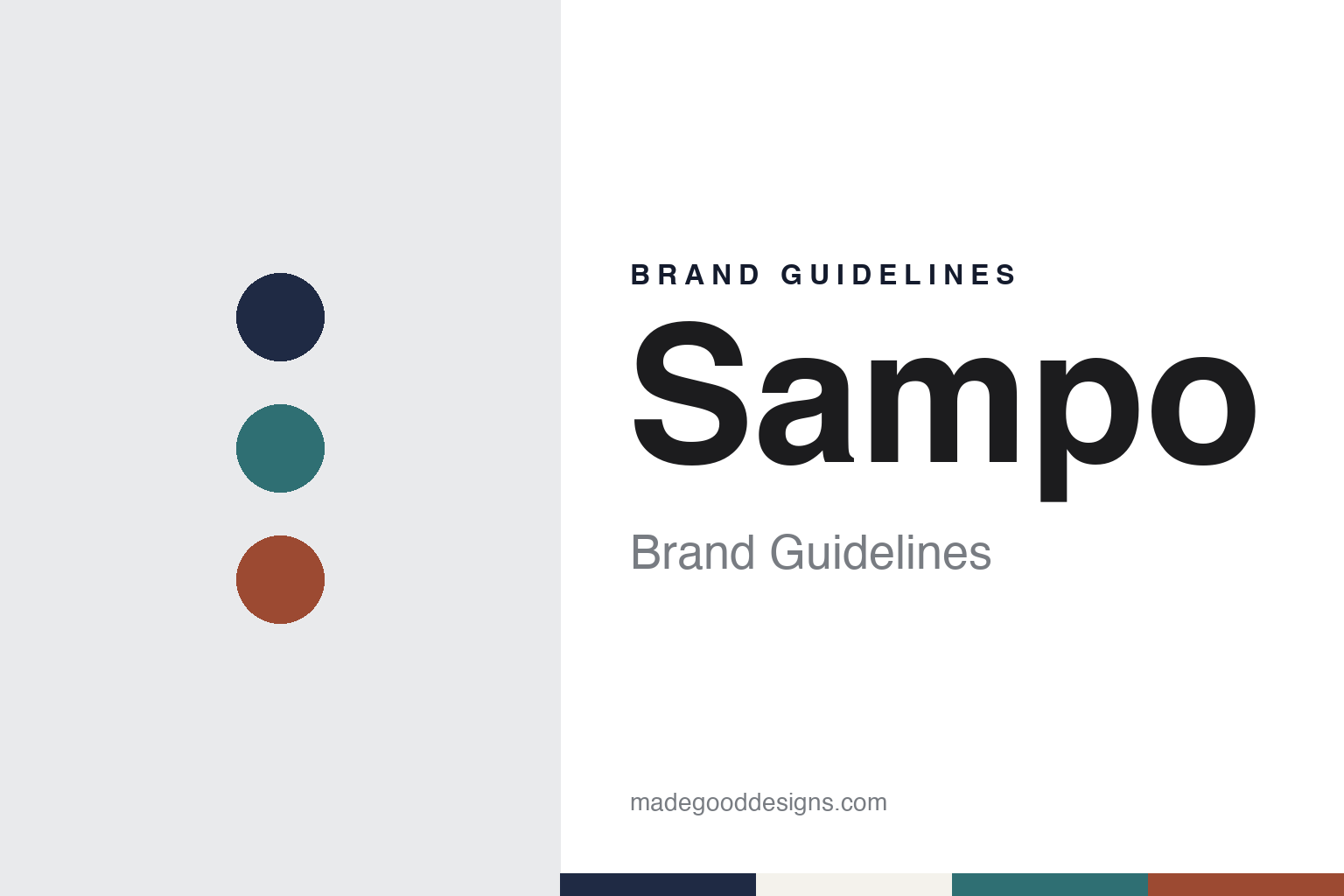
Sampo Brand Guidelines
A 1909 Turku mutual named after the Kalevala, now the owner of If.
Aa
Two constants: a midnight blue, birch white, teal and brick palette and a plain grotesque sans register. Abstract homage — not a Sampo asset; no logo or mark is reproduced.
A Turku mutual
Several kinds of insurance under one roof.
Sampo began in Turku, on Finland’s south-west coast, in 1909, as a mutual insurance company, Keskinäinen Vakuutusyhtiö Sampo; Finnish Wikipedia gives its original official name in Swedish as Ömsesidiga Försäkringsanstalten Sampo. The company says it was set up by a group of Turku businessmen who wanted to offer several lines of insurance under one roof, at a time when most Finnish insurers sold only one, and that it had 16 employees at the end of its first year. Its first offices were in a stone building in central Turku that it shared with two other Turku insurers, Fennia and the reinsurer Verdandi.
The name comes from the Kalevala, Finland’s national epic, in which the Sampo is a magical artefact that brings good fortune. Finnish Wikipedia notes that names drawing on national sentiment were typical for insurers around the turn of the 20th century.
The company’s own history describes a business that grew with the country. It says Sampo created the first forest insurance in the Finnish market in 1914, and was among the first companies to offer car insurance, in 1920, five years before a traffic law made it compulsory. During the civil war of 1918 the Red Guards occupied Turku and business in the city stopped. In 1936 Sampo held an architectural competition for a new head office; the winner was the Turku architect Erik Bryggman, a pioneer of functionalism in Finland, and the building was completed in central Turku in 1938. That same year, the company says, Finnish became the only language of its Board, in a firm that had long been seen as Swedish-speaking.
The Second World War reached the head office directly. The company says the bombing of Turku began at the end of 1939, and that in February 1940 the roof and façade of its building were damaged, moving office work into the building’s shelter. It also took heavy losses on buildings in Karelia, the region ceded after the Winter War, and its Vyborg office ended up on the other side of the new border. Growth returned from 1948, with new offices across Finland. In 1967 Sampo merged with Kaupunkien Keskinäinen Vakuutusyhtiö, and in 1977 the life insurer Kaleva joined the group; that year Sampo also launched the “Sampo agreement,” which gathered a family’s policies under one contract.
Colour
From mutual to listed group, and the If years.
Sampo stayed a mutual, owned by its policyholders, until 1987. The company says its board decided at the end of 1984 to convert it into a limited company; policyholders received shares in proportion to their insurance, and Sampo was listed on the Helsinki Stock Exchange on 14 January 1988. Sources give the first shareholder count differently: about 750,000 according to Finnish Wikipedia, more than 800,000 according to the company. In March 1989 the bank Suomen Yhdyspankki took control of Sampo, Finnish Wikipedia says.
The 1990s brought consolidation in Finland. In 1994 Sampo took over the insurers Otso and Teollisuusvakuutus, and Kansa was merged in at the end of 1995. A life insurer, Henki-Sampo, was founded in 1997 and renamed Mandatum Life in 2008. At the turn of 2000 and 2001 Sampo combined with the state-owned Leonia, the former Postipankki, as Sampo-Leonia, making the Finnish state a major owner; the investment bank Mandatum joined, and at the April 2001 general meeting the name was shortened back to Sampo, according to Finnish Wikipedia. In June 2002 the Helsinki district court found that representatives of Sampo and Leonia had manipulated the share price of the construction group YIT before a large trade in June 2000, and ordered Sampo’s insurance companies to forfeit the gain to the state, Finnish Wikipedia says.
The decisive move came in non-life insurance. In 2002 Sampo became a shareholder in If, the Nordic insurer that Skandia of Sweden and Storebrand of Norway had founded in 1999, and in 2004 it bought out Skandia, Storebrand and the Finnish insurer Varma to become the sole owner of If, according to both English Wikipedia and the company. Sampo sold its banking arm, Sampo Bank, to Danske Bank in a deal announced in November 2006 and confirmed in January 2007, and put the proceeds into shares of Nordea, a holding it had sold in full by April 2022. In 2005 the company moved its head office from Turku to Helsinki.
Two more customer brands followed. In August 2020 Sampo and the South African investor RMI made a joint bid for the British car insurer Hastings, and Sampo took full ownership in December 2021. In Denmark, Sampo had first flagged a holding in Topdanmark in 2008 and offered for the company in 2016, when fewer than 10% of shareholders accepted, Insurance Journal reported in September 2024. Its second offer, announced in June 2024, lifted its holding to about 92.6% on a preliminary count, and the compulsory acquisition of the remaining shares was completed on 25 October 2024. If says Topdanmark became part of If in 2025. In between, Mandatum was separated from Sampo by a partial demerger that took effect on 1 October 2023, a step Insurance Journal described as part of Sampo’s turn into a pure-play insurance company.
Typography
How European insurers present themselves.
European insurers sell something that cannot be seen or held, so their identities do a great deal of the work. Many rely on a short wordmark or a simple symbol, often drawn in a single strong colour such as orange, blue, red or green, and repeated on offices, apps, letters and roadside-assistance vans. Several of these marks have been redrawn in recent years with softer shapes, lowercase letters or brighter tones meant to read well on small screens.
The language tends to be plain. Product pages for home, car, life and pension cover usually lead with short sentences about what is included, what a customer can expect when making a claim and how to get in touch, and campaign lines often speak directly to the reader. Photography leans towards customers, families, homes and everyday moments rather than abstract imagery, and many groups add illustration systems and short animations to explain how a policy or pension works.
Sponsorship is another common thread. Insurers attach their names to running events, football teams, sailing races, stadiums, music festivals and museums, which puts the colour and symbol in front of large audiences far from any policy document. Some also run foundations or corporate art collections that hold exhibitions under the group name.
The paperwork matters too. Listed insurers publish annual reports, sustainability reports and investor presentations that follow the same typography and colour rules as their marketing, and these documents are often the clearest public record of how a brand is applied in long-form layouts, charts and tables. For a designer, the useful lessons sit in that consistency: one mark, a short palette and a calm, readable voice used across many countries and channels.
Aa
A plain grotesque sans for a holding name drawn from a national epic. (Specimen set in Work Sans, a sans STAND-IN; NOT the Sampo logo.)
Sampo
A listed parent above three customer brands.
Today Sampo plc, based in Helsinki, is the parent of a non-life insurance group working in the Nordics, the Baltics and the UK through the customer brands If, Topdanmark and Hastings. The parent company is responsible for strategy, capital allocation, risk management, group accounts and investor relations, English Wikipedia says, and the group describes itself as the only insurer present in all Nordic countries, customer segments and products. If describes itself as the largest insurance company in the Nordics, with around 4.6 million customers, and says it is wholly owned by Sampo. The group’s chief executive since 1 October 2025 has been Morten Thorsrud, formerly head of If, according to Finnish Wikipedia.
Sampo’s A share trades in Helsinki, Stockholm and Copenhagen; the company says the A share was listed directly on Nasdaq Stockholm in February 2026, replacing depositary receipts introduced there in November 2022. All 200,000 of its B shares are held by the mutual insurer Kaleva, Finnish Wikipedia says. The Sampo name is carried by the listed parent, while customers deal with If, Topdanmark and Hastings, the group says. Sampo published its first group-level sustainability report in 2017 and joined the UN Global Compact in 2019, according to English Wikipedia, and each group company publishes its own sustainability report.
For a design guide, Sampo shows how a name taken from a national epic can carry a holding company while its customer brands keep names of their own. Compare Tryg, the Danish insurer that sold its Finnish business to If in 2012, and Aviva, a British insurer in the market where Hastings trades. For this guide we use a midnight blue, birch white, an archipelago teal and a brick red with a sans, an unofficial interpretation; no product or logo is reproduced.
Explore & save
Keep Sampo’s identity on hand — save it to a board in the Made Good inspiration library.
Sampo identity set
Pin the Sampo midnight blue, birch white, teal and brick palette and the plain grotesque sans register to your own board.