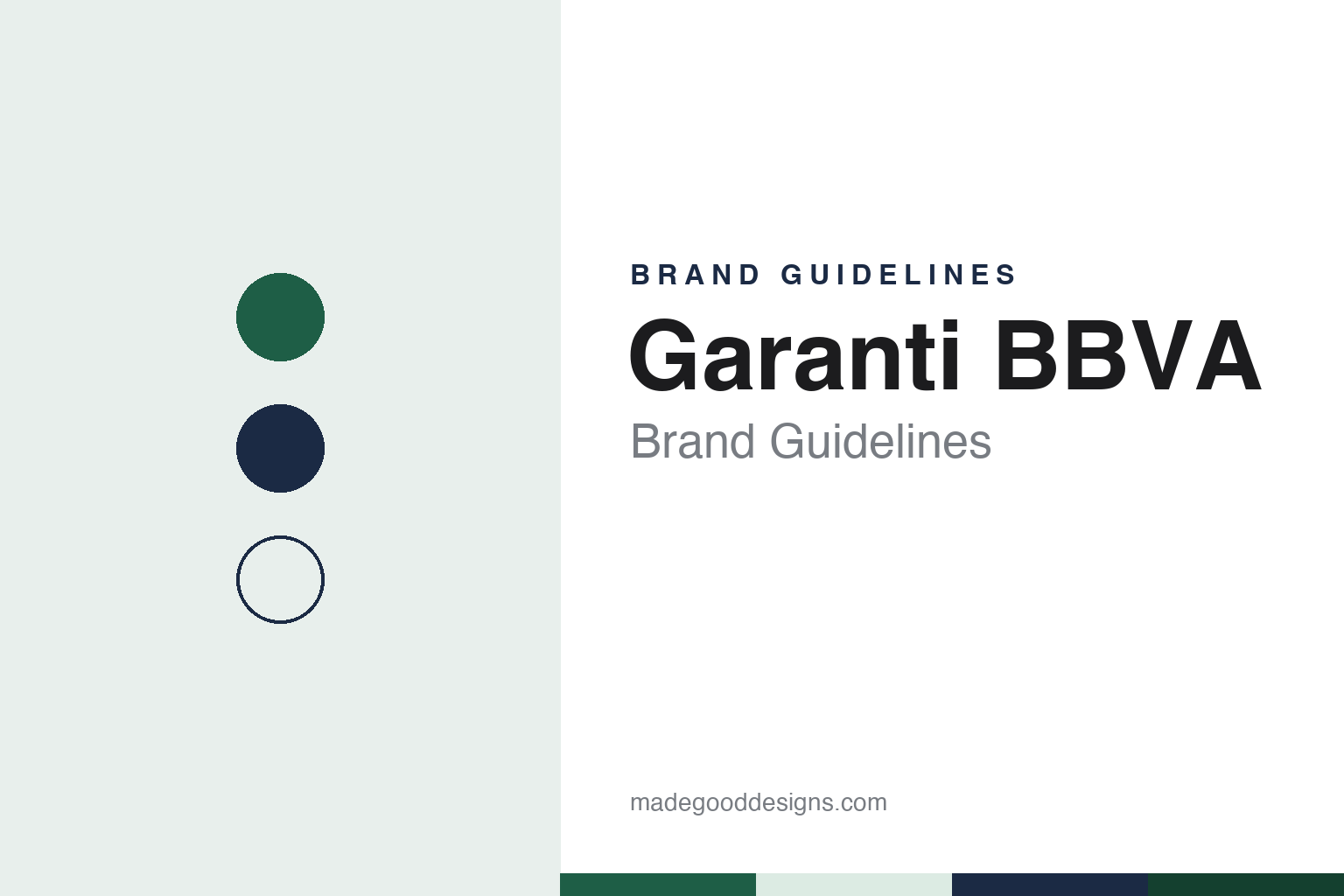
Garanti BBVA Brand Guidelines
An Ankara bank of 1946 that took a Spanish group’s name in 2019.
Aa
Two constants: a deep green, dark navy and mint palette and a geometric sans register. Abstract homage — not a Garanti BBVA product or mark; no card, logo or sign is reproduced.
Ankara, 1946
A joint-stock bank founded by 103 traders.
Garanti began in Ankara in 1946. The bank’s own history says it was set up that year as a joint-stock company by 103 co-founders, traders who wanted to invest fortunes built up by the end of the Second World War, and that it opened its first branch on Anafartalar Street in Ankara on 21 June 1946. A second branch followed on Bankalar Street, Istanbul’s street of banks, and the company says its network reached 22 branches within seven years. In 1950 the head office moved to a building on Yeni Postane Street in Sirkeci, Istanbul. Turkish Wikipedia gives the same place and year of founding.
The legal name is still Türkiye Garanti Bankası A.Ş.; in English the bank was long called Garanti Bank. Its ownership passed through Turkey’s large family groups. According to the company, most of its shares were bought by the Koç and Sabancı groups towards the end of the 1970s, when conglomerate-owned banking was growing; in the early 1980s first Koç and then Sabancı sold their holdings to the Doğuş Group, and by 1983 Garanti was wholly owned by Doğuş.
Under Doğuş the bank went public. It held its initial public offering on the Istanbul exchange in 1990, and the company says that in 1993 it became the first Turkish corporation to issue shares on international markets. Its shares trade on Borsa İstanbul and its depositary receipts in the United Kingdom and the United States, the bank says. In 1996 it bought Osmanlı Bank, and in 2001, after Osmanlı Bank had merged with Körfezbank, the combined business was merged into Garanti, according to the company’s history.
Colour
Bonus, lunch-hour banking and a bank archive turned art institution.
Much of Garanti’s public image rests on cards and channels. By 2000, the company says, it had launched Bonus, which it describes as Turkey’s first multi-brand, chip-enabled credit card, along with Shop&Miles, a card that earns airline miles; in 2002 Bonus became what the bank calls the first interbank card platform in Turkey, a programme that other banks could join. In 1995 it introduced the “Öğlen Açık Banka” idea, keeping branches open over the lunch break, and in 1997, it says, it became the first bank to offer internet and mobile banking at the same time.
That technology story has been noticed outside the bank. In March 2021 the Hürriyet Daily News reported that a NielsenIQ Turkey survey of 1,000 people, carried out in December 2020 for its “Tech Brands” study, had chosen Garanti BBVA as the country’s most technological bank.
The purchase of Osmanlı Bank also gave Garanti an unusual cultural inheritance: the archive and buildings of the Imperial Ottoman Bank. In 2011 Garanti and the curator Vasıf Kortun started SALT, a contemporary art and research institution, English Wikipedia says. SALT brought together the bank’s Garanti Gallery, the Ottoman Bank Archives and Research Centre and the Platform Garanti Contemporary Art Center, and it works from three buildings owned by Garanti BBVA: the former Imperial Ottoman Bank headquarters in Galata, designed by the architect Alexandre Vallaury and used by that bank from 1892 to 1999; the Siniossoglou Apartments in Beyoğlu; and a former Ottoman Bank guest house in Ulus, Ankara. SALT is one of six members of L’Internationale, a confederation of European art institutions that also includes the Reina Sofía in Madrid and the Van Abbemuseum in Eindhoven.
The bank’s other businesses carry the same name. The group includes pension and life, leasing, factoring, payment-systems, securities and asset-management companies, as well as an international subsidiary in the Netherlands, according to its investor-relations site.
Typography
How Turkish banks present themselves.
Turkish banks tend to present themselves through bold, simple wordmarks and one dominant colour. Across the country’s large lenders the palettes run through greens, reds, blues and purples, and the names keep their Turkish letters — the dotted capital İ, the ş, the ı and the ğ — on logos, apps and branch signs, so a typeface that handles those diacritics cleanly belongs in any design brief for the sector.
Advertising is a large part of how these brands are known at home. Mascots, recurring characters and campaigns led by well-known actors and athletes appear across the sector, alongside photography of branches, city streets and Istanbul itself. On their websites the banks arrange themselves around everyday tasks: accounts, loans, credit cards and loyalty programmes, and mobile apps that sit at the front of most pages.
Sponsorship and culture extend the identity. Turkish banks sponsor football, concerts and festivals, and some run publishers, galleries, museums or art collections under their own names; İşbank’s publishing house and painting collection, and the SALT institution that grew out of Garanti BBVA’s Ottoman Bank archive, are two documented examples covered in this series.
The banks also publish a great deal of formal material. Listed lenders produce annual and integrated reports, sustainability reports and investor presentations in Turkish and English. This series sets out what can be checked about each bank — when and where it was founded, who owns it and how its name has changed — and marks clearly what rests only on a bank’s own word.
Aa
A geometric sans for a two-part name. (Specimen set in Plus Jakarta Sans, a sans STAND-IN; NOT the Garanti BBVA logo.)
Garanti BBVA
From Doğuş to BBVA, and a new name in 2019.
The present name comes from Spain. In 2005, the company says, General Electric became an equal strategic partner with Doğuş in Garanti. In 2010 Banco Bilbao Vizcaya Argentaria (BBVA) acquired 24.9% of the bank and agreed with Doğuş to manage it jointly, English Wikipedia says; Garanti’s own history dates the partnership to 2011, after GE decided to leave. BBVA then bought a further 14.89%, which the company dates to 2015, and 9.95% in 2017, reaching 49.85%. On 15 November 2021 BBVA announced a voluntary offer for the remaining shares; approved by Turkey’s Capital Markets Board on 31 March 2022, the offer ended on 18 May 2022, and BBVA’s holding reached 85.97%, the figure on the bank’s shareholding page today.
The name followed the ownership. On 24 April 2019 BBVA announced that it would unify its brand worldwide under a new logo, dropping local names such as Bancomer in Mexico and Compass in the United States, and that Garanti would become Garanti BBVA; the bank says the rebrand took effect on 10 June 2019. BBVA’s design team wrote in June 2019 that its four letters and its blue, used since the Banco de Bilbao logo of 1969, were the core of the new identity. The logo was drawn by four in-house designers working with Landor’s London office in a studio in Madrid, with a digital-first approach and a design system built on the ideas of “light” and “elevation,” including photography taken in the golden hour of early morning.
The bank has also faced the competition regulator. On 8 March 2013 Turkey’s Competition Board fined twelve banks, Garanti and İşbank among them, after finding that they had adopted anti-competitive policies on loan rates and credit card services, the Hürriyet Daily News reported. As of 30 September 2026 the company described itself as Turkey’s second-largest private bank, with 787 branches in Turkey, four in Cyprus and one in Malta.
For a design guide, Garanti BBVA shows how a long-established local name can be joined to a global group’s mark without being dropped. Compare İşbank, another Turkish bank with a large cultural programme, and Santander, another Spanish banking group. For this guide we use a deep green, a dark navy and a pale mint with a geometric sans, an unofficial interpretation; no product or logo is reproduced.
Explore & save
Keep Garanti BBVA’s identity on hand — save it to a board in the Made Good inspiration library.
Garanti BBVA identity set
Pin the Garanti BBVA deep green, dark navy and mint palette and the geometric sans register to your own board.