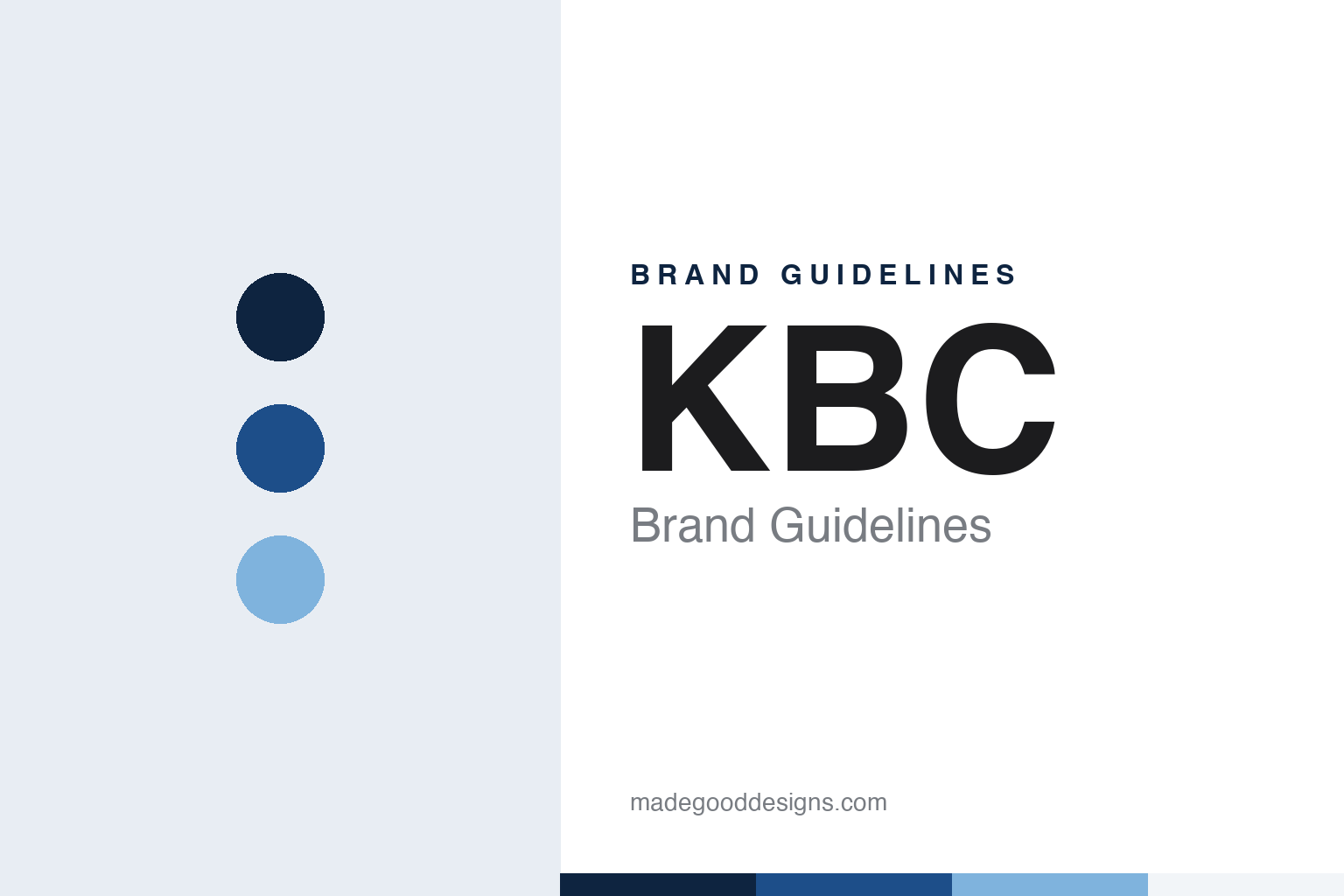
KBC Brand Guidelines
Kredietbank, CERA, ABB and the blue swimmer.
Aa
Two constants: a navy and swimming-pool blue palette and a rounded geometric sans register. Abstract homage — not a KBC asset; no logo, swimmer or card design is reproduced.
From Leuven to Brussels
A Catholic people’s bank, farmers’ savings funds and a Flemish bank.
KBC is a merger name, but its roots go back to Leuven. On 17 July 1889, according to English Wikipedia, a group of Catholics founded the Volksbank van Leuven, a cooperative “people’s bank” to finance business in and around the town. In the early 1890s the Boerenbond, the farmers’ movement also based in Leuven, began building a network of rural savings and loan funds on the Raiffeisen model, starting in the village of Rillaar in 1892, and in 1895 set up the Middenkredietkas as their central body. The network spread quickly: English Wikipedia counts 190 local funds in 1902 and 1,099 by 1934.
After the First World War the two groups worked together closely. The Algemeene Bankvereeniging, founded in Antwerp in 1921, merged with the Volksbank van Leuven in 1928 and became one of the larger Belgian credit institutions. It also financed the Boerentoren in Antwerp, completed in 1931, which English Wikipedia says was then the second-tallest skyscraper in Europe; the tower later served as offices for Kredietbank and KBC.
The early 1930s brought losses. The Middenkredietkas declared a moratorium in December 1934 and was liquidated in 1935 under government supervision, and on 9 February 1935 the Algemeene Bankvereeniging merged with the Bank voor Handel en Nijverheid of Kortrijk to form the Kredietbank voor Handel en Nijverheid, known as Kredietbank. It was registered in Antwerp, with its working head office in Brussels. The farmers’ funds were regrouped the same year under a new central body in Leuven, which in the late 1970s took the short name CERA; their insurance business became ABB, the Boerenbond’s insurer, in 1941. The sources used for this guide do not say how Kredietbank and its sister institutions operated during the occupation of 1940–1944.
Colour
Three Belgian names become one group.
Kredietbank grew after the war. It opened a Luxembourg subsidiary in 1949, listed its shares in Brussels in 1951 and built an international network from the late 1960s, English Wikipedia says. It opened a branch in Léopoldville, in the Belgian Congo, in 1952, an operation wound up in 1966, expanded into Wallonia from 1958, and in 1970 it was one of seven European institutions that set up the Inter-Alpha Group of Banks. In 1997 it entered Hungary through the privatisation of K&H Bank. CERA, meanwhile, became a full central bank for the cooperative funds as CERA Bank in 1986.
On 3 June 1998 CERA Bank, ABB and Fidelitas, the insurance arm of the holding company Almanij, merged into Kredietbank. KBC’s own history page says the merger of “two Belgian banks” and “a Belgian insurance company” launched its bank-insurance model in Belgium. The group took the name KBC Bank and Insurance Holding Company in 2000 and, after merging with Almanij in 2005, became KBC Group NV.
Expansion into Central and Eastern Europe followed, starting with ČSOB in the Czech Republic and Slovakia in 1999. In 2008 and 2009, KBC says, it agreed capital transactions and guarantees with the government; a divestment programme followed from 2010 and was completed in 2014, and the company says it repaid all outstanding government debt before the end of 2015. Further purchases included UBB in Bulgaria in 2017. In Ireland, the sale of KBC Bank Ireland was finalised in 2023, and English Wikipedia says its banking licence was handed back on 30 April 2024.
The latest step is in Slovakia. KBC agreed to buy 365.bank, formerly Poštová banka, from J&T Finance Group in May 2025, and on 15 January 2026 the Slovak news agency TASR reported that the purchase of a 98.45 per cent stake had been completed after regulators approved it, with a legal and operational merger with ČSOB planned as the next step.
Typography
Design and documentation.
Banks in the Netherlands, Belgium and Luxembourg tend to present themselves with restraint. The usual starting point is a clear sans-serif wordmark, often paired with a simple symbol, set in one or two strong colours. Green, orange, red and blue recur across the region, and many of the names are short: initials, contractions of older merger names, or a single coined word that is easy to say in more than one language.
The messages behind those marks often go back to how the banks are owned and what they say they stand for. Cooperative banks put their members and local roots up front, savings banks and state-owned banks point to their public role, and a growing number of banks lead with sustainability, publishing impact reports alongside their annual reports. Several of today’s names were formed by mergers, and their identities have had to carry two or more histories at once.
Language shapes the design work too. Dutch, French and English often sit side by side, and in Luxembourg Luxembourgish and German join them, so type has to stay readable across longer words, accents and switching between languages on the same page. Photography is usually kept to a minimum, with plain layouts, generous white space and simple icons doing most of the work on websites and in apps.
The pages people visit most are practical ones: everyday banking, savings, mortgages, business accounts and the mobile app. Behind them sit the formal documents, from annual and impact reports to investor pages, where the same colours and type carry a more sober tone. For a designer, the region shows how a bank can stay recognisable through colour and a short name while keeping its interface quiet and functional.
Aa
A rounded, friendly sans for a bank that likens itself to a swimmer. (Specimen set in Figtree, a sans STAND-IN; NOT the KBC logo or house typeface.)
KBC
A swimmer as a group personality.
KBC describes its group personality through its logo, which it calls “the blue swimmer.” On its brand page the company says that, like a swimmer, it dares “to jump into the flows,” always goes forward, stays alert and agile, and adapts to “different types of water.” It links the mark to a company culture it calls PEARL, and says the same logo unites all the companies of the group.
Today KBC names its core markets as Belgium, the Czech Republic, Slovakia, Hungary and Bulgaria, where it trades through local brands such as ČSOB, K&H and UBB alongside KBC itself. Its shares are listed on Euronext Brussels, and English Wikipedia lists its core shareholders as KBC Ancora and Cera, both rooted in the old cooperative, the Boerenbond’s investment vehicle MRBB, and a group of industrial families. The group also keeps an art collection in the Rockox House in Antwerp, English Wikipedia says.
For a design guide, KBC shows how a merged group can carry one simple mark across several countries and languages while its local banks keep their own names. Compare Belfius, another Brussels bank-insurer, and BNP Paribas Fortis. For this guide we use navy, a mid blue and a pale pool blue with a sans, an unofficial interpretation; no product or logo is reproduced.
Explore & save
Keep KBC’s identity on hand — save it to a board in the Made Good inspiration library.
KBC identity set
Save the KBC navy and pool-blue palette and the rounded geometric sans register to your own board.