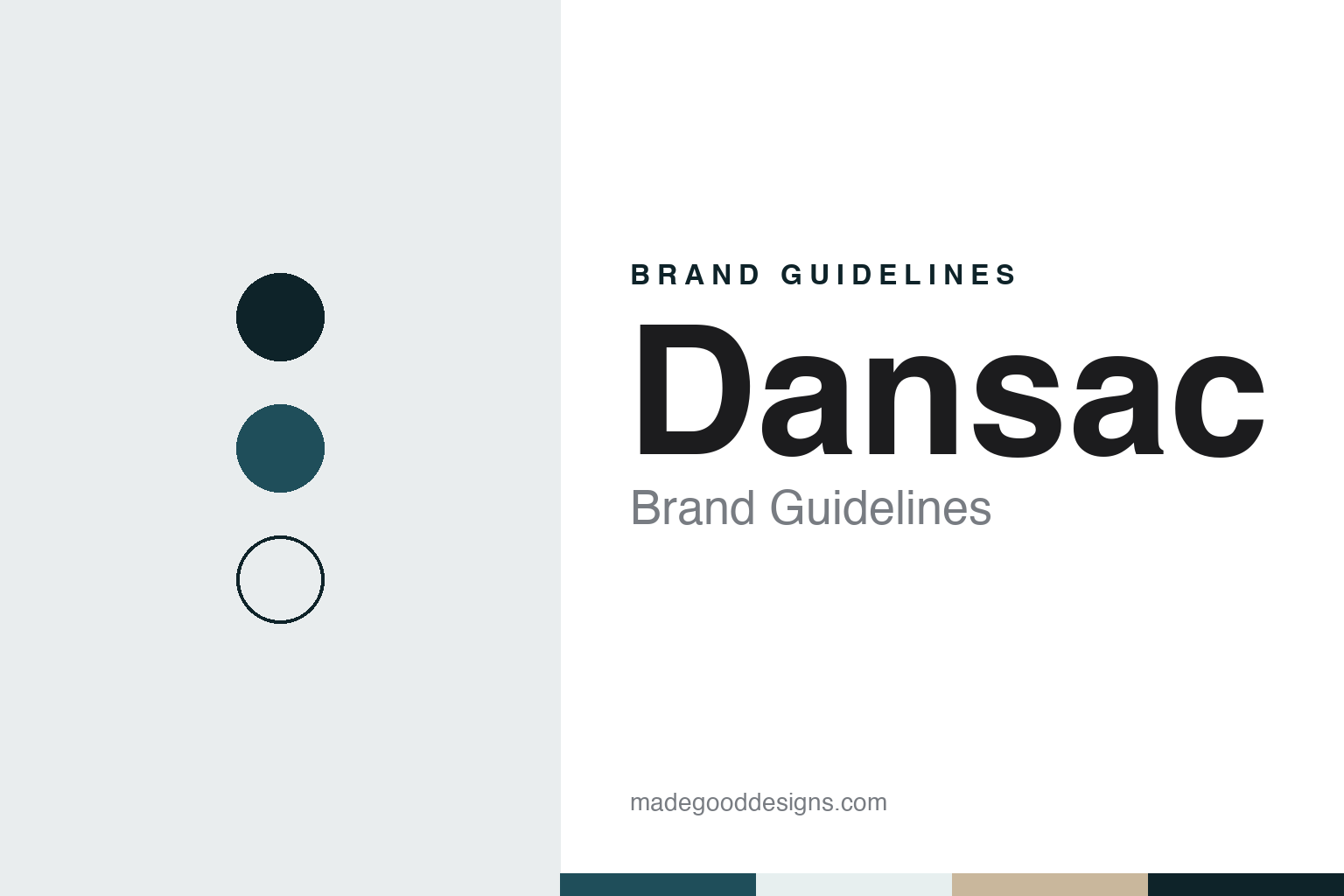
Dansac Brand Guidelines
The Fredensborg stoma-care maker of 1971, part of Hollister since 1989.
Aa
Two constants: a Dansac teal and sand palette and a Calm sans register. Abstract homage — not a Dansac product or mark; no pouch, logo or packaging is reproduced.
Fredensborg, 1971
A Danish company that makes nothing but stoma care.
Dansac was founded in 1971 in Fredensborg, the North Zealand town north of Copenhagen, according to the company’s own history. Danish Wikipedia describes it simply as a company in Fredensborg that makes only ostomy products — pouches and barriers for colostomy, ileostomy and urostomy — and that narrow focus is still how the business presents itself. Its sign-off, repeated across its national websites, is “Dansac – Dedicated to Stoma Care.”
The company has not been independent for most of its life. In 1989, Dansac says, it was acquired by Hollister Incorporated, the American maker of ostomy and continence products based in Libertyville, Illinois. In May 2021 Dansac marked two anniversaries together: its own fiftieth, and the centenary of The Firm of John Dickinson Schneider, Inc., the 1921 company that owns Hollister. Hollister describes itself as an independent, employee-owned company and says it has manufacturing and distribution centres on three continents and sells in nearly 80 countries.
Dansac still trades under its own name. In Sweden the two brands have shared a sales organisation: a June 2015 decision by Sweden’s Dental and Pharmaceutical Benefits Agency, TLV, names the applicant for a Dansac pouch as “Dansac and Hollister Scandinavia Inc. (USA) filial Sverige,” the Swedish branch of Dansac and Hollister Scandinavia Inc. The legal entity behind the brand today is Dansac A/S, which carries the copyright line on its websites. Dansac says its products are sold in more than 30 countries; its own site selector lists seventeen European markets plus Australia, New Zealand and Japan.
Colour
NovaLife, Nova and the TRE barrier.
Dansac’s catalogue is organised the way stoma nurses and users shop for it: closed pouches, drainable (open) pouches, urostomy pouches, skin barriers and accessories. The pouch families are Nova and the newer NovaLife, each in one-piece and two-piece versions, with flat, soft convex and convex barriers. Accessories include an adhesive remover spray and the Dansac TRE seal.
The TLV decision of 4 June 2015 gives a dated snapshot of the range. It admitted the NovaLife 1 Convex — a closed, one-piece convex pouch with an EasiView window, in midi and maxi sizes and a beige finish — to Sweden’s subsidised consumables from 18 June 2015, comparing it with an existing NovaLife 1 Soft Convex pouch already on the list.
The current platform is NovaLife TRE. Dansac says its TRE barrier is 0.7 mm thick, against 1.1 mm for its traditional hydrocolloid, and tapers to 0.3 mm at the edge, and that the pouches combine a filter, a soft water-repellent cover and the EasiView viewing option. The company frames the TRE barrier around three ideas — adhesion, absorption and pH balance.
Design, in the visual sense, arrived with colour. In August 2025 Dansac introduced the NovaLife TRE Black Pouch, presenting black as a choice that lets a pouch sit with clothing and personal style rather than look clinical. In January 2026 the company announced that the black pouch had received a 2025 GOOD DESIGN award from The Chicago Athenaeum Museum of Architecture and Design and the European Centre for Architecture, Art, Design and Urban Studies, the programme founded in 1950. Dansac says the pouch is made from non-woven polypropylene rather than the woven PET used before. In February 2026 it also announced smaller packaging for its TRE seal products under the slogan “Caring for Tomorrow,” saying each package was almost 60 per cent smaller than the previous design.
Typography
How wound, ostomy and continence brands present themselves.
Wound-care, ostomy and continence companies sell mostly to nurses, surgeons and pharmacists, and their visual language tends to reflect that audience. Brochures and websites in the category often favour soft-focus close-ups of skin and dressings, clean white backgrounds and pale, calm colours, with the product shown in use rather than as an object. Nurses appear again and again: at hospital bedsides, in clinics and in community care, changing a dressing or talking with a patient at home.
Ostomy and continence brands face a different task. Their users live with the products every day, so the imagery usually moves out of the clinic and into ordinary life: discreet lifestyle photography of people with a stoma swimming, hiking, travelling or at work, with the pouch rarely in view. Packaging across the category tends towards pastel tones, plain product names and clear labelling that has to read on a ward shelf and in a home bathroom alike.
The trade also has its own calendar. Companies meet clinicians at congresses such as the conference of the European Wound Management Association (EWMA) in Europe, the Symposium on Advanced Wound Care (SAWC) in the United States and the annual meeting of the Wound, Ostomy and Continence Nurses Society (WOCN), where stands, posters and education sessions carry much of a brand’s presence. Swedish Wikipedia records that Mölnlycke prepared a position document on its Safetac technology together with EWMA.
The companies in this guide range from a Swedish textile mill of 1849 and a Dijon family group to British ostomy specialists and American medical-technology firms. Each guide sets out what can be checked — who founded the company, who owns it and where it says its products are made — and separates documented facts from the company’s own claims.
Aa
A calm, rounded sans for a discreet stoma-care brand. (Specimen set in Inter Tight, a sans STAND-IN; NOT the Dansac logo.)
Dansac
Dedicated to stoma care.
Dansac’s brand voice is built on three stated values. The company lists Dedication, to people living with a stoma and to those who care for them; Collaboration, an open dialogue with users and clinicians to develop products, tools and services; and Authenticity, which it explains as being honest and straightforward because it deals with “real people, real lives, and real stomas.” Its websites put much of their space into education rather than products: guides to stoma types, recovery after surgery and life with a stoma, a glossary, patient stories, and clinical-education material for stoma care nurses, whose role the company singles out in its anniversary statement.
That tone carries across markets. The Danish site gives the same history and values in Danish — Engagement, Samarbejde, Autenticitet — and both the Danish and British sites share one layout and one product structure, with a line in the menu stating that Dansac is part of Hollister Incorporated. The legal notice is equally plain: Dansac A/S owns the Dansac name, the Dansac logo and the TRE mark, according to its own trademark line.
The Firm of John Dickinson Schneider, Inc. remains the parent of Hollister, and in July 2024 it named a new chief executive, only the fifth in its history, the group said in a release published on Dansac’s own news pages.
For a design guide, Dansac shows how a medical brand can treat colour, material and packaging as part of the user’s everyday life, from a black pouch to a smaller seal pack. Compare Hollister, its owner since 1989, and Coloplast, another Danish ostomy company. For this guide we use a deep teal, a pale sea mist and a warm sand with a sans, an unofficial interpretation; no product or logo is reproduced.
Explore & save
Keep Dansac’s identity on hand — save it to a board in the Made Good inspiration library.
Dansac identity set
Pin the Dansac teal and sand palette and the Calm sans register to your own board.