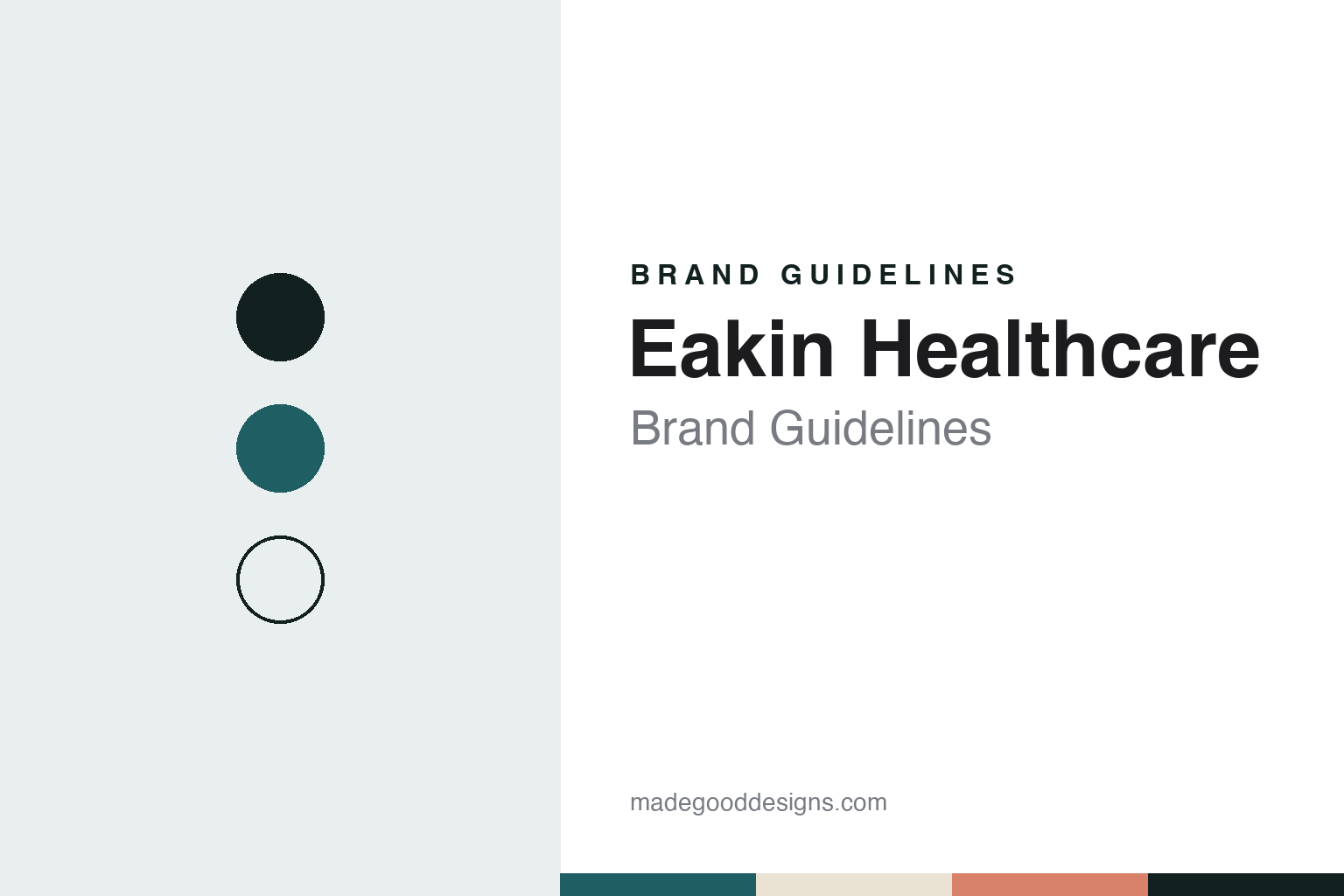
Eakin Healthcare Brand Guidelines
A Comber pharmacist’s seal and a family ostomy group.
Aa
Two constants: a teal, sand and coral palette and a rounded geometric sans register. Abstract homage — not an Eakin Healthcare product or mark; no seal, pouch, logo or pack is reproduced.
TG Eakin
A pharmacist, a leaking pouch and an adhesive.
Eakin Healthcare began with one pharmacist in Northern Ireland. The company says Tom George Eakin saw his patients struggling with leaking urostomy pouches and set out to fix the problem himself, formulating what became the eakin Cohesive® seal. It gives 1973 as the year the business was first established. In a 2020 interview with Manufacturing Today, his son Paul Eakin described the starting point as TG Eakin Ltd, set up in Northern Ireland in the 1970s as a medical device maker focused on a single product: a specialist adhesive.
The company says it was the first to manufacture an ostomy seal of this kind, a claim it makes on its own website. The seal gave the firm a foothold in ostomy care, the care of people living with a stoma, and ostomy has remained its core business ever since.
The group is still headquartered in Comber, County Down and it remains a family business. “We’re still keeping it in the family,” the company says, and its board lists Tom Eakin as founder alongside a non-executive director from the family, Jeremy Eakin. Companies House records show that the present holding company was formed in 2006, traded as Eakin Holdings from 2007 and took the name Eakin Healthcare Group in 2015.
The step that turned a one-product adhesive maker into a group came in 2007, when the Eakin family bought Pelican Healthcare, a Cardiff manufacturer of ostomy appliances, Manufacturing Today reported. Paul Eakin, then Pelican’s UK chief executive, told the magazine the purchase was “a fast track approach” to a much fuller range of ostomy products, and that the fact Pelican made its products in Cardiff was central to the decision. The magazine described a programme of re-equipping that began in 2007, with automated production lines for stoma bags, and reported that around the same time Pelican became the first company on the market to offer a “soft convex” stoma bag.
Colour
Seals, bags, a delivery service and a respiratory arm.
Ostomy remains the core of the business. Eakin’s seals are branded in lower case, as eakin Cohesive® and eakin freeseal®, and sit alongside stoma bags, belts and skin-care accessories. The company says its ostomy products are made at its sites in Cardiff and Comber and sold in the UK and more than 30 other markets. Its most recent bag, ModaVi®, is one it describes as having “cutting edge design, comfort and style.”
The consumer side of the brand has a separate website, eakinostomy.com, which carries product finders, free samples and plain-spoken advice on living with a stoma, written in a conversational voice. It runs a podcast, Beyond the Pouch, built on interviews with ostomates, and a programme of ambassadors who share their own stories. In the UK the group also runs Respond, a home delivery and nursing service for ostomy supplies that the company calls award-winning.
In January 2021 the group moved beyond ostomy. It bought Armstrong Medical, a Coleraine maker of respiratory care products, Health Tech World reported on 7 January 2021, calling the deal a diversification for a group that had until then specialised in ostomy and wound care. Jeremy Eakin, then managing director, called Armstrong “a well-established and successful Northern Ireland family business” and said the two family-owned companies shared “a common culture and philosophy.” The magazine reported that there would be no change to company names or brands. Today the respiratory range includes the AMSORB® Plus carbon dioxide absorbent used during anaesthesia, AquaVENT® adult breathing systems and NeoFlow® neonatal systems, the company says.
The group has also let one part go. On 7 April 2026 Vernacare, a maker of single-use medical devices backed by H.I.G. Capital, announced that it had completed the purchase of Eakin Surgical Limited from Eakin Healthcare Group. Vernacare described Eakin Surgical as a manufacturer of single-use surgical instruments, including suction products and sterile procedure solutions. Eakin Healthcare’s corporate website still lists a surgical area alongside ostomy and respiratory.
Typography
How the category presents itself.
Wound-care, ostomy and continence companies sell mostly to nurses, surgeons and pharmacists, and their visual language tends to reflect that audience. Brochures and websites in the category often favour soft-focus close-ups of skin and dressings, clean white backgrounds and pale, calm colours, with the product shown in use rather than as an object. Nurses appear again and again: at hospital bedsides, in clinics and in community care, changing a dressing or talking with a patient at home.
Ostomy and continence brands face a different task. Their users live with the products every day, so the imagery usually moves out of the clinic and into ordinary life: discreet lifestyle photography of people with a stoma swimming, hiking, travelling or at work, with the pouch rarely in view. Packaging across the category tends towards pastel tones, plain product names and clear labelling that has to read on a ward shelf and in a home bathroom alike.
The trade also has its own calendar. Companies meet clinicians at congresses such as the conference of the European Wound Management Association (EWMA) in Europe, the Symposium on Advanced Wound Care (SAWC) in the United States and the annual meeting of the Wound, Ostomy and Continence Nurses Society (WOCN), where stands, posters and education sessions carry much of a brand’s presence. Swedish Wikipedia records that Mölnlycke prepared a position document on its Safetac technology together with EWMA.
The companies in this guide range from a Swedish textile mill of 1849 and a Dijon family group to British ostomy specialists and American medical-technology firms. Each guide sets out what can be checked — who founded the company, who owns it and where it says its products are made — and separates documented facts from the company’s own claims.
Aa
A rounded geometric sans for a plain-spoken family brand. (Specimen set in Outfit, a sans STAND-IN; NOT the Eakin Healthcare logo.)
Made in the UK
Three sites, one family name.
Eakin Healthcare is direct about where its products come from. “All manufacturing for Eakin Healthcare takes place in the UK,” the company says, naming three core sites: Comber in County Down, the original home of the seals; Cardiff, the former Pelican Healthcare plant; and Coleraine in County Londonderry, the former Armstrong Medical base. It says its products are available in more than 60 countries, that it has colleagues in 11, and that it has sites and subsidiaries in Ireland, the Netherlands, France, Japan, Germany, Belgium and Luxembourg as well as the UK. Its corporate website is published in English, German, Dutch and Japanese.
The company is led by chief executive Padraic Dempsey, with Mark Moran as chairman, and it says its operations team numbers more than 400 people. Its leadership is split along the same lines as its products, with separate commercial heads for ostomy and respiratory.
The family name carries the brand. It is written in lower case on the seals, and the Pelican Healthcare web address now leads to the Eakin ostomy website, where ambassadors, podcast guests and user reviews sit in the foreground alongside the products.
For a design guide, Eakin Healthcare shows how a single product invented by a pharmacist can carry a family name across a whole group, from seals to breathing systems. Compare Coloplast, another ostomy company, and Convatec. For this guide we use teal, sand and a soft coral with a sans, an unofficial interpretation; no product or logo is reproduced.
Explore & save
Keep Eakin Healthcare’s identity on hand — save it to a board in the Made Good inspiration library.
Eakin Healthcare identity set
Pin the Eakin Healthcare teal, sand and coral palette and the rounded geometric sans register to your own board.